
How to Apply for Family-Based Adjustment of Status
December 8, 2025
Family-based adjustment of status allows eligible immigrants to obtain permanent residence without leaving the United States. This process can save months of waiting and avoid the risks of consular processing abroad.
We at Law Offices of Jeffrey A. Thompson guide families through each step of this complex application. Understanding the requirements and procedures helps avoid costly delays and denials.
Who Qualifies for Family-Based Adjustment of Status
Understanding Your Family Connection Category
Your relationship to the U.S. citizen or permanent resident determines your path to adjustment of status. Immediate relatives of U.S. citizens (spouses, unmarried children under 21, and parents) face no numerical limits and can typically file Form I-485 immediately after their Form I-130 petition approval. Family preference categories F1 through F4 cover other relationships like adult children and siblings, but these categories face annual caps with up to 10,000 visas available for certain categories, with unused numbers falling down from higher to lower preference categories. The Visa Bulletin that the State Department publishes monthly shows current availability, and wait times can stretch from 1 year for F2A spouses of permanent residents to over 20 years for F4 siblings from high-demand countries like the Philippines.
Physical Presence and Entry Standards You Must Meet
Adjustment of status requires lawful entry through inspection and admission or parole under Immigration and Nationality Act Section 245(a). Those who entered without inspection, overstayed visas, or violated status face significant barriers. USCIS statistics show that roughly 40% of adjustment applications involve status violations that require careful legal analysis. Physical presence in the United States when you file Form I-485 is mandatory, and departure from the country without advance parole abandons your application. The 3-year and 10-year unlawful presence bars under INA Section 212(a)(9)(B) affect individuals who accumulated over 180 days of unlawful presence, which makes adjustment of status the safer option compared to consular processing for many applicants.

How to Overcome Inadmissibility Obstacles
Criminal history, immigration violations, and health issues can trigger inadmissibility grounds that block adjustment applications. Form I-601 waivers are available for certain grounds, but approval rates vary significantly by violation type. Immigration fraud carries a permanent bar with extremely limited waiver options, while criminal inadmissibility under INA Section 212(a)(2) may qualify for waivers if the crime involves moral turpitude with sentences under one year. Medical inadmissibility affects applicants with communicable diseases or mental disorders and requires civil surgeon evaluations and treatment compliance. You must identify inadmissibility issues early and develop waiver strategies before you file, as USCIS denies roughly 10% of adjustment applications primarily due to unresolved inadmissibility concerns.
Once you understand your eligibility status, the next step involves gathering the extensive documentation and forms that USCIS requires for your application.
What Documents Do You Need for Form I-485
Form I-485 Completion Requirements
Form I-485 spans 18 pages and demands precise completion to avoid rejection. USCIS rejects approximately 15% of applications due to incomplete forms or missing signatures according to agency data. You must answer every question completely and write N/A for inapplicable sections rather than leave blanks. The current fee is $1,440 for applicants aged 14-78, plus an $85 biometrics fee, which totals $1,525 per application. Use the USCIS Fee Calculator to verify current amounts, as fees increase regularly. Submit separate payments for each family member to prevent delays. Include two passport-style photos taken within 30 days that follow specific USCIS requirements for background color and dimensions.
Financial Documentation and Affidavit of Support Standards
Form I-864 Affidavit of Support requires sponsors to demonstrate income at 125% above federal poverty guidelines. For 2024, a family of four needs $39,750 annual income, while sponsors for immediate relatives need higher thresholds. Your petitioner must provide three years of tax returns, recent pay stubs, and employment verification letters.

Bank statements that cover the past six months strengthen financial evidence. Joint sponsors become necessary when primary sponsors fall below income requirements (both sponsors share legal responsibility for support obligations that last until citizenship or 40 quarters of work history).
Medical Examination and Vaccination Compliance
USCIS-designated civil surgeons must conduct your medical examination with Form I-693, which costs between $200-500 depending on location and required tests. You need current vaccinations for measles, mumps, rubella, polio, tetanus, diphtheria, pertussis, Haemophilus influenzae type b, hepatitis A and B, rotavirus, meningococcal disease, varicella, pneumococcal disease, and seasonal influenza.
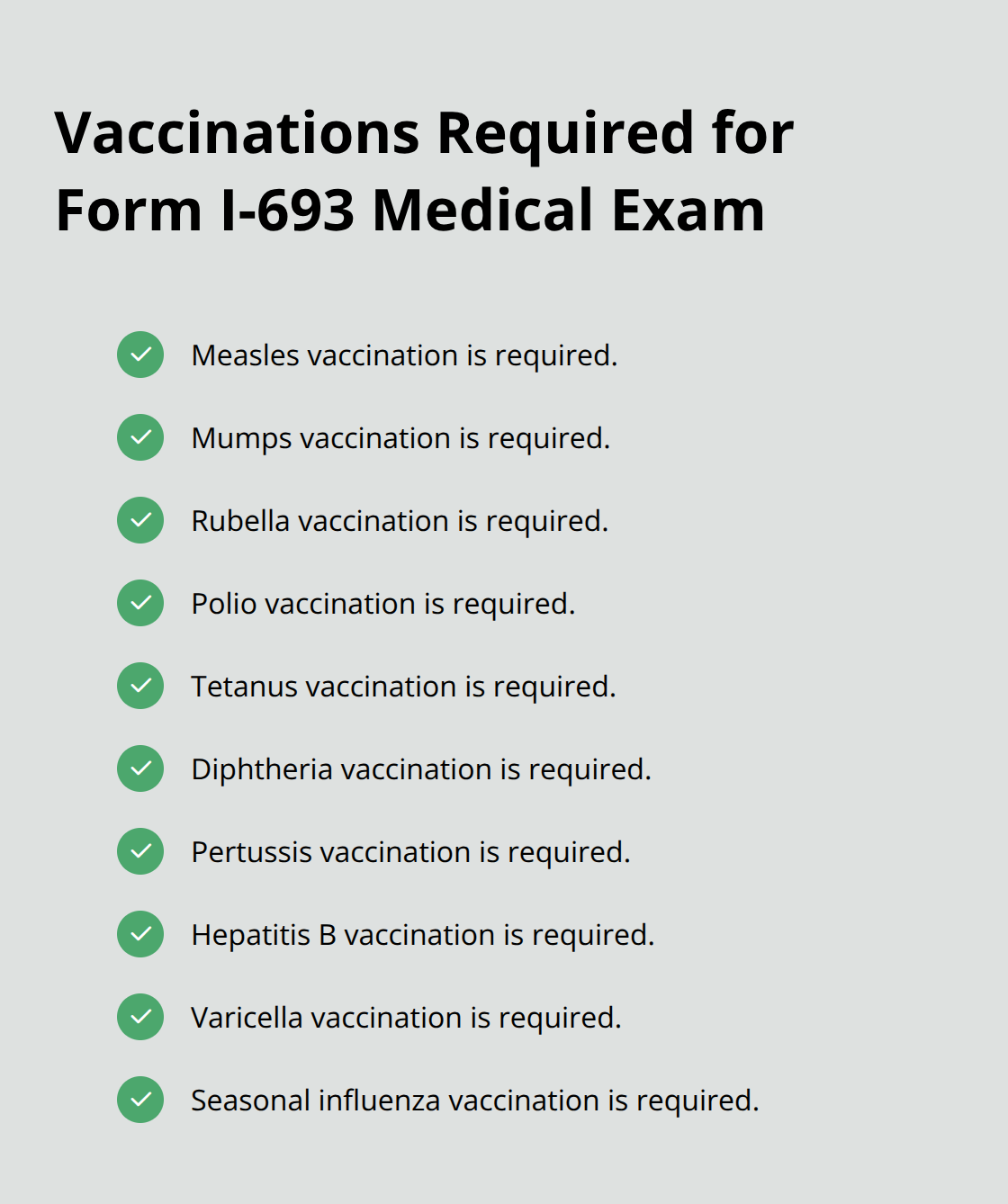
Missing vaccinations require completion before examination approval. The sealed medical report remains valid for two years from the civil surgeon’s signature date (you cannot open the envelope or examination becomes invalid).
Additional Supporting Evidence Requirements
Birth certificates, marriage certificates, and divorce decrees must accompany your application with certified English translations if issued in foreign languages. Passport pages that show entry stamps prove lawful admission to the United States. Employment authorization documents and I-94 records establish your current status. Police clearance certificates from countries where you lived for six months or more after age 16 address criminal background checks.
Strategic timing and careful preparation maximize approval chances while you navigate the complex application process ahead.
How Do You Navigate Filing and Processing
Strategic Filing Approach for Maximum Success
File your Form I-485 package with certified mail and return receipt to create a paper trail that proves USCIS received your application. The National Benefits Center processes most family-based adjustment cases, and their current processing times range from 8 to 33 months according to USCIS data. Submit your complete package in a single envelope with all documents arranged in the order that Form I-485 instructions specify. Include a cover letter that lists every document you enclosed and highlights any special circumstances like concurrent filing or derivative applications. USCIS rejects applications within the first 30 days for missing signatures, incorrect fees, or incomplete forms, so check every page three times before you mail your package.
Biometrics Appointment Requirements
Your biometrics appointment notice arrives 4-6 weeks after you file, and you must attend the scheduled appointment at your local Application Support Center within the specified timeframe. You can reschedule through the USCIS Contact Center at 800-375-5283 with advance notice, but missed appointments result in application denial. The appointment takes 30-45 minutes and includes fingerprints, photographs, and signature collection. Bring your appointment notice and valid government-issued photo identification. USCIS uses this biometric data for background checks that typically take 2-4 weeks to complete.
Interview Preparation and Attendance
The interview notice comes 2-4 months after biometrics for most applicants, though USCIS waives interviews for certain categories like parents of U.S. citizens who file independently. Prepare for your interview with original documents, updated financial evidence, and recent tax returns. Your Form I-130 petitioner must attend the interview with you, and derivative family members need separate appearances. Practice answers to questions about your relationship history, immigration background, and application details. USCIS officers focus on identity verification, eligibility confirmation, and resolution of any inconsistencies in your file.
Processing Timeline Variations
Processing times vary dramatically by field office location, with some offices completing cases in 6 months while others take over 2 years. Check USCIS processing times regularly for your specific field office and form type. You can submit case inquiries if your case exceeds normal processing times (though this rarely speeds up the process). USCIS may request additional evidence during review, which adds 60-90 days to your timeline depending on your response speed.
Final Thoughts
Family-based adjustment of status success requires meticulous preparation and complete attention to detail. You must complete Form I-485 accurately, collect all required documents before you file, and maintain copies of everything you submit. File your application with certified mail to create a delivery record, and respond promptly to any USCIS requests for additional evidence.
The most damaging mistakes include missed biometrics appointments, incomplete applications, and departure from the United States without advance parole. These errors often result in automatic denials that force you to start the entire process over. Double-check fee calculations with the USCIS Fee Calculator, as incorrect payments trigger immediate rejections.
Complex cases that involve criminal history, immigration violations, or inadmissibility issues require professional legal guidance. We at Law Offices of Jeffrey A. Thompson help families navigate immigration challenges and overcome legal hurdles throughout the adjustment process (our experience with family law and immigration matters provides comprehensive support for successful applications). Contact us today to discuss your specific situation and develop a strategy for your family-based adjustment of status case.
Share this post: