How to Create an Adjustment of Status Checklist
March 30, 2026
Adjustment of status is one of the most common paths to permanent residency in the United States, but the process involves dozens of forms, documents, and requirements that trip up applicants every year.
At Law Offices of Jeffrey A. Thompson, we’ve helped countless clients navigate this complex journey. This guide walks you through building a comprehensive adjustment of status checklist so you can file with confidence and avoid costly delays.
What Adjustment of Status Actually Is
Adjustment of status is a specific legal process that allows you to become a permanent resident while staying in the United States, rather than going through consular processing abroad. According to USCIS guidance updated March 17, 2026, you must already be physically present in the U.S. on a valid nonimmigrant visa status to qualify. This matters because it eliminates the need to return to your home country for visa interviews, which saves months and reduces the risk of denial at a U.S. port of entry. Someone else-typically a family member or employer-must file an immigration petition on your behalf first. Without an approved petition, you cannot move forward. Once that petition receives approval and an immigrant visa becomes available for your category according to the Department of State Visa Bulletin, you then file Form I-485 to request adjustment of status. The entire process from petition approval to Green Card in hand typically takes 12 to 18 months, though employment-based cases often move faster if premium processing is available.
Why consular processing creates unnecessary risk
Consular processing requires you to leave the United States and attend a visa interview at a U.S. embassy or consulate in your home country. This approach takes longer-often 18 to 24 months-and creates significant risk because USCIS can deny your case at the interview stage, leaving you stranded outside the country. Adjustment of status eliminates this travel requirement and provides stronger protections because you remain in the U.S. throughout the process.
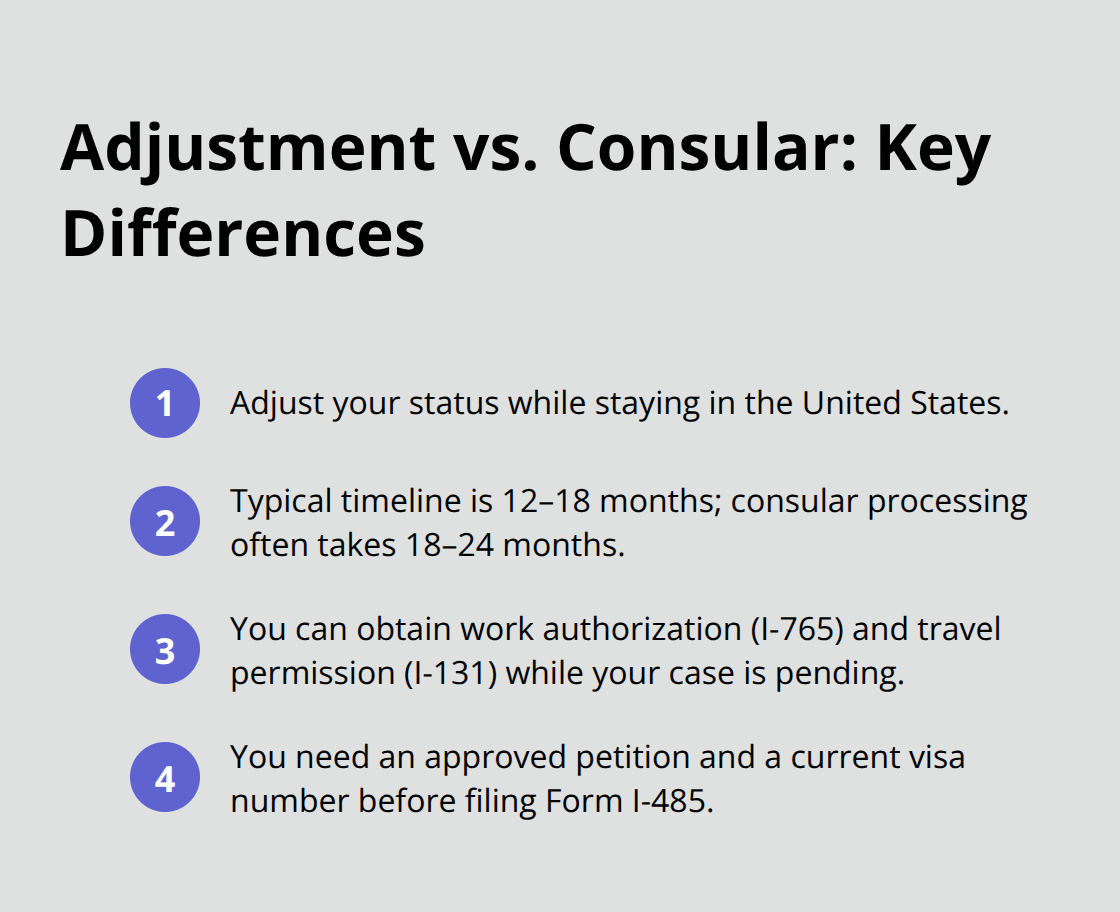
You also gain work authorization and travel permission while your case is pending, whereas consular processing applicants cannot work or travel legally until the visa is issued.
When you should choose adjustment over consular processing
If you qualify for adjustment of status, you should always choose this path over consular processing. The only reason to pursue consular processing is if you don’t qualify for adjustment-for example, if you entered the U.S. illegally without inspection. However, exceptions exist under INA 245(i) that allow certain applicants to adjust despite illegal entry. Understanding which category you fall into determines whether adjustment is even an option for you, which is why the next step involves identifying your specific Green Card eligibility category.
What Forms and Documents You Actually Need
The adjustment of status application requires far more than just Form I-485. Most applicants file a core package that includes Form I-130 or I-140 (the underlying petition), Form I-485 (adjustment application), Form I-765 (work authorization), Form I-131 (travel document), Form I-864 (affidavit of support), Form I-693 (medical exam), and Form G-1145 (e-notification).
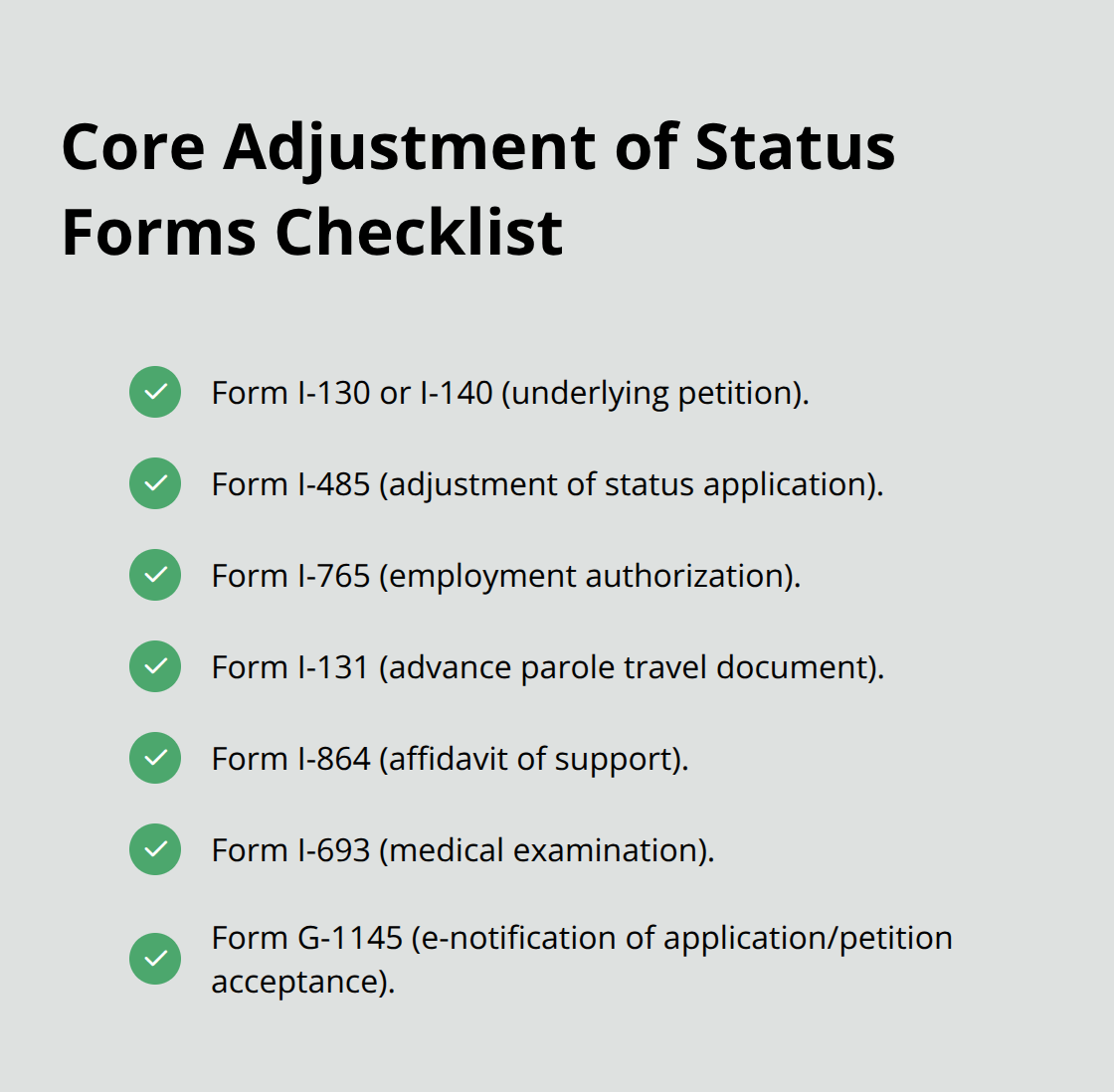
This coordinated package minimizes requests for evidence, which USCIS issues in roughly 30 to 40 percent of adjustment cases according to immigration practitioners’ experience. Each form serves a specific function, and filing them together demonstrates to USCIS that you understand the process and have prepared thoroughly.
Most applicants treat I-485 as the only critical form and underestimate how much supporting documentation matters. You need certified copies of your birth certificate, passport, government-issued photo ID, police records for any arrests or convictions regardless of outcome, and proof of your current immigration status. If you entered the U.S. legally, bring your I-94 arrival record. If you qualify under INA 245(i), file Form I-485 Supplement A and pay the additional fee.
Medical Examination Requirements
The civil surgeon examination is mandatory and cannot be skipped or delayed until after filing. You must schedule your appointment at a USCIS-designated civil surgeon as soon as your visa becomes current according to the Department of State Visa Bulletin, because these appointments fill quickly in major cities and can take weeks to secure. The examination includes a physical, vaccination review, and tuberculosis screening.
USCIS requires proof of certain vaccinations including measles, polio, tetanus, and hepatitis B unless you qualify for a medical or religious exemption. If you lack vaccination records, bring whatever documentation exists and the civil surgeon will work with you, but missing records complicate the process unnecessarily. The cost typically ranges from $300 to $600 depending on location and whether you need additional tests.
One critical detail: any I-693 dated after November 1, 2023 no longer expires, so you can submit it with confidence that USCIS will accept it without requesting an updated exam.
Translation and Document Preparation
Any document in a foreign language requires a complete English translation with a translator’s certification of accuracy, and USCIS rejects incomplete translations routinely. You should prepare all documents before filing because requests for evidence delay your case by three to six months on average and create unnecessary stress.
Financial Documentation and Sponsor Requirements
Your sponsor must provide recent tax returns, usually from the past two years, plus current pay stubs and an employment verification letter confirming their job title and salary. Bank statements showing liquid assets matter if income alone falls short. Self-employed sponsors need additional documentation including profit and loss statements and business tax returns.
Your affidavit of support demonstrates that your sponsor meets income requirements for their household size. If your sponsor’s income falls short, add a co-sponsor or include evidence of assets, stocks, or savings to bridge the gap. USCIS scrutinizes income claims heavily because sponsors are legally responsible for supporting you if you receive means-tested benefits within ten years of adjustment approval.
Avoiding Document Gaps Before Filing
The mistake that creates the most delays is incomplete preparation. You should gather every required document before submitting your I-485 because the forms and supporting evidence work together to tell USCIS a complete story. When you file a coordinated package with all required documentation attached, you reduce the likelihood that USCIS will issue a request for evidence and keep your timeline on track. The next chapter covers the specific mistakes that applicants make during the filing process itself and how to avoid them.
Filing Errors That Delay Your Green Card
Incomplete or Unsigned Forms Restart Your Timeline
The most expensive mistake applicants make is submitting Form I-485 with incomplete information or unsigned sections. USCIS rejects unsigned I-485 applications outright, forcing you to resubmit and restart the processing clock. Many applicants rush through Part 3 (processing information) and leave fields blank, thinking they can clarify later during the interview.
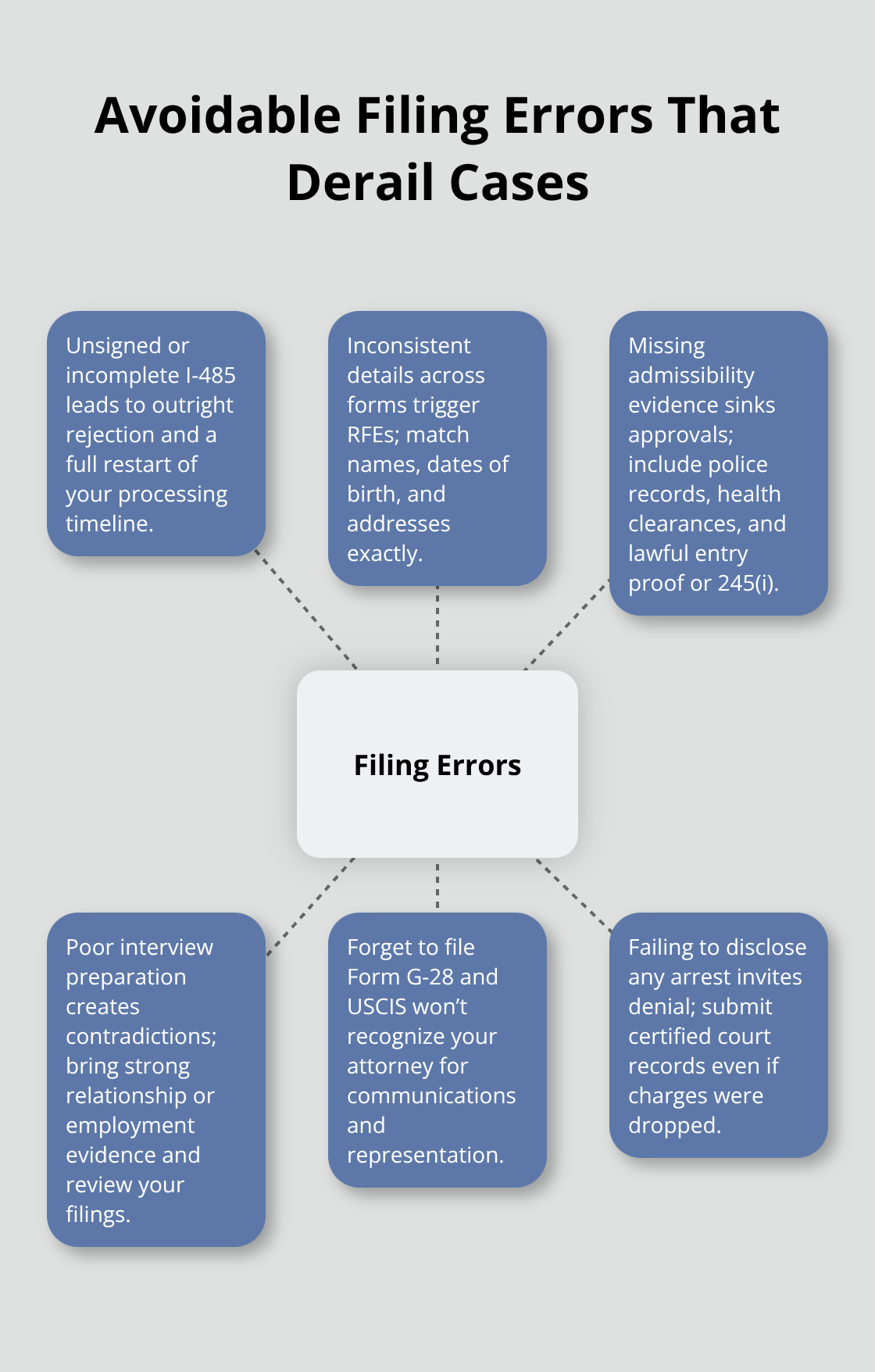
This assumption costs you three to six months because USCIS issues a request for evidence instead of moving forward. You must sign the form yourself in black or blue ink and include your A-number if you have one. If you’re represented by an attorney, file Form G-28 simultaneously so USCIS knows you have legal counsel.
Inconsistencies Between Forms Trigger Requests for Evidence
The second major error involves inconsistencies between your I-485 and the underlying petition. If your I-130 or I-140 lists your middle name one way but your I-485 lists it differently, USCIS flags this as a discrepancy and requests clarification. Cross-reference every detail including your full legal name, date of birth, passport number, and current address across all forms before submitting. Applicants also fail to disclose prior immigration violations or arrests because they misunderstand what counts as reportable. Any arrest, regardless of outcome or whether charges were dropped, must be disclosed with certified court records attached. USCIS discovers undisclosed arrests during your biometrics appointment or interview, and this discovery can result in denial and removal proceedings.
Missing evidence of admissibility Stops Approval
The third critical gap is missing evidence of admissibility, which determines whether USCIS will grant you permanent resident status. You need certified police records from every country where you’ve lived for more than six months, proof that you’re not inadmissible on health or criminal grounds, and documentation showing you didn’t enter the U.S. illegally unless you qualify under INA 245(i). Many applicants assume their clean background speaks for itself and skip the police records. USCIS doesn’t accept silence as proof. You must affirmatively demonstrate admissibility through documentation.
Interview Preparation Determines Your Final Outcome
The final error that destroys cases happens during the green card interview itself. Applicants arrive unprepared, contradicting statements they made on their I-485 or providing vague answers about their relationship to their sponsor or their job history. If you’re adjusting through marriage, bring your marriage certificate, photos together, joint bank statements, and evidence of shared household expenses. USCIS officers conduct fraud interviews specifically designed to catch marriages of convenience, and inconsistencies between your testimony and your spouse’s testimony will be noticed. If you’re adjusting through employment, bring documentation proving you’ve maintained lawful status since your arrival and that your job offer remains valid. For family-based applications, USCIS generally requires the Form I-130 petitioner to appear for the interview with the principal adjustment of status applicant. Prepare for your interview by reviewing every document you submitted, practicing answers to common questions about your background and your relationship to your sponsor, and arriving with original documents including your passport, I-94, birth certificate, and any travel records. The interview is your last chance to control your narrative before USCIS makes a final decision.
Final Thoughts
A thorough adjustment of status checklist separates applicants who receive their Green Card on schedule from those who face months of delays and requests for evidence. You must gather everything USCIS requires upfront, verify that all forms match perfectly, and prepare for your interview as if your entire case depends on it-because it does. File your coordinated package together rather than submitting forms piecemeal, since USCIS processes complete applications faster and issues fewer requests for evidence when applicants demonstrate they understand the requirements.
After you submit your I-485, USCIS will send you a biometrics appointment notice within two to four weeks, and you must attend this appointment on time because missing it results in automatic denial. You will then wait for an interview notice, which typically arrives within three to six months depending on your local USCIS office workload. Use this waiting period to prepare by reviewing every document you submitted and practicing answers to questions about your background, your relationship to your sponsor, and your immigration history.
If USCIS issues a request for evidence, respond within the stated deadline without exception, since missing the deadline means your case is denied and you lose your filing fee. We at Law Offices of Jeffrey A. Thompson understand that immigration law creates stress and uncertainty, and our team assists clients in navigating the adjustment of status process from paperwork through approval. Contact us for expert guidance tailored to your specific situation.
Share this post: