
How to Get Advance Parole for Adjustment of Status
March 16, 2026
Adjustment of status advance parole is one of the most misunderstood immigration benefits available today. Many people don’t realize they can travel outside the US while their green card application is pending, which can be a game-changer for family emergencies or business needs.
At Law Offices of Jeffrey A. Thompson, we’ve helped countless clients navigate this process successfully. This guide walks you through eligibility, documentation, and the exact steps to file your application.
What Advance Parole and Adjustment of Status Actually Mean
Advance Parole: Your Travel Authorization
Advance Parole is a travel document issued by USCIS that allows you to leave the United States and return while your green card application (Form I-485) is pending. Without it, traveling abroad while your adjustment of status case is active will terminate your application entirely. This is not a minor consequence-it means your entire green card process stops, and you lose your place in line. USCIS is clear on this point: traveling without Advance Parole while your I-485 is pending results in automatic abandonment of your case.
The document itself is straightforward. It’s a physical card you carry with you when you travel internationally, and you present it to U.S. Customs and Border Protection when you re-enter. The approval process typically takes several weeks to months depending on your category and whether you file online or by mail. Online filing is available if your I-485 has an IOE-based receipt number and you’re applying from inside the United States, which can speed things up considerably.
Understanding Adjustment of Status
Adjustment of status is the process of becoming a lawful permanent resident (green card holder) without leaving the United States. Instead of going through consular processing abroad, you file your immigrant visa application directly with USCIS while already in the country. This pathway is available if you have an immediate relative sponsoring you, qualify through employment, or fall into specific humanitarian categories.
The priority date system determines when you can actually file your I-485. You must wait until your category has an available visa number according to the monthly Visa Bulletin published by the State Department. This timing affects everything about your case, including when you can request Advance Parole.
Why Advance Parole Matters During Adjustment
Family emergencies don’t pause for immigration timelines. Someone gets seriously ill abroad, a parent passes away, or a business crisis demands your presence internationally. Without Advance Parole, you’re stuck-leave and your green card application disappears. With it, you can handle these situations and return to continue your case without penalty.
The key distinction here is that Advance Parole is not a visa and doesn’t guarantee entry. U.S. Customs and Border Protection still inspects you at the port of entry and can deny admission. But with an approved Advance Parole document, you have legal authorization to attempt re-entry, which is fundamentally different from traveling without it.
What Happens Next in Your Application
Understanding these concepts sets the foundation for your next step: determining whether you actually qualify for Advance Parole and what documentation USCIS requires from you.
Eligibility Requirements for Advance Parole
Who Qualifies for Advance Parole
Not everyone with a pending I-485 automatically qualifies for Advance Parole, and USCIS applies specific eligibility rules that catch many applicants off guard. The most straightforward scenario involves having a pending adjustment of status application with an IOE-based receipt number, which means you filed Form I-485 with USCIS and received an electronic receipt. If this describes your situation, you generally qualify to request Advance Parole on Form I-131 while inside the United States. However, certain visa categories face restrictions.
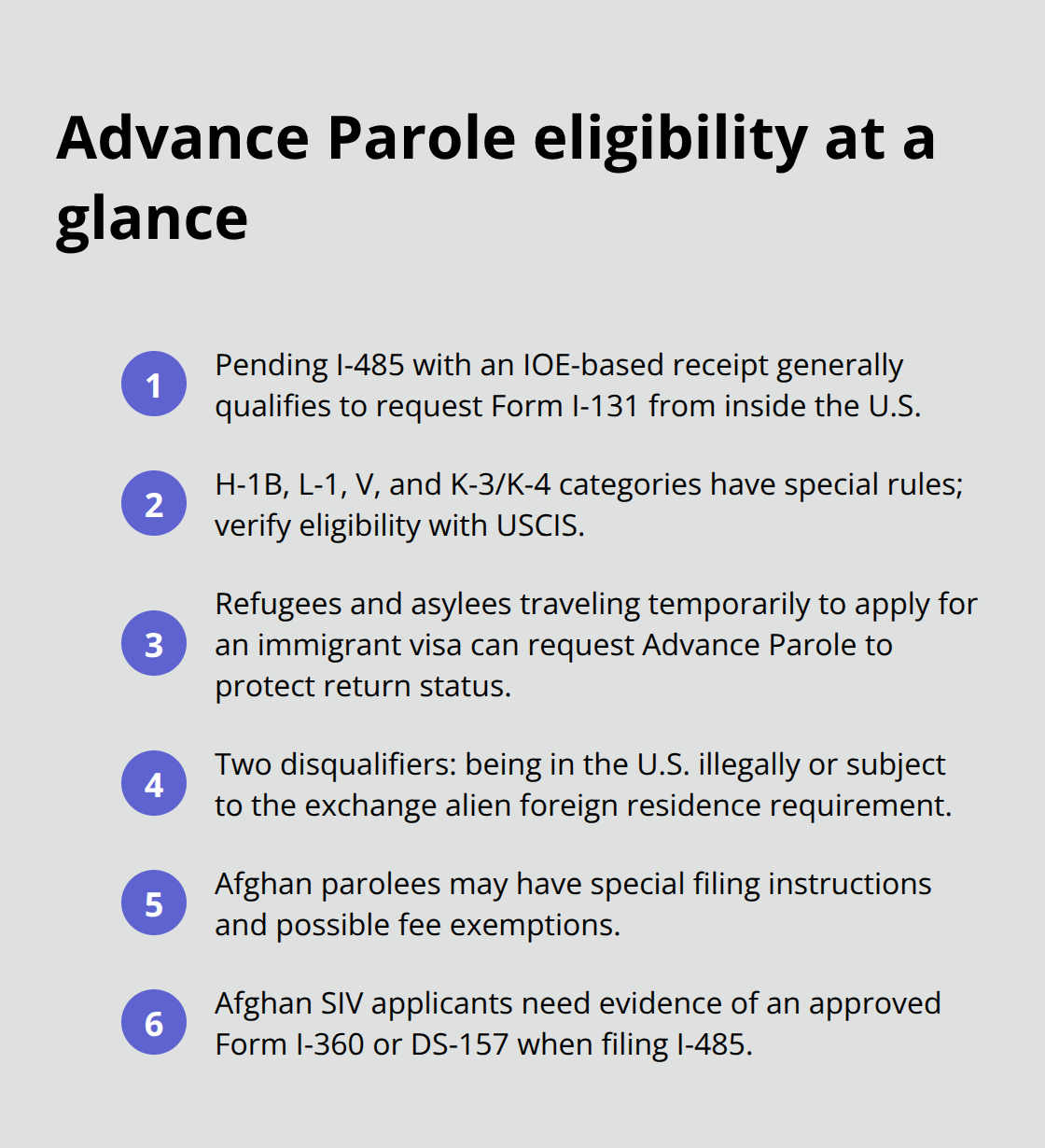
If you hold H-1B, L-1, V nonimmigrant status, or K-3/K-4 visa status, you must verify your specific eligibility with USCIS because these categories operate under different rules. Refugees and asylees planning temporary travel to apply for an immigrant visa abroad can request Advance Parole to protect their return status. Two critical disqualifiers exist: being in the United States illegally or being subject to the exchange alien foreign residence requirement bars you from Advance Parole entirely. Afghan parolees receive special filing instructions and potential fee exemptions, so if you arrived under that program, follow the specific guidance for your category. Afghan SIV cases require evidence of an approved Form I-360 or DS-157 approval when filing I-485, which affects your Advance Parole timeline.
Documentation USCIS Requires
USCIS wants proof that your I-485 exists and is pending. If you file I-131 concurrently with I-485, select only item 5.A in Part 1 of Form I-131 and submit everything together. If you file I-131 separately after your I-485 is already with USCIS, attach a copy of your I-797C receipt notice from your I-485 submission. The form edition matters more than most applicants realize: the I-131 must carry the date 01/20/25, and all pages must come from that same edition. Mixing form editions causes USCIS to reject your entire submission without processing it further.
Payment Methods and Filing Addresses
For payment, you have options depending on how you file. Online filers through a USCIS account with an IOE-based I-485 can pay through Pay.gov. Paper filers use Form G-1450 for credit card payments or Form G-1650 for ACH transfers. To receive email or text notifications when USCIS accepts your application, attach Form G-1145 to the first page of your submission. The filing address matters significantly: incorrect addresses delay processing considerably, so verify the correct direct filing address on the USCIS website before mailing anything.
Biometrics and Next Steps
USCIS will schedule a biometric services appointment as part of the I-131 process after you submit your application. This appointment is mandatory, and you must attend to move forward with your case. Once you complete biometrics and USCIS processes your I-131, approval typically takes several weeks to months depending on your category and filing method. Understanding what documentation USCIS requires and how to submit it correctly sets you up for faster processing and reduces the risk of rejection or requests for additional evidence.
Filing Your I-131 Application
Preparing Your Form I-131 Correctly
Accuracy matters far more than speed when submitting your I-131. Download Form I-131 directly from USCIS with the edition date 01/20/25 on every single page. If even one page shows a different date, print the entire form again. USCIS rejects mixed-edition submissions without processing them, and you won’t receive your filing fee back. Complete Part 1 by selecting only item 5.A if you request Advance Parole. If you file I-131 with your I-485 at the same time, submit them together as one package. If your I-485 is already pending with USCIS, attach a copy of your I-797C receipt notice to prove it exists.
Gathering Supporting Documents
Collect your passport, birth certificate, and marriage certificate if applicable. Include any medical examination results on Form I-693 if USCIS requires one. Attach Form G-1145 to the first page of your submission if you want email or text notifications when USCIS accepts your application at the lockbox. This notification arrives within days and confirms your package reached its destination intact.
Choosing Your Filing Method and Payment
Determine whether you file online or by mail before preparing payment. If you have an IOE-based I-485 receipt and you’re inside the United States, you can file online through your USCIS account and pay through Pay.gov, which typically processes faster. If you file by mail, use Form G-1450 for credit card payment or Form G-1650 for ACH transfers. Find the correct mailing address on the USCIS Direct Filing Addresses page for Form I-131, as sending your package to the wrong lockbox creates significant delays.
What Happens After Submission
USCIS will send you a receipt notice and schedule a biometric services appointment within weeks. You must attend this appointment without fail-it’s mandatory and missing it terminates your case. During biometrics, USCIS takes your fingerprints and photographs for background checks. Processing time varies considerably depending on your category and filing method. USCIS publishes processing times on their website, broken down by field office, so check the specific office handling your case for a realistic timeline.
Receiving and Using Your Advance Parole Document
Once approved, you’ll receive your Advance Parole document in the mail. This is your legal authorization to travel-it’s the physical card you present to U.S. Customs and Border Protection when you return from international travel. Do not travel before you hold this document in your hands. Traveling without an approved Advance Parole document, even if your I-131 is pending, will result in denial of your adjustment of status case and potential deportation proceedings. The approval doesn’t guarantee entry at the border, but it gives you legal authorization to attempt re-entry, which protects your green card application.
Final Thoughts
Getting Advance Parole for adjustment of status requires careful planning, accurate paperwork, and strict adherence to USCIS deadlines. The stakes are high because traveling without approval terminates your green card application entirely. You now understand the eligibility rules, know which documents USCIS demands, and can navigate the filing process without costly mistakes.
If your I-485 is already pending with an IOE-based receipt number, you can file your I-131 immediately through your USCIS account if you’re inside the country. If your priority date isn’t current yet according to the Visa Bulletin, focus on gathering your supporting documents now so you’re ready to file the moment your category becomes available. Either way, download the correct form edition, verify your filing address, and prepare for your biometric appointment before you submit anything.
We at Law Offices of Jeffrey A. Thompson help clients navigate every step of the adjustment of status advance parole process, from initial eligibility questions through approval and beyond. If you need guidance on your specific situation, whether it’s determining your priority date, preparing your I-131, or handling complications that arise, contact our immigration law team in Brockton, Massachusetts.
Share this post: