
How to Navigate Bars to Adjustment of Status
January 2, 2026
Bars to adjustment of status can stop your immigration case in its tracks. These legal obstacles prevent eligible immigrants from obtaining permanent residency through the standard process, even when they meet other requirements.
At Law Offices of Jeffrey A. Thompson, we help clients understand these barriers and find pathways forward. This guide breaks down what bars exist, how to overcome them, and what immigration officers evaluate in your case.
What Exactly Are Bars to Adjustment of Status
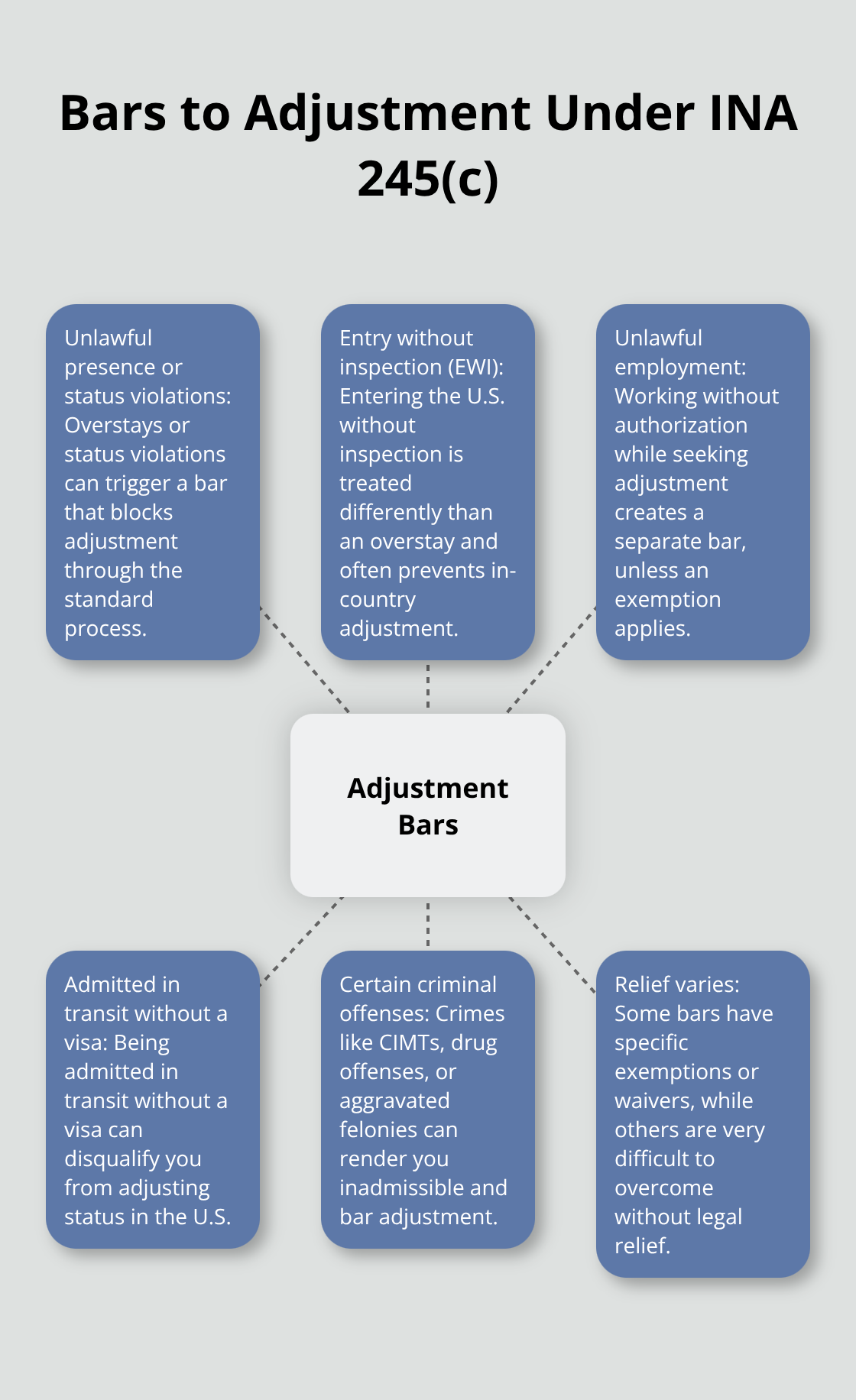
Bars to adjustment of status are legal disqualifications that prevent you from obtaining a green card through the standard process, even when you otherwise meet eligibility requirements. The Immigration and Nationality Act defines these obstacles under INA 245(c), and they fall into specific categories. The most common bar involves unlawful presence or status violations-if you overstayed a visa or entered without inspection, you likely face this barrier. Unlawful employment while seeking adjustment creates another bar, as does being admitted in transit without a visa or having a criminal history tied to certain offenses. USCIS Policy Manual Volume 7 identifies eight distinct bar categories, and understanding which ones apply to your situation determines whether you can adjust in the United States or must pursue consular processing abroad. Some bars are nearly impossible to overcome without legal relief, while others have specific exemptions or waivers available. A single bar can derail your entire case, forcing you to leave the country and restart the process from abroad-a scenario that separates families for years.
The Unlawful Presence Bar and How It Works
The unlawful presence bar under INA 245(c)(2) affects most applicants more than any other barrier. If you accumulated more than 180 days of unlawful presence after your most recent lawful admission, this bar applies unless you qualify for an exemption. Counting starts from the earliest of status expiration, status revocation, or your first violation, and continues until you file your adjustment application, obtain lawful status, or depart the United States. Employment-based applicants in certain categories-EB-1, EB-2, EB-3, EB-5, and religious workers-may qualify for INA 245(k) exemption if their total violations after the most recent lawful admission do not exceed 180 days in aggregate. Days with authorized work, pending extensions, or technical violations typically do not count toward this limit.
Who Avoids These Bars Entirely
Immediate relatives of U.S. citizens-spouses, unmarried children under 21, and parents of citizens age 21 or older-are exempt from most bars, which is why this category offers a faster pathway for those who qualify. VAWA self-petitioners and certain special immigrants similarly avoid many bars that would otherwise disqualify them. Your entry method matters significantly: if you entered without inspection, you generally cannot adjust under the standard process unless you fall into a protected category like immediate relative or qualify for INA 245(i) relief, which applies to applicants with approved immigrant petitions filed before April 30, 2001, or those with labor certifications filed before that date.
The Unlawful Employment Bar and 245(k) Relief
The unlawful employment bar under INA 245(c)(7) blocks you if you worked without authorization while your adjustment was pending. However, the 245(k) exemption covers this violation as well for eligible employment-based applicants. This exemption represents a significant pathway for those in qualifying employment categories who might otherwise face insurmountable obstacles.
What Happens When a Bar Applies to Your Case
When a bar applies to your case, you face limited options. If you are not an immediate relative and lack exemption eligibility, you must either find a waiver or pursue consular processing abroad. Form I-601, Application for Waiver of Grounds of Inadmissibility, addresses certain bars by demonstrating extreme hardship to a U.S. citizen or lawful permanent resident spouse or parent. The extreme hardship standard requires a totality-of-evidence approach examining medical, financial, educational, and emotional factors. The applicant must prove that the qualifying relative would face substantial hardship if the applicant is unable to adjust or if the relative must relocate abroad. This standard is deliberately high, and many cases fail because applicants underestimate the evidence needed. Provisional waivers, available since August 29, 2016, allow in-country approval before you travel abroad for consular processing, eliminating the need to depart first and then wait for waiver adjudication-a process that previously separated families for months or years. However, approval of a waiver does not guarantee visa issuance; other grounds of inadmissibility or removal orders can still block your case. If you have a prior removal order, you must reopen that order before applying for adjustment, and reopening itself requires meeting specific procedural requirements outlined in immigration court rules. Early case assessment prevents wasted effort on ineligible applications and allows you to plan reopening or waiver strategies before filing costly applications that will be denied. Understanding which bars apply to your situation and what relief options exist sets the foundation for the next critical step: identifying the specific waivers and exemptions that might unlock your pathway forward.
How to Overcome Bars to Your Adjustment
The 245(k) Exemption for Employment-Based Applicants
The 245(k) exemption offers the most direct relief for employment-based applicants facing the unlawful presence or unlawful employment bars. If you pursue an EB-1, EB-2, EB-3, EB-5, or religious worker category, you can potentially bypass bars 245(c)(2), 245(c)(7), and 245(c)(8) provided your total status violations and unauthorized work after your most recent lawful admission do not exceed 180 days in aggregate. Counting begins on the earliest of status expiration, status revocation, or your first violation, and stops when you properly file your I-485, obtain lawful status, or depart the United States. Days with USCIS authorization to work, pending extensions or changes of status, and technical violations typically do not count. If you worked without authorization for 120 days and then remained out of status for 50 days, that totals 170 days-well within the threshold.
The key is gathering precise documentation: copies of your Arrival/Departure Records (Form I-94), passport pages with nonimmigrant visas, employment history letters, residence history, and any I-797 notices from USCIS. USCIS databases can fill some gaps, but you should compile everything yourself to avoid delays.

Form I-601 Waivers and Extreme Hardship
If you do not qualify for 245(k) relief and face a bar, the Form I-601 waiver becomes essential. This application specifically addresses grounds of inadmissibility by demonstrating extreme hardship to a U.S. citizen or lawful permanent resident spouse or parent. The current form edition requires all pages from the same edition; submitting pages from different editions or missing pages will result in rejection.
The extreme hardship standard demands a totality-of-evidence approach: you must present medical records showing health conditions that worsen abroad, financial documentation proving the qualifying relative depends on your income, educational evidence for children, and emotional impact statements. Many applicants fail because they submit generic hardship claims rather than case-specific evidence. Provisional waivers allow you to obtain in-country approval before traveling for consular processing, eliminating months of family separation that plagued earlier cases. However, waiver approval does not guarantee visa issuance; other grounds of inadmissibility or a prior removal order can still block you.
Prior Removal Orders and Reopening Requirements
If you have a prior removal order, you must reopen that order before filing I-485 in most circumstances. Reopening requires meeting specific procedural requirements and carries its own legal hurdles; attempting adjustment without addressing the removal order will result in automatic denial. The filing location for I-601 varies depending on whether you adjust status in the United States or pursue consular processing abroad-use the USCIS Direct Filing Addresses page to confirm the correct location.
Payment Methods and Form Submission
Payment must be by credit or debit card using Form G-1450, or by ACH using Form G-1650; USCIS no longer accepts personal or business checks for paper filings. Attach Form G-1145 to the first page if you want email or text notifications when USCIS accepts your application.
Protected Categories and INA 245(i) Relief
Immediate relatives of U.S. citizens avoid most bars entirely, which is why this category remains the fastest pathway for those who qualify. VAWA self-petitioners similarly bypass numerous bars, as do certain special immigrants. If you entered without inspection and do not fall into these protected categories, INA 245(i) relief may apply if an immigrant petition was filed on your behalf before April 30, 2001, or if a labor certification was filed before that date. An immigration attorney can assess whether your employment category, family relationship, or prior petition history unlocks a viable pathway. Early case assessment prevents filing costly applications destined for denial and allows you to plan waiver or reopening strategies before investing time and money. The next critical step involves understanding what immigration officers actually examine when they review your case-your entry method, background, and ties to the United States all factor heavily into their decision.
Key Factors Immigration Officers Consider
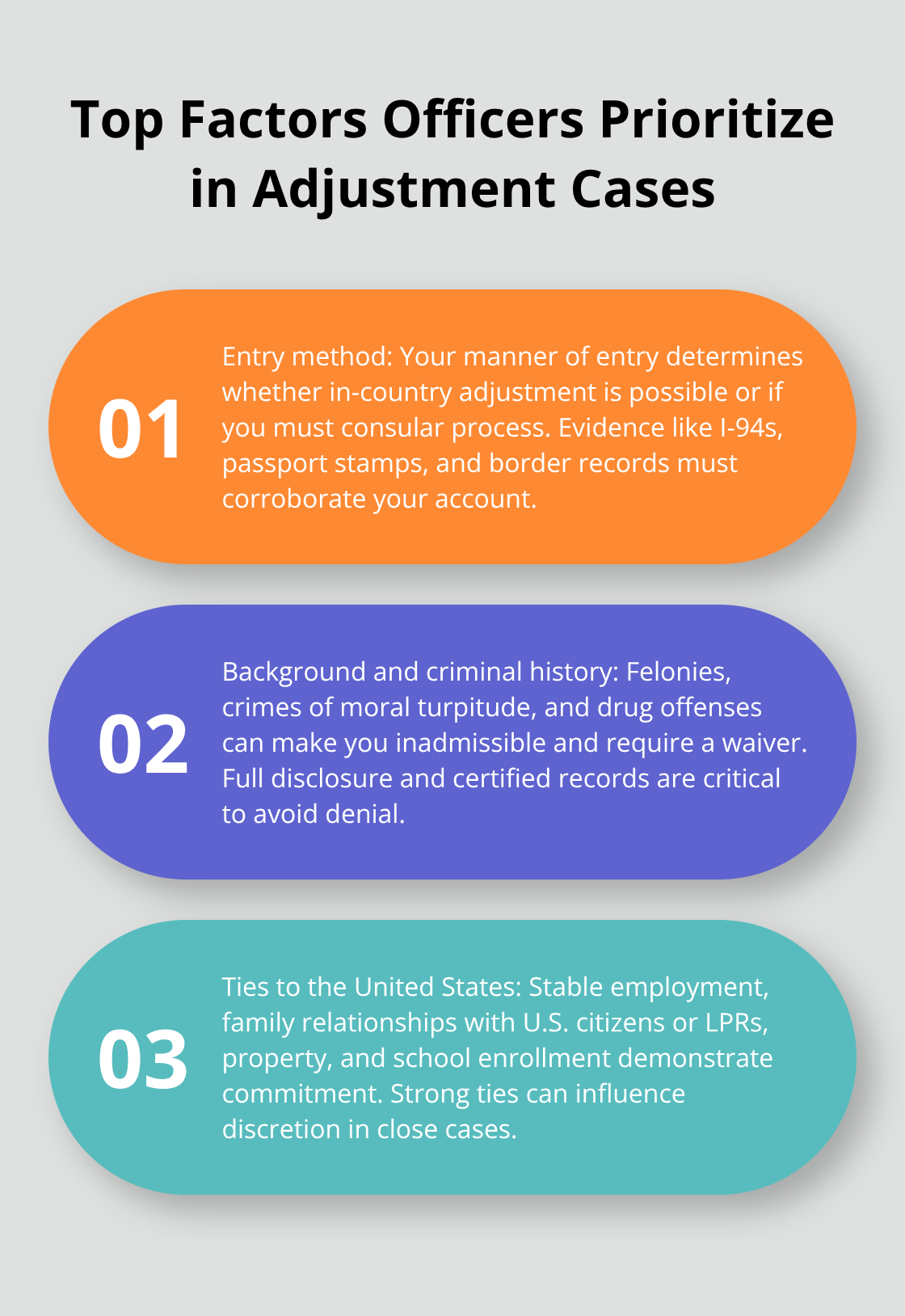
USCIS officers reviewing your adjustment application prioritize three factors above all others: how you entered the United States, whether your background raises red flags, and whether you have genuine ties to America. Your entry method determines whether you can adjust in the country or must pursue consular processing abroad, and this decision cascades through your entire case. If you entered without inspection, you generally cannot adjust unless you qualify as an immediate relative, obtained approval under INA 245(i), or fall into a special immigrant category. USCIS treats entry without inspection as fundamentally different from overstaying a visa, and the distinction carries enormous weight.
Your Entry Method and Visa History
An officer reviewing your I-485 will examine your Arrival/Departure Record, passport stamps, and border crossing documentation to establish exactly how you entered. If you cannot produce credible third-party evidence of being waved through a port of entry, officers will assume you entered without inspection. This is not a technical detail-it determines whether your case moves forward or faces immediate denial. The documentation you provide (Arrival/Departure Records, passport pages with visa stamps, travel history) either supports your account or contradicts it.
Officers cross-reference your statements against USCIS databases and immigration enforcement records to verify your entry narrative.
Criminal History and Background Checks
Criminal history triggers automatic scrutiny and often disqualification. Any felony conviction, crime of moral turpitude, drug offense, or aggravated felony creates grounds of inadmissibility that require a waiver under Form I-601. USCIS does not overlook these issues, and attempting to conceal a criminal record guarantees case denial and potential deportation proceedings. Misdemeanors involving violence, dishonesty, or controlled substances also raise serious concerns. Officers conduct background checks through FBI databases, state criminal records, and immigration enforcement databases, so disclosure is mandatory and hiding information is counterproductive.
Family Ties and Commitment to the United States
Your ties to the United States matter more than many applicants realize, and weak ties often signal that you lack genuine commitment to remaining in America. USCIS officers evaluate employment history, property ownership, family relationships with U.S. citizens or permanent residents, educational enrollment, and community involvement. Applicants with stable employment for multiple years, homeownership, or children enrolled in American schools demonstrate commitment far more effectively than those who cannot show consistent residence or work history. Family ties carry the most weight: having a U.S. citizen spouse, U.S. citizen children, or U.S. citizen parents dramatically strengthens your case because officers recognize these relationships as binding ties. Conversely, applicants with no family in the country, no employment, and recent arrival dates face skepticism about their intent to remain.
The strength of your ties directly affects officer discretion in close cases, and discretion matters even when you technically meet all eligibility requirements. You should document every tie to the United States-employment letters, property deeds, school enrollment records, lease agreements, tax returns, and affidavits from family members. These documents transform abstract claims into concrete evidence that officers can evaluate. The officer reviewing your case is not looking for reasons to approve your application; they are looking for reasons to deny it. Demonstrating strong ties, clean background, and lawful entry removes the most common denial grounds and positions your case for approval.
Final Thoughts
Bars to adjustment of status create real obstacles, but they do not eliminate your options. Employment-based exemptions like 245(k), extreme hardship waivers under Form I-601, and qualification as an immediate relative all provide viable pathways forward when you assess your situation correctly. The documentation you compile-entry records, employment history, residence timeline, and family relationships-transforms abstract claims into evidence that immigration officers can evaluate and act upon.
Immigration law shifts with policy updates and court decisions, making it difficult to navigate these barriers without professional guidance. Miscalculations on the 180-day violation threshold, missed filing deadlines, or procedural errors can permanently damage your eligibility and force you to restart from abroad. An immigration attorney identifies which bars apply to your specific facts, determines whether exemptions protect you, and develops a strategy that positions your case for approval rather than denial.
We at Law Offices of Jeffrey A. Thompson help clients overcome bars to adjustment of status and move forward with confidence toward permanent residency. Contact us today to discuss your case and develop a strategy tailored to your circumstances.
Share this post: