How to Navigate Pending Adjustment of Status Under Section 245
February 6, 2026
Pending adjustment of status under Section 245 of the Immigration and Nationality Act is one of the most direct paths to permanent residency in the United States. The process, however, involves multiple steps and strict requirements that can feel overwhelming without proper guidance.
At Law Offices of Jeffrey A. Thompson, we help clients navigate this complex journey from start to finish. This guide walks you through what you need to know to strengthen your application and move forward with confidence.
What Section 245 Actually Does for Your Case
Section 245 of the Immigration and Nationality Act allows you to apply for permanent residency without leaving the United States, provided you meet specific eligibility criteria. This differs fundamentally from consular processing, where you would return to your home country for visa issuance. The USCIS Policy Manual, Volume 7, Part B, establishes that adjustment under 245(a) requires you to be physically present in the U.S. and maintain lawful status at the time of filing-a distinction that shapes your entire strategy. If you entered the country unlawfully or overstayed a visa, you may still qualify under adjustment of status under Section 245(i), which grandfathers certain individuals who had a qualifying immigrant petition or labor certification filed by April 30, 2001. This matters because 245(i) allows you to adjust despite past violations, whereas 245(a) demands clean status from the moment you apply.
Determining Your Eligibility Path
Your eligibility hinges on your immigration category and entry status. Family-based applicants (spouses, parents, siblings of U.S. citizens or permanent residents) typically qualify under 245(a) if they maintain lawful status and an approved I-130 petition exists. Employment-based applicants need an approved I-140 petition and visa number availability to proceed. The Supreme Court decision in Sanchez v. Mayorkas clarified that U nonimmigrant status does not count as a lawful admission for 245(a) purposes, so U visa holders must carefully evaluate whether they qualify. If you are in unlawful status, bars under INA 245(c)(2) may block your adjustment entirely-unless you fall under 245(i) grandfathering. Processing times for employment-based I-485 applications average 8 to 18 months depending on your USCIS office, according to current USCIS processing data, so you should plan ahead to prevent delays.
Adjustment Versus Consular Processing
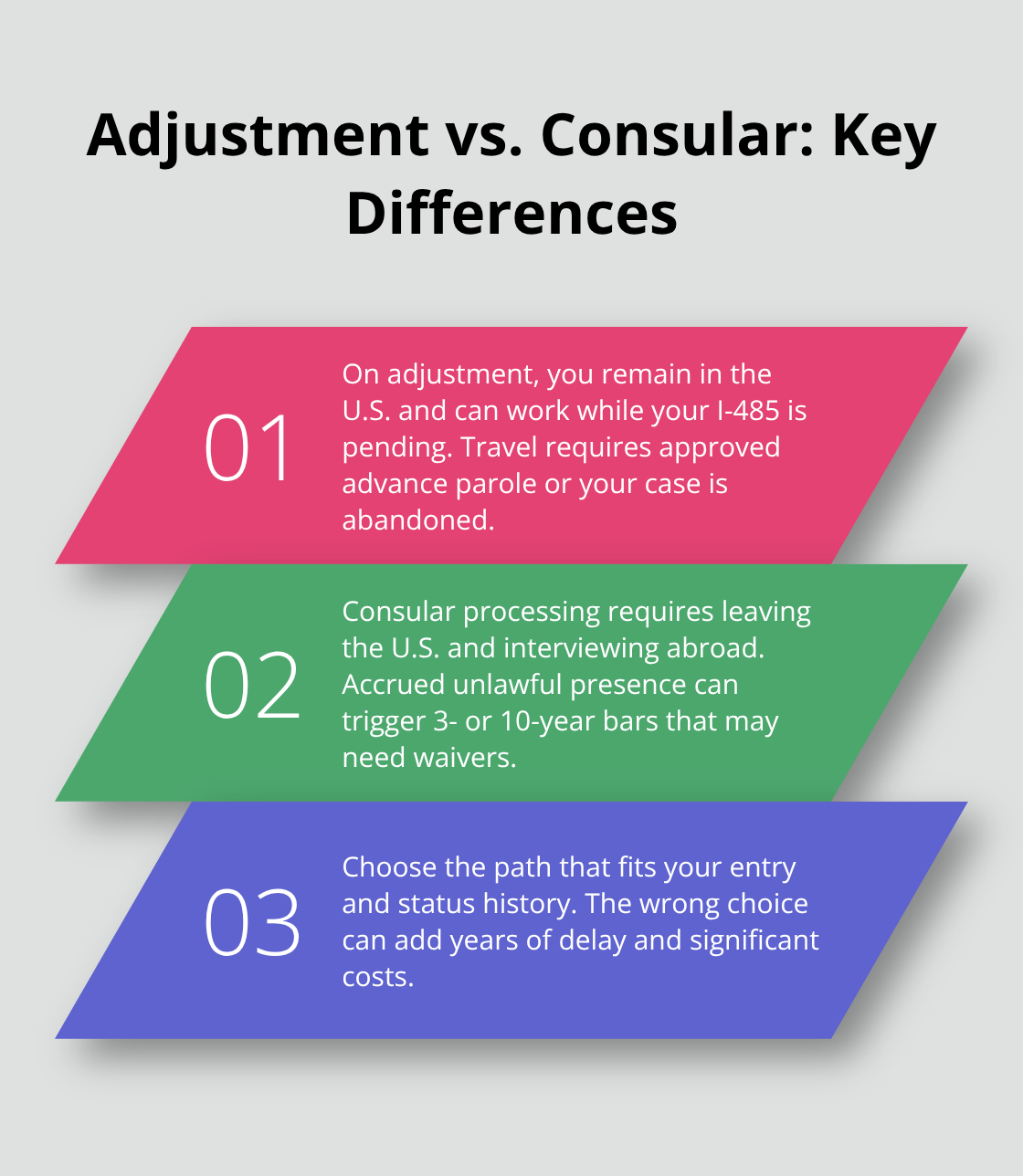
Adjustment allows you to remain employed and in the U.S. during processing, whereas consular processing requires you to leave and interview abroad-a riskier path if you have accumulated unlawful presence. Individuals who have accrued more than 180 days of unlawful presence while in the United States must obtain a waiver of inadmissibility under the 3-year or 10-year reentry bar under INA 212(a)(9)(B), meaning you cannot return for years even if your visa receives approval. With adjustment, you can file Form I-765 for employment authorization and Form I-131 for advance parole to travel legally while your I-485 remains pending. However, departure without advance parole approval abandons your entire application. If your case involves bars to adjustment (prior removal, fraud, or criminal grounds), consular processing may require waivers like Form I-601 anyway, so adjustment offers no advantage. Your specific entry and status history determines which path makes sense for your situation, and the wrong choice can cost years and thousands of dollars.
What Happens Next in Your Application
Once you understand which adjustment path applies to you, the next phase involves gathering the correct documentation and submitting your forms to USCIS.
Filing Your I-485 and Gathering the Right Documents
Submitting Your Application Correctly the First Time
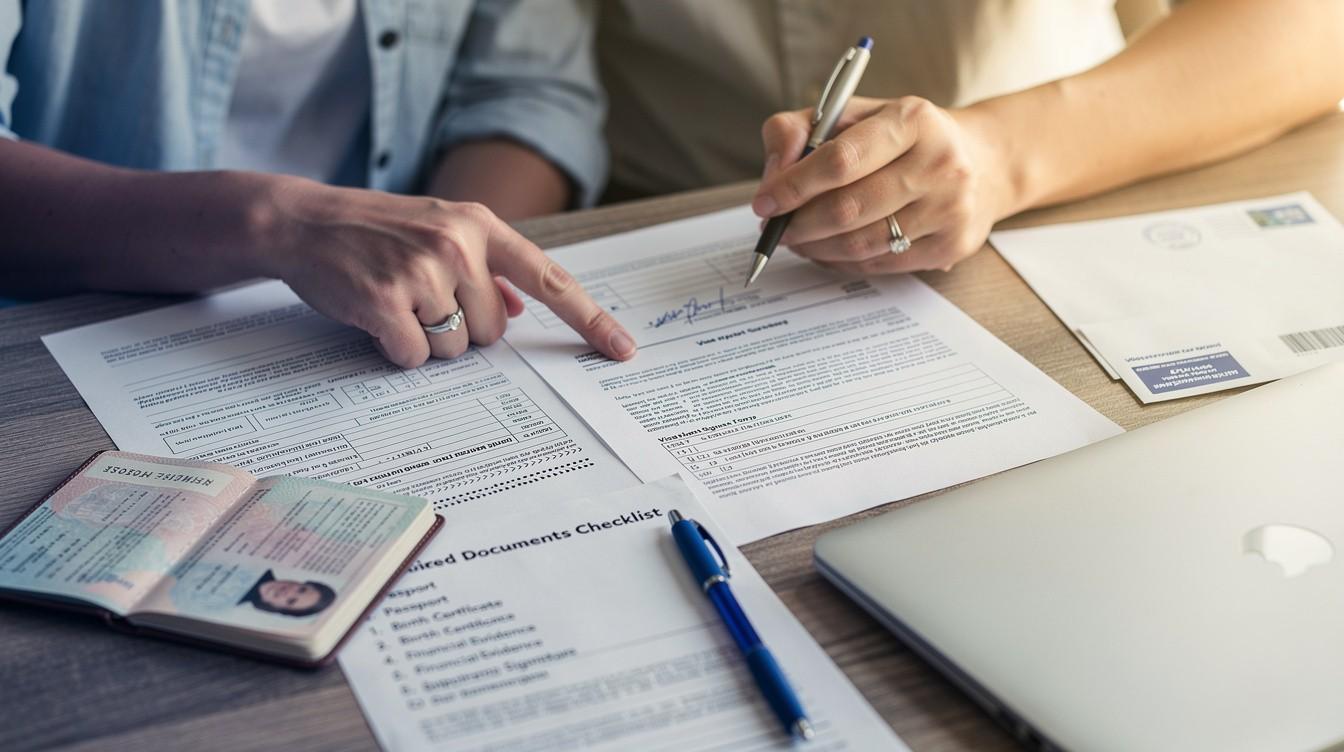
Your I-485 application launches your adjustment of status with USCIS, and submitting it correctly prevents months of delays. According to USCIS, the form itself is straightforward, but the supporting documentation checklist determines whether your application moves forward or faces rejection. Start by collecting your birth certificate, passport pages, government-issued photo ID, and two passport-style photos taken within the last six months.
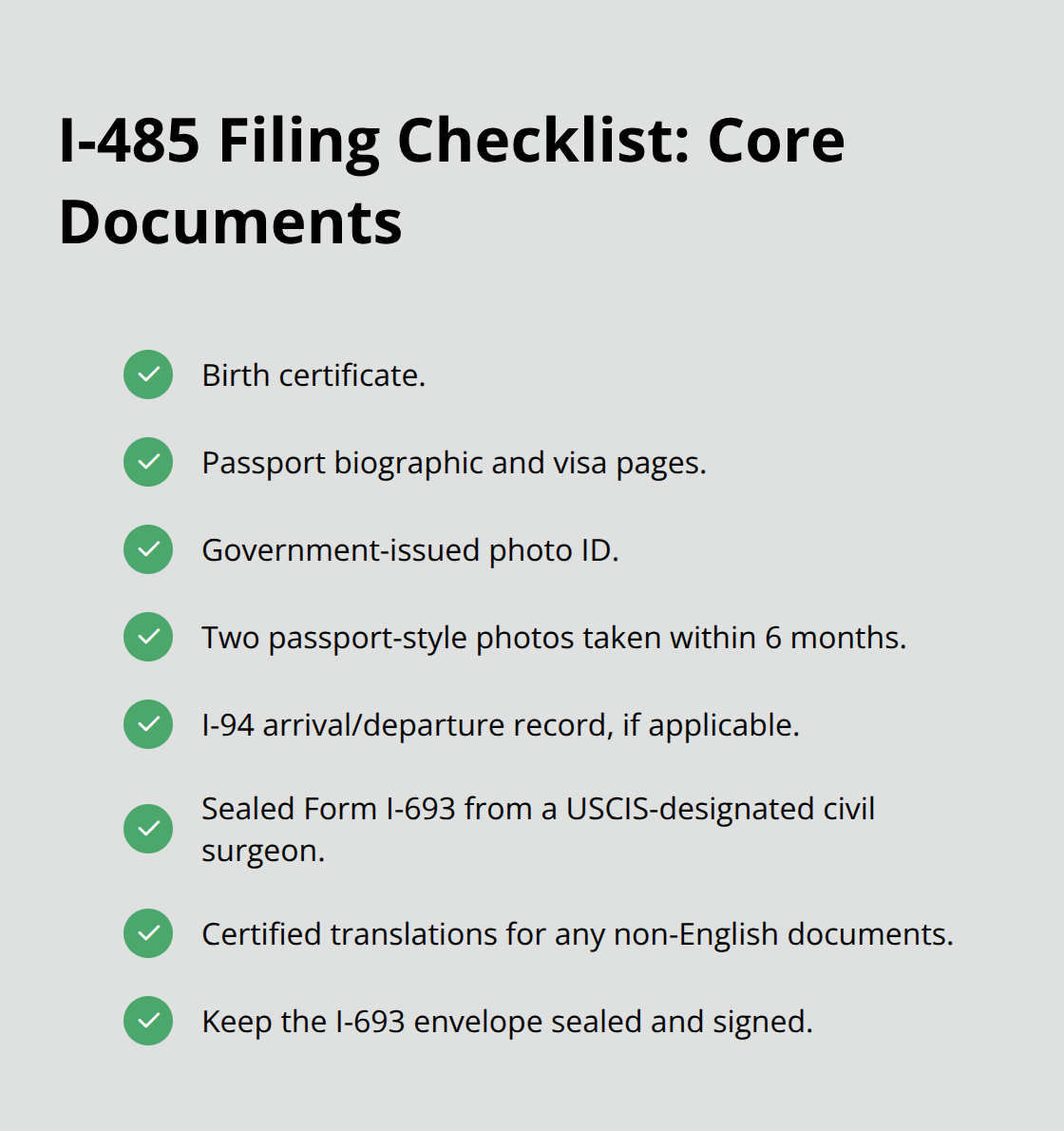
If you entered the U.S. lawfully, include your I-94 arrival/departure record; if you lack one, request it from USCIS or CBP before filing. You must also submit Form I-693, the medical examination completed by a USCIS-designated civil surgeon, in a sealed envelope. Do not open this envelope or the exam becomes invalid.
Essential Documents and Forms You Need
Include your I-797 approval notice for your underlying petition (I-130 for family-based cases or I-140 for employment-based cases) along with certified copies of any police or court records, even if charges were dismissed or expunged. If you need a waiver for inadmissibility grounds, file Form I-601 concurrently. For family-based applicants, submit Form I-864, the Affidavit of Support, signed by your sponsor showing income at 125 percent of the federal poverty guideline; without this, USCIS will reject your application. Employment-based applicants file Form I-944, the Declaration of Self-Sufficiency, instead. The filing fee totals 640 dollars for the I-485 itself, plus an additional 1,000 dollars biometric services fee if you are under 79 years old and not exempt. If you file under Section 245(i) because you entered unlawfully, add Form I-485 Supplement A with evidence of your grandfathered petition or labor certification filed by April 30, 2001, plus proof you were physically present in the U.S. on December 21, 2000. Incomplete I-485 filings trigger rejections or Requests for Evidence that delay your case by months; non-English documents require certified translations, and USCIS will not accept documents in other languages without English versions attached.
Tracking Your Case and Avoiding Common Delays
Processing times for employment-based I-485 cases currently range from 8 to 18 months depending on your local USCIS field office. You can check your specific office’s timeline on the USCIS Processing Time Information page before filing. Once USCIS receives your application, you will receive a receipt notice (I-797) with a case number; use this number to track your case status through Case Status Online on the USCIS website. Do not rely on postal address changes to update USCIS; you must submit a Change of Address request directly to USCIS within 10 days of moving or you will miss critical notices. Most delays stem from incomplete documentation or inconsistencies between your I-485, I-140, and PERM labor certification. Your job title, salary, and employer name must match across all three documents, and any discrepancy triggers a Request for Evidence (RFE) that adds 2 to 6 months to your timeline.
Managing Employment and Travel While Your Case Pending
If your employer changes ownership, merges with another company, or relocates, notify USCIS immediately because the original employer must remain able to pay your offered wage. You can apply for work authorization (Form I-765) and travel permission (Form I-131 for advance parole) while your I-485 is pending, but departing the U.S. without approved advance parole abandons your entire application. Many applicants lose their cases by traveling without this critical document. If your case involves prior removal or deportation, file Form I-212 requesting permission to reapply for admission; without it, USCIS will deny your I-485 regardless of other qualifications. Once you understand what documents you need and how to track your case, the next phase focuses on strengthening your application through medical exams and background checks.
Strengthening Your Application Before USCIS Reviews It
Medical Examination Requirements and Timing
Your medical examination forms the backbone of USCIS approval. The I-693 medical exam must take place with a USCIS-designated civil surgeon within two years of your I-485 filing date. You cannot use a personal physician or telemedicine provider for this exam. Schedule this appointment immediately after submitting your I-485 because delays here cascade through your entire timeline. The civil surgeon checks your vaccination status against CDC requirements, screens for communicable diseases, and flags any conditions requiring waivers under INA 212(a). Most applicants fail the vaccination portion because their records are incomplete or outdated. Bring original immunization records, not copies, because the civil surgeon must verify each shot date and vaccine type. If you lack vaccination records, the surgeon can administer vaccines on the spot, but this adds cost and appointment time. USCIS will reject your I-485 if the I-693 arrives in an opened envelope or without the surgeon’s original signature in blue ink.
Police Records and Criminal History Disclosure
For police records, obtain certified copies from every police department, courthouse, and country where you have lived for more than six months in the past ten years. This includes arrests that were dismissed, charges that were dropped, and convictions that were expunged. USCIS pulls its own background check through the FBI and Interpol, so omitting even one record triggers an immediate denial. Many applicants assume juvenile records or sealed cases need not be reported, but USCIS considers everything. If you have any criminal history whatsoever, consult with an immigration attorney before filing because a single misdemeanor or felony can render you deportable even after approval.
Biometrics Appointment: What to Expect

Your biometrics appointment arrives via notice within two to four weeks after USCIS receives your I-485. Attend this appointment on the exact date and time listed or USCIS will deem your case abandoned. Bring your receipt notice, government-issued photo ID, and nothing else unless the notice specifies additional items. The appointment itself takes 15 to 30 minutes, and USCIS collects fingerprints, photographs, and signatures for background verification. Dress professionally because USCIS photographs you for your green card and any future travel documents. Do not miss this appointment under any circumstance because rescheduling delays your case by months and demonstrates to USCIS that you lack commitment to the process.
Interview Preparation and Performance
After biometrics, USCIS typically schedules your interview within four to eight weeks, though processing times vary significantly by office. The interview is not a casual conversation; USCIS officers ask detailed questions about your job duties, family relationships, medical history, and criminal background to verify the accuracy of your I-485. Prepare a folder containing originals of documents you submitted plus extra certified copies of your birth certificate, passport, and I-797 approval notice. Arrive 15 minutes early, bring your receipt notice and ID, and answer all questions directly without volunteering extra information. If the officer asks about your employment, describe your actual job duties matching the position listed on your I-140 or I-130. Inconsistencies between your I-485 answers and interview statements result in denials or Requests for Evidence that cost additional time and legal fees.
Final Thoughts
Navigating pending adjustment of status under Section 245 of the Immigration and Nationality Act demands attention to detail and strict adherence to deadlines. The process becomes manageable when you submit complete documentation the first time, respond promptly to any Requests for Evidence, and maintain consistent information across all forms and supporting materials. We at Law Offices of Jeffrey A. Thompson understand that your case touches on your employment, family relationships, medical history, and future in the United States.
After you file your I-485, your primary responsibility is staying organized and responsive. Update your address with USCIS within ten days of any move, attend your biometrics appointment on the exact date scheduled, and prepare thoroughly for your interview. Monitor your case status regularly through Case Status Online using your receipt number, and respond within the deadline specified if USCIS sends you a Request for Evidence.
When in doubt about your eligibility, bars to adjustment, or interview strategy, contact Law Offices of Jeffrey A. Thompson for a consultation. The cost of expert guidance now is far less than the cost of delays, denials, or having to restart your case from scratch. Our team provides the guidance you need to move forward with confidence.
Share this post: