Waivers for Residency: Navigating the Adjustment Process
April 3, 2026
Residency waivers can open doors that immigration law typically keeps closed. If you’re facing barriers to adjusting your status due to residency requirements, you need to understand your options.
At Law Offices of Jeffrey A. Thompson, we’ve guided countless clients through this complex process. This guide walks you through what waivers for residency actually are, how to apply, and how to handle obstacles along the way.
Understanding Residency Waivers
What a Residency Waiver Actually Does
A residency waiver isn’t a magic ticket, but it is a legitimate legal tool that addresses specific barriers in immigration law. Under the Immigration and Nationality Act, grounds of inadmissibility can block your path to permanent residency. A residency waiver allows USCIS to overlook these barriers so you can adjust your status without leaving the United States. The key distinction here is that waivers are discretionary, not automatic. An officer must determine that granting your waiver serves the national interest or demonstrates extreme hardship to a qualifying relative who is a U.S. citizen or lawful permanent resident. This is why the strength of your case depends entirely on how well you document your circumstances and present your evidence.
Which Waiver Types Match Your Situation
The types of waivers available depend on your specific inadmissibility ground. The most common pathway is the extreme hardship waiver under INA 212(i), which applies when unlawful presence or certain criminal grounds would otherwise block your adjustment. If you face a medical inadmissibility issue, a 212(g) waiver may allow you to overcome health-related barriers. For trafficking victims adjusting to T status, INA 245(l)(2) provides a broader waiver framework that covers most grounds except terrorism, espionage, and Nazi persecution. If you are an exchange visitor with a two-year foreign residence requirement, a 212(e) waiver exists if you can show exceptional hardship.
Identifying Non-Waivable Grounds
The critical point: not all grounds are waivable. Terrorist activities, serious criminal convictions involving moral turpitude, and international child abduction carry no waiver relief. This means your first step must be identifying exactly which ground of inadmissibility applies to you, because pursuing a waiver for a non-waivable ground wastes time and money.
Who Qualifies and What USCIS Looks For
Qualification hinges on your relationship to a U.S. citizen or lawful permanent resident and your ability to document hardship. Spouses and parents of U.S. citizens have the strongest cases because they are the qualifying relatives for most extreme hardship waivers. Children under 21 cannot establish hardship for the I-601A provisional waiver, which eliminates that pathway for some families. Financial hardship alone rarely succeeds; USCIS looks at medical needs, separation impacts, and country conditions in your home nation.
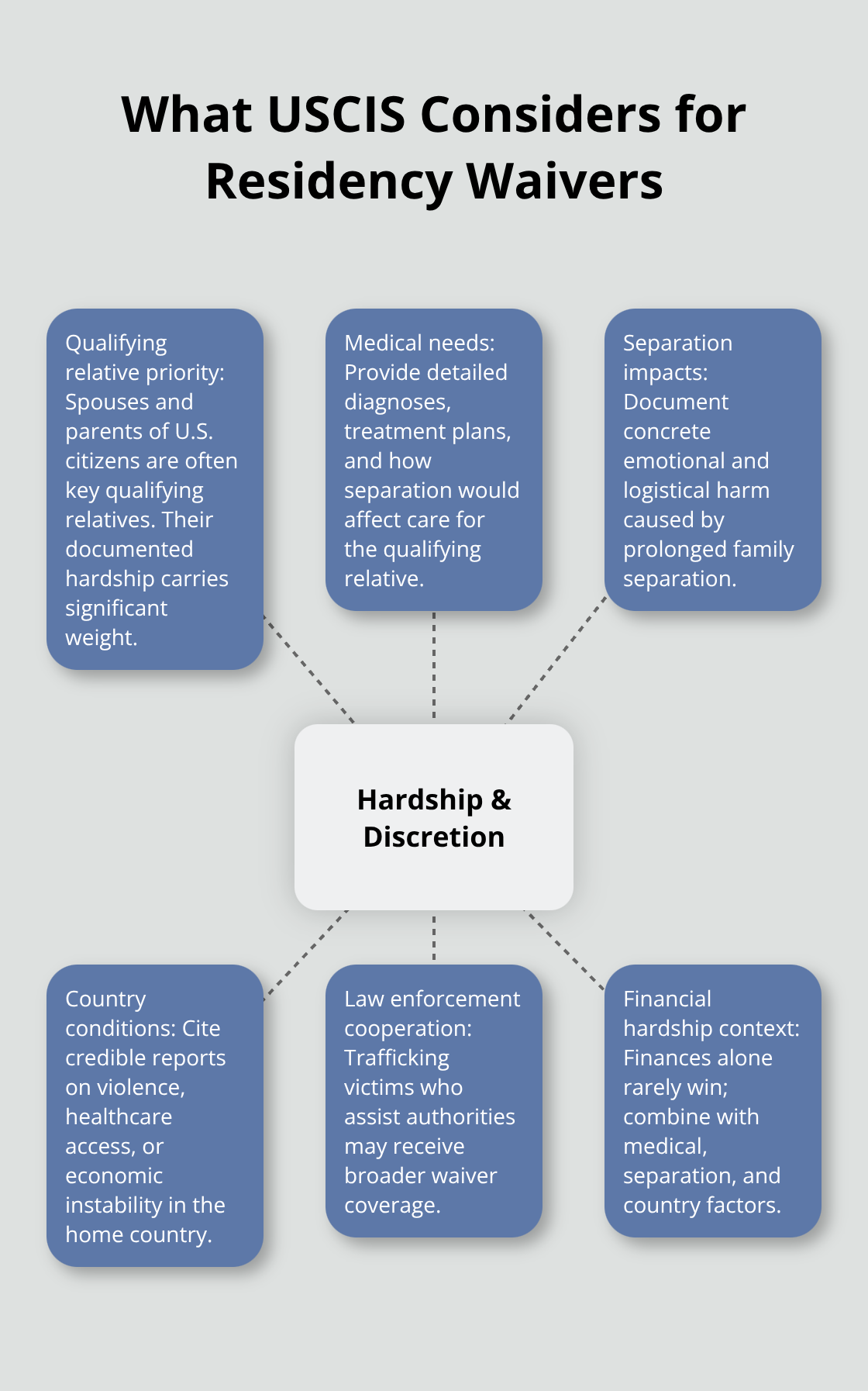
If you are a trafficking victim, your cooperation with law enforcement strengthens your waiver considerably, and the law provides more generous waiver coverage for your situation than for other applicants. Understanding these qualification standards helps you assess whether your circumstances align with what USCIS actually considers when making waiver decisions.
How to Start Your Waiver Application
Assess Your Eligibility Before Filing
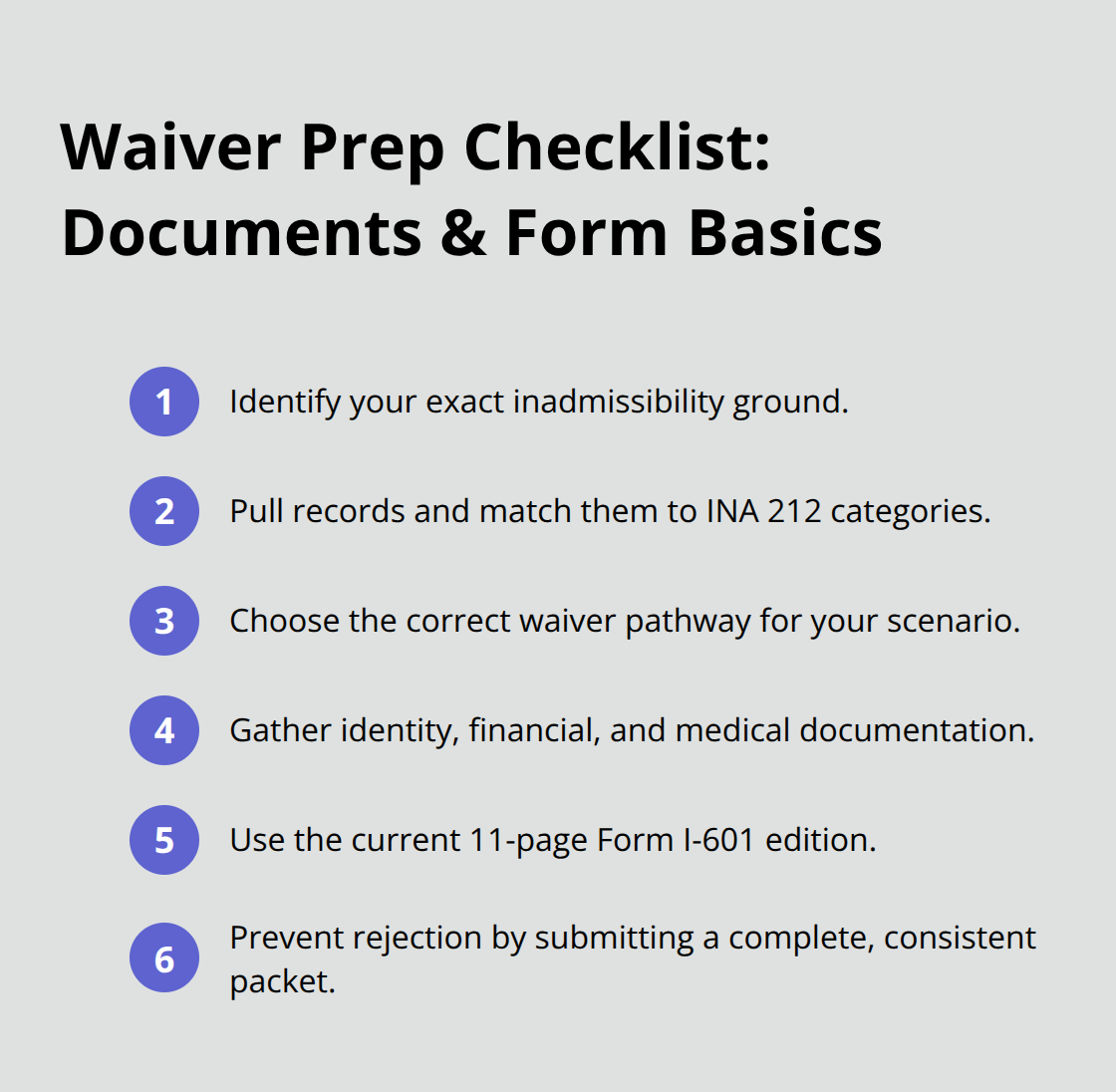
You must conduct a thorough eligibility assessment before you file anything with USCIS. The first critical step involves identifying your exact ground of inadmissibility, because filing for the wrong waiver wastes months and money. Pull your immigration records, including any notices of ineligibility or prior denials, and cross-reference them against the INA 212 grounds. If you were denied entry, received a criminal conviction, or accumulated unlawful presence, each scenario requires a different waiver pathway.
Documentation forms your foundation at this stage. Obtain your birth certificate, marriage certificate if applicable, tax returns from the past three years, bank statements, medical records if health is a factor, and employment letters. USCIS Form I-601 requires all 11 pages from the current edition, and incomplete versions trigger automatic rejection.
Gather Documentation for Your Qualifying Relative
If you have a qualifying relative who is a U.S. citizen or lawful permanent resident, obtain their documentation as well, including proof of their status. For extreme hardship waivers under INA 212(i), USCIS explicitly evaluates emotional and financial ties, medical needs, family separation, and country conditions in your home nation.
Medical hardship claims require detailed reports from licensed physicians; generic statements fail consistently. Financial hardship documentation must show specific monthly expenses and income shortfalls, not vague claims about struggling. If your qualifying relative has health issues that would worsen if you were separated, obtain medical evidence from their treating physician. Country conditions matter significantly for hardship analysis. If you come from a nation experiencing violence, limited healthcare access, or economic collapse, research and compile reports from organizations like the U.S. State Department or Human Rights Watch to strengthen this component.
Calculate Fees and Select Your Filing Location
The current Form I-601 fee is $715 according to the USCIS Fee Schedule, though T visa applicants and certain trafficking victims may qualify for fee waivers. Most applicants must pay electronically using Form G-1450 for credit or debit card payments or Form G-1650 for bank account transfers; personal checks are no longer accepted.
Your filing location depends on your specific immigration benefit. If you adjust status through an I-485 application, file the I-601 with your adjustment package at the USCIS service center handling your case. If you pursue consular processing instead, send your I-601 to the consulate processing your immigrant visa. Attach Form G-1145 to request electronic notification when USCIS receives your application, which typically arrives within two weeks for paper filings.
Prepare for Your Interview and Decision
After you file, expect your interview to occur within four to six months, though processing times fluctuate. USCIS will schedule a biometric appointment to collect fingerprints and photographs; failure to attend results in case closure. During your interview, a USCIS officer will question you about your hardship claims, your relationship to your qualifying relative, and your inadmissibility ground. Bring original documents and certified translations for any foreign-language materials.
The officer will make a decision on the spot or within weeks after your interview. If USCIS denies your waiver, the agency provides a written explanation and specifies any appeal rights under 8 CFR 103.3, though some waiver denials carry no appeal option. Understanding these timelines and requirements helps you prepare realistic expectations as you move forward with your application. The next chapter addresses the common obstacles that applicants encounter during this process and the strategies that help overcome them.
Common Challenges and How to Overcome Them
Documentation Failures That Sink Applications
Missing or weak documentation ranks as the single largest reason USCIS denies waiver applications. The agency receives roughly 30,000 Form I-601 waiver filings annually, and officers reviewing your case spend an average of 20 to 30 minutes on initial review. That compressed timeline means every missing page, every vague statement, and every undocumented claim works against you.
Generic medical letters stating that separation would be difficult fail consistently because officers see identical language in hundreds of applications. Your physician must document specific diagnoses, current medications, treatment frequency, and explicit statements about how your absence would impact your qualifying relative’s health trajectory. Financial hardship requires bank statements from the past six months, not just a claim that money is tight. Tax returns for three years establish income patterns. Medical bills, rent receipts, and utility statements show actual expenses.
Country conditions demand current documentation from credible sources. If you claim your home nation lacks adequate medical care, cite specific reports from the U.S. State Department’s Country Reports on Human Rights Practices or reports from organizations like Amnesty International rather than anecdotal stories. USCIS officers trained in waiver adjudication can distinguish between substantive evidence and filler.
Translation and Form Completion Requirements
One critical mistake applicants make involves submitting documents without translations. Any document not in English requires a certified English translation with the translator’s declaration of qualifications and accuracy. Incomplete Form I-601 submissions trigger automatic rejection. All 11 pages must come from the same edition, dated 01/20/25 according to current USCIS standards. Missing pages mean starting over, which costs months of processing time.
Understanding the Three-Step Denial Analysis
Waiver denials typically follow predictable patterns that reveal where your case weakened. USCIS applies a three-step analysis for extreme hardship waivers. Step One requires showing that your inadmissibility ground resulted from or connects to your circumstances, not random bad luck. Step Two demands demonstrating that granting your waiver serves the national interest through factors like cooperation with law enforcement, community contributions, or family unity considerations. Step Three involves discretionary balancing where the officer weighs favorable humanitarian factors against any adverse information in your record.
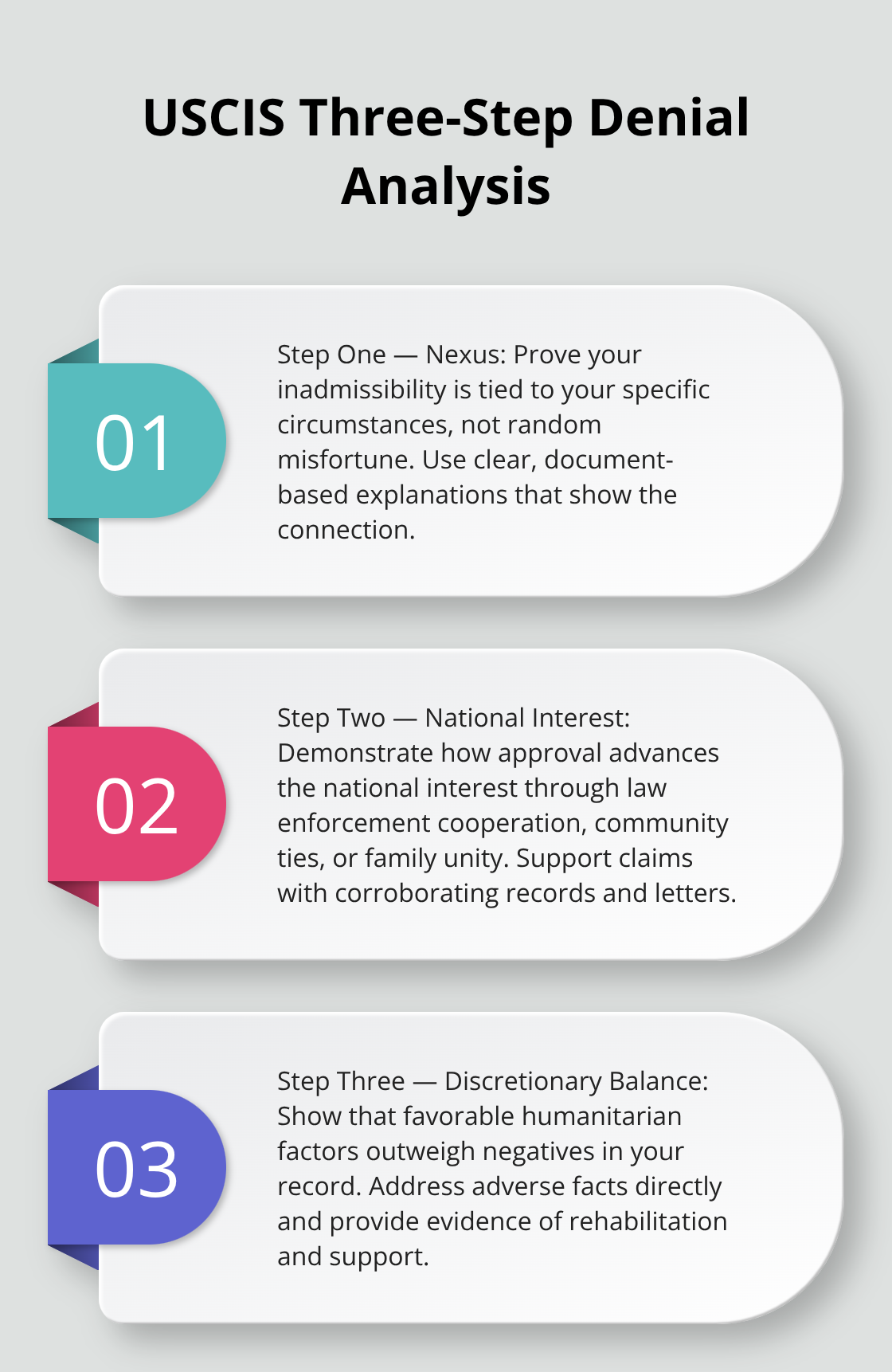
Denials at Step One mean your evidence failed to establish nexus between your ground and your situation. Denials at Step Two indicate insufficient national-interest justification. Denials at Step Three, despite passing Steps One and Two, reveal that adverse factors outweighed favorable ones in the officer’s discretionary judgment. Understanding where your case failed matters enormously because it determines whether you can request reconsideration or must pursue alternative pathways.
When to Seek Legal Representation
Some waiver denials carry no appeal rights under 8 CFR 103.3, which is why the initial application must be comprehensive and persuasive. This is where working with experienced immigration counsel becomes practical rather than optional. An attorney can assess the specific reasons behind denials and determine whether requesting reconsideration, filing a new I-601, or pursuing consular processing offers better odds given your exact circumstances. We at Law Offices of Jeffrey A. Thompson assist clients in navigating these complex decisions and help them overcome legal hurdles in their immigration journey.
Final Thoughts
Waivers for residency transform what appears impossible into an achievable outcome. The process demands precision, documentation, and realistic expectations, but thousands of applicants successfully navigate it each year. Your path forward depends on three concrete actions: identifying your exact inadmissibility ground, gathering comprehensive evidence that demonstrates hardship or national interest, and understanding that discretionary decisions rest on how persuasively you present your case.
The most successful applicants treat waiver applications as legal arguments, not paperwork exercises. Every document serves a purpose, and every statement connects to USCIS evaluation criteria. Medical records from treating physicians, financial documentation spanning months, and country condition reports from credible sources carry weight because officers review thousands of applications and recognize substantive evidence immediately.
Immigration law contains pathways for people in your situation, but those pathways require navigation by someone who understands both the regulations and the discretionary factors officers actually consider. We at Law Offices of Jeffrey A. Thompson assist clients in navigating immigration matters, from paperwork to overcoming legal hurdles, and our team helps you assess your specific circumstances, identify the strongest waiver pathway, and present evidence that persuades decision-makers.
Share this post: