Family Based Green Cards: A Practical Guide to Sponsoring Your Loved One
May 18, 2026
Sponsoring a family member for a family-based green card is one of the most direct paths to permanent residency in the United States. The process involves specific eligibility requirements, detailed documentation, and careful attention to deadlines.
At Law Offices of Jeffrey A. Thompson, we’ve guided countless families through this journey. We’ll walk you through each step so you can avoid costly mistakes and move forward with confidence.
Who Can Actually Sponsor a Family Member
Sponsorship Eligibility Basics
You can sponsor a family member for a green card if you’re a U.S. citizen or a lawful permanent resident. That’s the hard requirement-nothing else matters without it. U.S. citizens have more sponsorship options than permanent residents. If you’re a citizen, you can sponsor your spouse, unmarried children under 21, married children of any age, parents if you’re 21 or older, and siblings. Permanent residents face tighter restrictions: they can only sponsor spouses and unmarried children. This distinction matters tremendously because it affects how long your family member waits for their green card. If you’re a permanent resident trying to sponsor a sibling, that won’t work-you’d need to become a citizen first, which takes time and effort.
Meeting the Income Requirement
The income requirement is where many sponsors stumble. You must prove you can financially support your family member so they don’t rely on government benefits. According to the U.S. Department of Health and Human Services Poverty Guidelines, your household income must reach at least 125 percent of the federal poverty level for your household size. For 2026, a single sponsor supporting one immigrant needs roughly $23,000 annually, while a family of four sponsoring one immigrant needs approximately $47,000. These numbers come directly from the HHS poverty calculations.
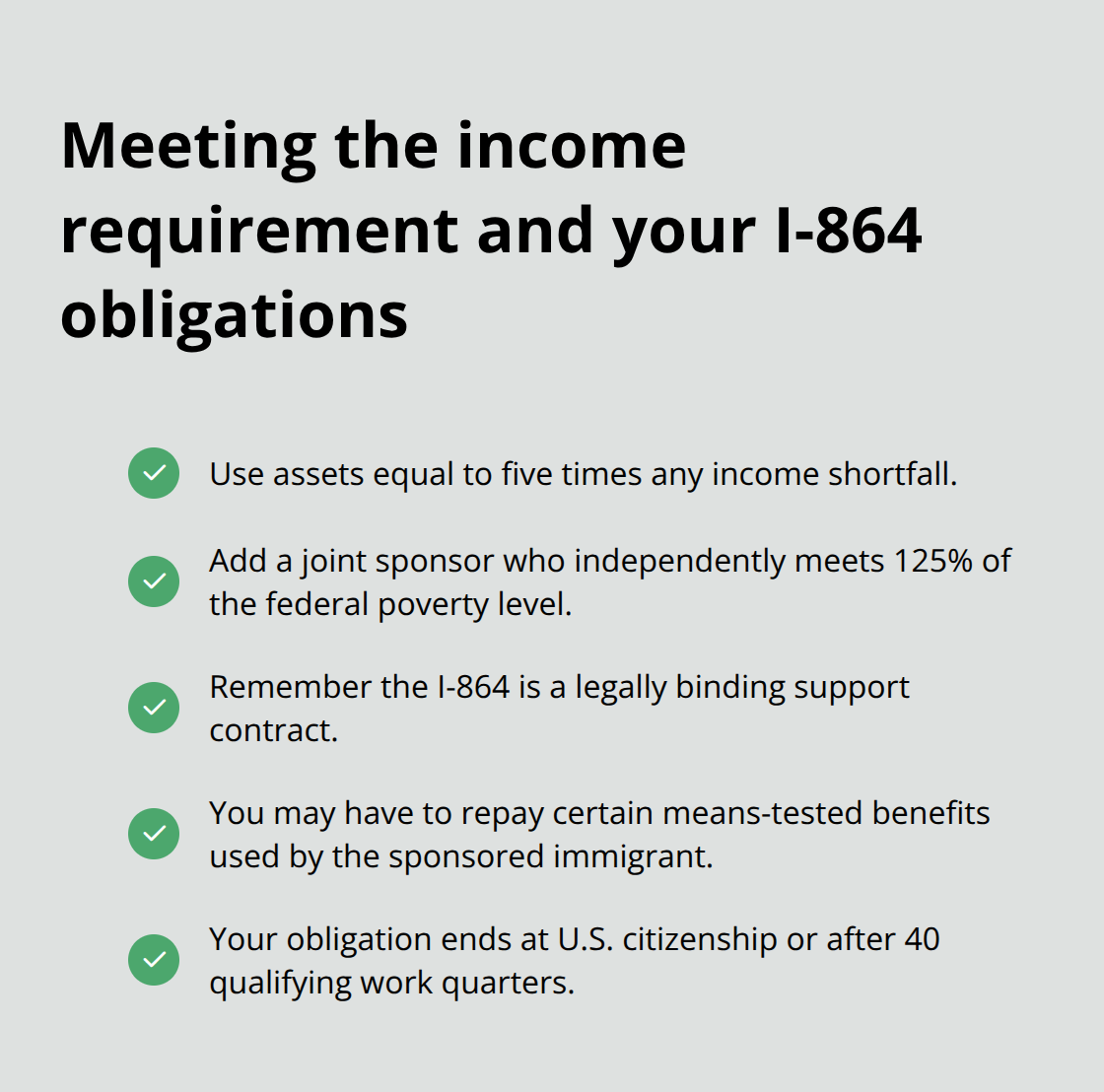
If your income falls short, you have two options: use assets to cover the gap (you’d need five times the shortfall in total assets), or bring in a joint sponsor who independently meets the 125 percent threshold. Joint sponsors cannot combine their income with yours-they must qualify on their own. You’ll file Form I-864 Affidavit of Support, which is a legally binding contract with the U.S. government to financially support the sponsored alien. This isn’t just paperwork. If your sponsored family member uses certain government benefits, you could be required to repay those benefits. The obligation lasts until they become a U.S. citizen or accumulate 40 qualifying quarters of work history (roughly 10 years).
Documentation You’ll Need
Document your income carefully: provide your most recent federal tax return and proof of current employment. If you weren’t required to file taxes, explain why. Missing documentation delays applications significantly.
Medical Exams and Background Checks
Medical and background checks happen later in the process but warrant planning now. Your family member will undergo a medical examination by a USCIS-designated civil surgeon, including required vaccinations. They’ll also provide certified police and court records for any arrests or criminal charges, regardless of the outcome. If they have a history with J-1 visa status that included a foreign residence requirement, they’ll need to prove compliance or obtain a waiver. These requirements aren’t negotiable, so budget time for obtaining records from other countries if necessary. Start gathering documentation early-waiting until USCIS requests it creates unnecessary delays.
Once you understand who qualifies and what financial proof you need, the next step involves actually filing the petition and preparing your initial documentation package.
How the Green Card Process Actually Moves Forward
Filing Your Initial Petition
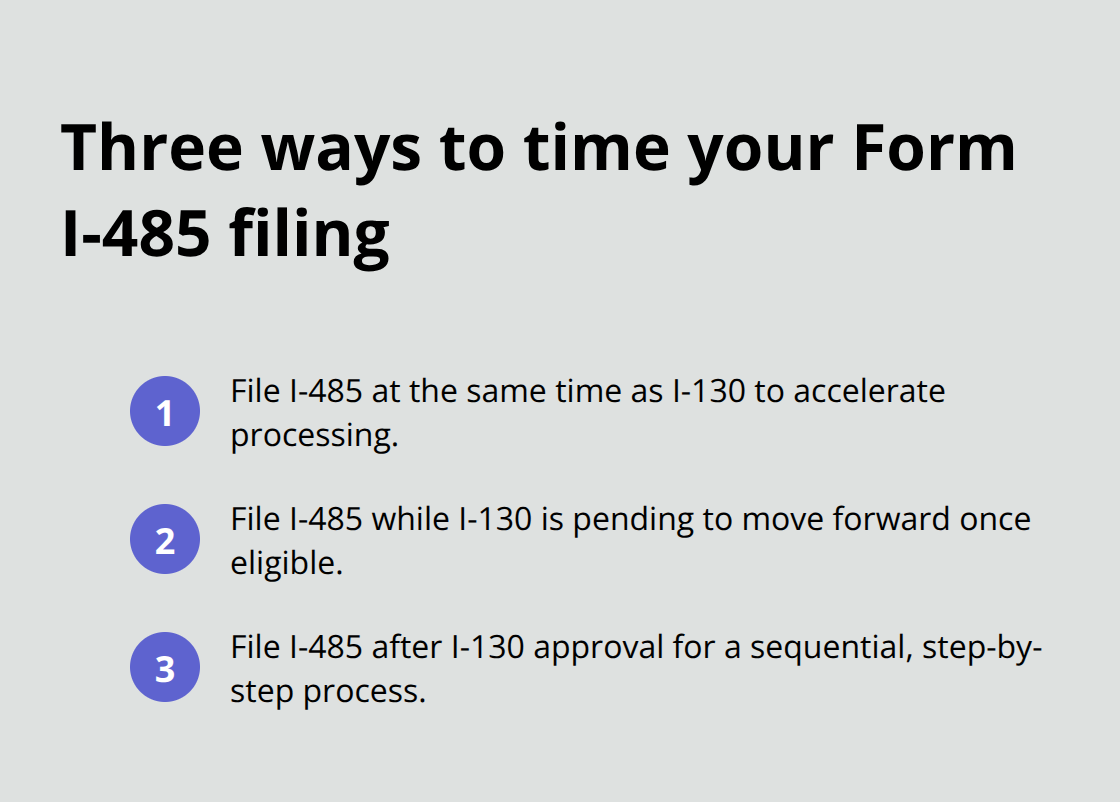
Filing Form I-130, Petition for Alien Relative, launches your entire case. You can file this form online or by mail, and you must submit a separate petition for each family member you sponsor. The timing of Form I-485, Application to Register Permanent Residence or Adjust Status, significantly affects your overall timeline. You have three options: file I-485 simultaneously with I-130, file I-485 while I-130 remains pending, or file I-485 after I-130 receives approval. Concurrent filing-submitting both forms together-typically accelerates the process because you avoid waiting for one approval before advancing to the next step.
Gathering Your Documentation Package
Your I-485 packet requires your I-130 approval notice and two passport-style photos along with government-issued ID, birth certificate, marriage certificate (plus proof of termination of any prior marriages), passport pages, and your I-94 or proof of admission or parole. Form I-693, the medical examination and vaccination record completed by a USCIS-designated civil surgeon, must accompany your I-485. Submit this medical exam with your application rather than waiting for USCIS to request it-missing this document triggers rejection. If your family member resides in the United States and was inspected and admitted or paroled, they can adjust of status domestically rather than pursuing consular processing abroad. This domestic path moves faster because the entire process occurs within the U.S. system.
Choosing Your Path: Adjustment or Consular Processing
Your family member’s location determines which route you take. If they already live in the United States and qualify, adjustment of status allows them to remain here while their case processes. If they reside outside the U.S., consular processing forwards your approved petition to the Department of State, and your family member completes the visa process at a U.S. embassy or consulate in their home country. The National Visa Center manages consular cases after I-130 approval, requesting documents and fees before scheduling the visa interview.
Understanding Processing Timelines
Processing times vary dramatically by category and country. Immediate relatives of U.S. citizens-spouses, unmarried children under 21, and parents of citizens age 21 or older-have unlimited visa numbers available, so no annual backlog affects their wait time. Family preference categories like F1, F2A, F2B, F3, and F4 face annual caps, which create significant delays depending on demand. According to the Department of State Visa Bulletin, the F4 category (siblings of U.S. citizens) currently shows priority dates from 2015, meaning applicants filed in 2015 are just now moving forward. This reality demands patience and realistic expectations about your timeline.
Managing Travel and Work During Processing
If you or your family member must travel internationally while adjustment of status remains pending, file Form I-131 for Advance Parole. Leaving the United States without advance parole abandons your I-485 application entirely-no second chance exists on this rule. File I-131 concurrently with I-485 and select only item 5.A in Part 1 if you want advance parole. You can also request employment authorization through Form I-765 while your I-485 remains pending, allowing your family member to work legally while waiting for the green card. The entire process from initial petition to final decision typically spans anywhere from six months for immediate relatives to several years for family preference categories, so plan your finances and life decisions around extended timelines rather than optimistic projections. Understanding these timelines helps you prepare for what comes next in your sponsorship journey.
What Mistakes Sink Family Sponsorship Cases
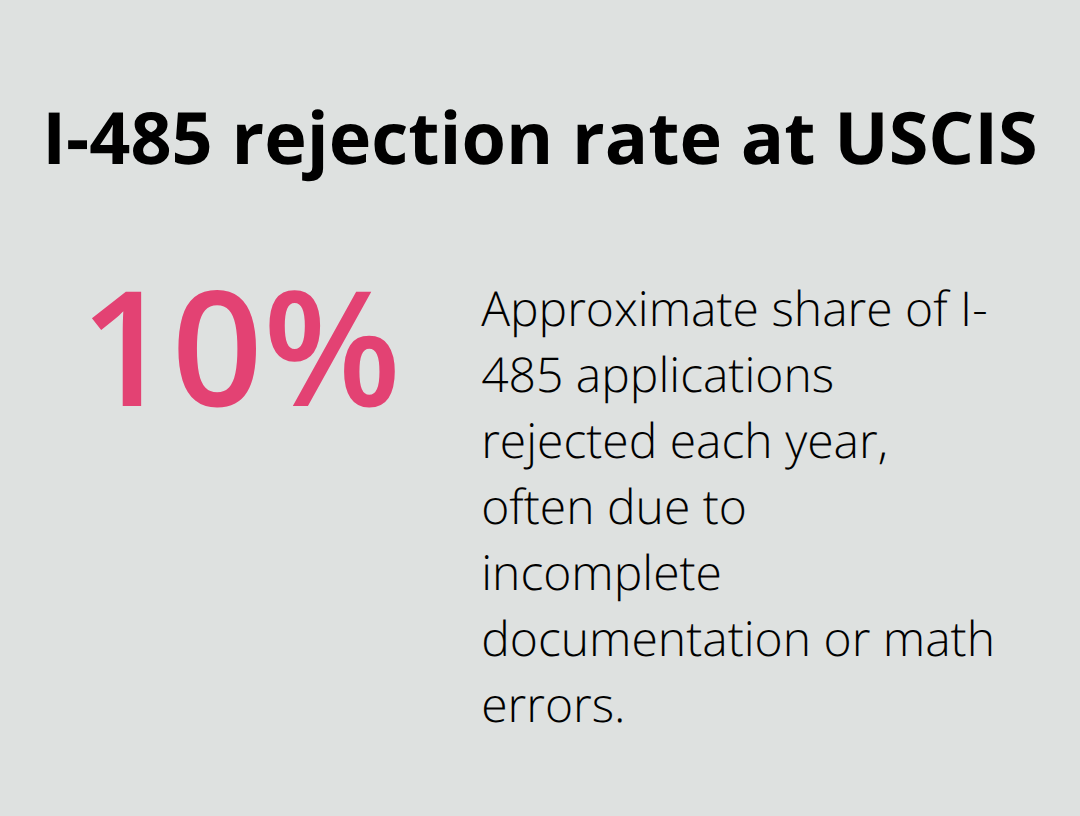
Most family sponsorship cases fail not because of complex legal issues but because sponsors make preventable errors with forms, finances, and responsiveness. USCIS rejects approximately 10 percent of I-485 applications annually, with a significant portion traced to incomplete documentation or mathematical errors on the Affidavit of Support.
These rejections don’t just delay your case-they force you to start over, incurring additional filing fees and extending the timeline your family member already faces. The mistakes we see most frequently are fixable with attention to detail, but they require understanding exactly what USCIS expects before you submit anything.
Forms That Fail Because of Careless Errors
Form I-485 and Form I-864 demand absolute accuracy. USCIS will reject I-485 applications missing the I-693 medical exam, even if the exam was completed and you simply forgot to attach it. Cases get delayed when a sponsor writes their income on the I-864 in a way that doesn’t match their tax return-USCIS flags the discrepancy as potential fraud. Your tax return, W-2s, and employment verification letter must align exactly with the income figures you report. If you’re self-employed, your Schedule C from your tax return becomes the basis for income calculation, not your gross business revenue. Many self-employed sponsors overstate income by including revenue rather than net profit, and USCIS catches this during verification. Form I-130A, the supplemental form for spouse beneficiaries, gets forgotten entirely by sponsors who file online and think one form handles everything. The online system doesn’t prevent you from submitting incomplete petitions-it accepts them and processes them as filed. This means your case stalls while USCIS requests the missing form months later. When you file Form I-131 for Advance Parole, selecting the wrong item in Part 1 causes denial. You must select only item 5.A if you want advance parole for international travel. Selecting multiple items or the wrong item results in automatic denial, and you’ll need to refile with another fee.
The Financial Requirement That Catches Sponsors Off Guard
Sponsors frequently miscalculate the 125 percent poverty threshold or underestimate household size, which directly affects whether they meet the income requirement. Many sponsors count only their immediate dependents on their tax return, forgetting that household size includes anyone living in their home, whether or not they claim them as dependents. If your adult child lives with you, they count toward household size even if they work and you don’t claim them. This increases your required income. Asset calculations confuse sponsors who own property. Your home equity does not count as an asset for the I-864 unless you liquidate it, and USCIS won’t accept a mortgage as proof you can liquidate. Only savings accounts, stocks, bonds, and accessible property count. If your total assets fall short of the required amount, a joint sponsor becomes necessary-and joint sponsors must independently meet income requirements without combining income with you. Many sponsors attempt to use household member income through Form I-864A without understanding that household members must be related to you by birth, marriage, or adoption and must have lived with you for the past six months or be listed as dependents on your tax return. Using income from a roommate or unrelated household member violates the rules and can trigger investigation for fraud.
Responding to USCIS Means Acting Within Their Deadlines
USCIS sends requests for additional evidence (RFE) via mail, and sponsors often miss deadlines because they don’t open mail promptly or don’t understand that the deadline printed in the notice is absolute. You typically receive 84 days to respond to an RFE, but that clock starts the moment USCIS mails the request, not when you receive it. If your request gets lost in mail or arrives late, you still missed the deadline. USCIS will not extend deadlines for mail delays. Submitting your response two days late results in case denial and requires starting over. The only way to protect yourself is checking your USCIS account online regularly through the USCIS portal, where notices appear before physical mail arrives. Many sponsors don’t set up online accounts for their cases and rely entirely on mail notification, which guarantees delays. When USCIS requests police records from another country, sponsors delay responding because obtaining foreign records takes time. USCIS doesn’t care about reasonable delays-they care about their deadline. If you can’t obtain records within the deadline, you must request an extension in writing before the deadline passes, explaining why records are unavailable and providing evidence of your efforts to obtain them. Ignoring the request or responding late without explanation triggers case denial. Address changes must be reported to USCIS within 30 days using Form I-865, and failure to report carries civil penalties of 250 to 2,000 dollars. If your sponsored family member used any means-tested benefits after you filed the Affidavit of Support, USCIS can pursue you for repayment, and the penalties increase to 2,000 to 5,000 dollars.
Final Thoughts
Family-based green cards require precision at every stage, from accurate forms to verified financial documentation and strict adherence to USCIS deadlines. Sponsors who invest time understanding income thresholds, household size calculations, and filing requirements avoid the costly rejections that force cases to restart. Your family member’s future depends on getting details right the first time, not hoping USCIS overlooks errors.
The most successful sponsorships share common characteristics: sponsors file concurrent I-130 and I-485 applications to accelerate timelines, gather all required documentation before submitting anything, and establish online USCIS accounts to monitor case progress rather than relying on mail. They understand that immediate relatives face no visa backlogs while family preference categories involve years of waiting. They recognize that advance parole requires specific form selections and that traveling without it abandons the entire application.
We at Law Offices of Jeffrey A. Thompson assist clients in navigating family-based green card sponsorship from paperwork through overcoming legal hurdles. Contact Law Offices of Jeffrey A. Thompson in Brockton, Massachusetts, to discuss your family sponsorship situation and move forward with confidence.
Share this post: