
How to Adjust Status from Asylum to Permanent Resident
February 27, 2026
Transitioning from asylum to permanent resident status is one of the most important decisions you’ll make in your immigration journey. At Law Offices of Jeffrey A. Thompson, we help clients navigate the asylum adjustment of status process with clarity and confidence.
The path forward involves specific forms, documentation requirements, and interviews. Understanding each step makes the process less overwhelming and increases your chances of success.
What Changes When You Adjust from Asylum to Permanent Resident
Asylum and permanent resident status sound similar, but they create fundamentally different legal positions. As an asylee, you have protection from removal based on persecution you’ve experienced, but your status remains temporary and conditional. USCIS can terminate asylum if country conditions improve, you commit certain crimes, pose a security threat, or gain a new nationality. Permanent resident status, by contrast, is a stable immigration status that grants you the right to live and work in the United States indefinitely. You can sponsor family members, access federal benefits, and travel internationally with a green card. The shift from asylum to permanent resident removes the uncertainty hanging over your head and creates a foundation for building your future.
One Year After Asylum Grant Marks Your Starting Point
You cannot file Form I-485 to adjust status until you’ve been physically present in the United States for one full year after your asylum grant. USCIS counts this one-year presence at the time they adjudicate your application, not when you file it. Filing early creates risk. If USCIS adjudicates your case before you hit the one-year mark, they’ll request additional evidence and your processing will take longer.
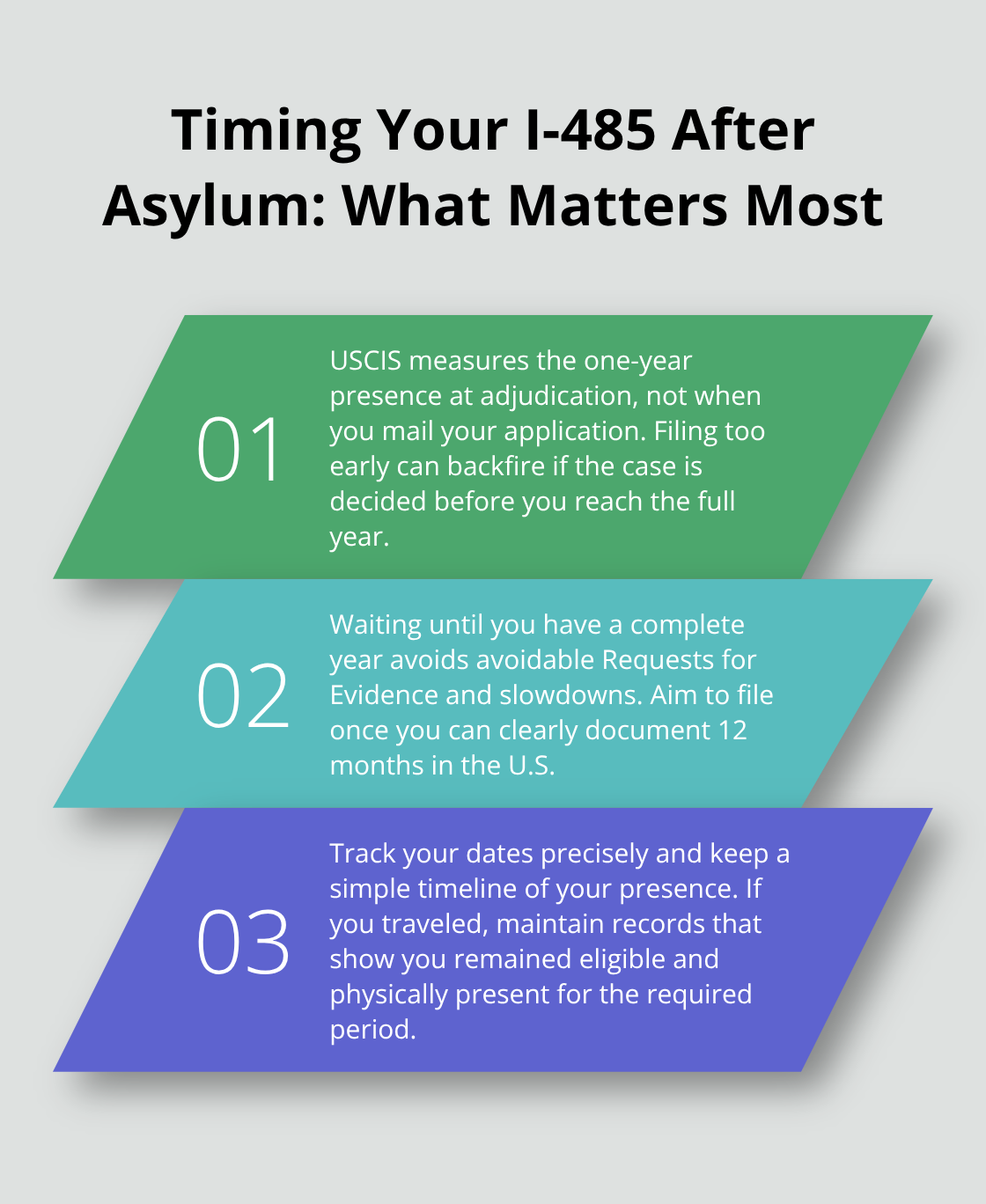
The practical strategy is straightforward: wait until you’ve completed the full year, then file.
Document Your Physical Presence
You must prove continuous residence in the United States during that entire one-year period. Lease agreements, utility bills, pay stubs, or benefit receipts all serve as strong evidence of your presence. Collect these documents as you accumulate them rather than scrambling to gather them later. USCIS had pending asylum applications creating significant backlogs. Filing when you’re clearly eligible avoids triggering requests for evidence that slow down an already sluggish system.
The Documentation You Must Submit
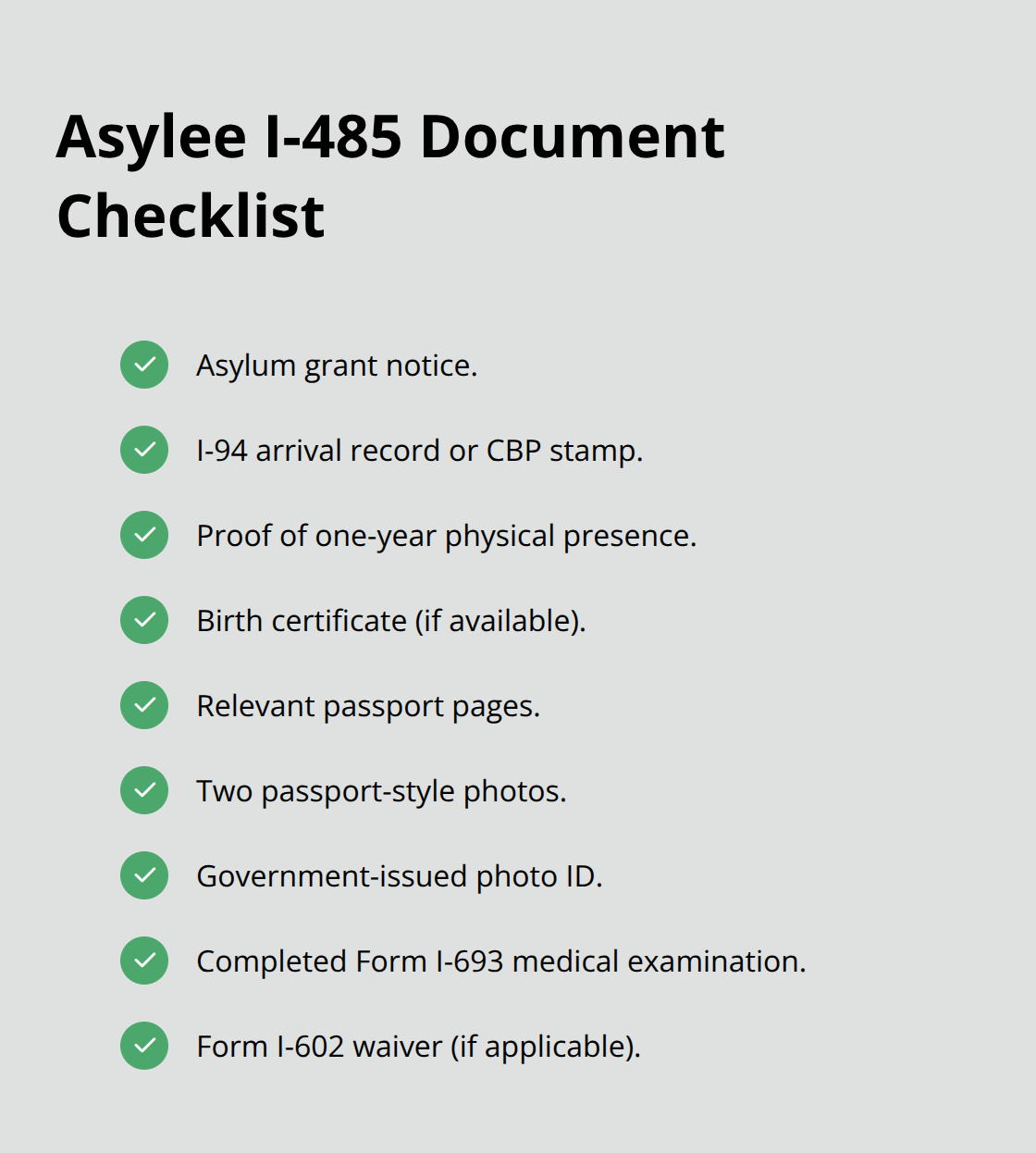
Adjustment requires submitting Form I-485 along with specific documents proving your eligibility. You need your asylum grant notice, your I-94 arrival record or CBP stamp, evidence of one-year physical presence, a birth certificate if available, relevant passport pages, two passport-style photos, government-issued photo ID, and a completed Form I-693 medical examination. If you have any grounds of inadmissibility, you may need Form I-602 to request a waiver. Some inadmissibility grounds do not apply to asylees, but others require formal waiver applications.
Fee Waivers and Filing Locations
The filing fee for Form I-485 is waived for asylees, which removes a significant financial barrier compared to other adjustment applicants. You file at the USCIS lockbox address corresponding to your location, and submitting all required documents at once reduces requests for evidence that delay decisions. After USCIS accepts your application, you’ll receive a notice with your A-Number, which becomes your identifier throughout the process. With your documentation complete and your one-year presence confirmed, you’re ready to move forward with the actual adjustment application itself.
Moving Forward with Your I-485 Application
Filing Form I-485 launches the adjustment process into motion. You submit this form along with your supporting documents to the USCIS lockbox designated for your geographic location. The form requests biographical information, your immigration history, and confirmation that you meet the eligibility requirements we discussed. USCIS processes thousands of these applications monthly, and your complete submission at filing reduces the likelihood of requests for additional evidence that extend timelines. As of January 2025, USCIS had over 1.4 million pending affirmative asylum cases, making it critical that you submit everything required upfront rather than triggering follow-up requests.
Include your asylum approval notice, I-94 arrival record, birth certificate, passport pages, two passport-style photos, government-issued ID, proof of one-year physical presence, and the completed Form I-693 medical examination. The medical exam must be performed by a USCIS-designated civil surgeon. Updated guidance indicates a properly completed I-693 signed after November 1, 2023 no longer expires, which simplifies timing for your submission. File Form G-1145 alongside your I-485 to receive electronic notifications when USCIS accepts your application at the lockbox. This gives you immediate confirmation rather than waiting for paper mail.
When your application arrives, USCIS will issue an initial receipt notice. If you file at a lockbox, you may not receive an A-Number on that first notice-it typically appears on a second notice after full acceptance. Update your address with USCIS using Form AR-11 if you move during processing, and complete this within ten days of relocating to avoid jeopardizing your case.
Schedule Your Medical Examination with a Civil Surgeon
The Form I-693 medical examination is straightforward but non-negotiable. You schedule an appointment with a civil surgeon approved by USCIS, not your personal doctor. The examination checks your vaccinations, medical history, and general health to determine whether you present any grounds of inadmissibility based on medical conditions. The surgeon reviews your vaccination record and may request certain vaccines if your records show gaps.
For asylees adjusting status, the vaccination portion of Form I-693 is required, though only individuals with Class A medical conditions typically need a repeat full examination. The civil surgeon completes the form and seals it in an envelope that you include with your I-485 submission. Do not open this envelope yourself, as USCIS will not accept it if the seal is broken. Schedule this appointment well before you plan to file so the completed form is ready when you submit your application. The cost varies by location but typically ranges from $100 to $300 depending on your area and the surgeon’s fees.
Prepare for Your Adjustment Interview
After USCIS processes your application, you’ll receive a notice for an adjustment interview. This is not a re-litigation of your asylum claim. The officer reviews your eligibility for permanent resident status-whether you’ve genuinely been physically present for one year, whether you remain eligible as a refugee or asylee, and whether any new grounds of inadmissibility have emerged. Come prepared with original documents and copies of everything you filed.
The interview typically lasts 20 to 45 minutes. USCIS officers ask about your residence history, employment, family situation, and any travel outside the United States since your asylum grant. Be honest about any trips, as returning to your home country before naturalization can jeopardize your asylum status and derail your adjustment. If you traveled using a Refugee Travel Document rather than returning home directly, that’s documented and acceptable.
Some cases receive adjudication on paper without an interview, but many require the in-person meeting. Bring your green card application receipt, your passport, your I-94, proof of residence, and employment verification. Having everything organized and readily available demonstrates you’re serious about the process and reduces the chance the officer will request additional materials. The questions you face will focus on verifying the facts you submitted in your I-485 application, so consistency between your written answers and your spoken responses matters significantly.
What Happens When USCIS Requests More Evidence
Missing documents derail more adjustment cases than any other single factor. USCIS does not wait patiently for you to locate a lost lease or reconstruct your address history. When the agency identifies gaps in your submission, they issue a Request for Evidence (RFE) that sets a deadline, typically 84 days, to respond. Missing that deadline results in denial.
Documentation Gaps That Trigger RFEs
The most common documentation gaps involve proof of one-year physical presence and evidence of continuous residence. Utility bills, rental agreements, and employment letters work well, but they must cover the full 12 months without significant gaps. A three-month break in documentation raises questions about where you actually were during that period. You should collect these documents incrementally rather than waiting until you file.
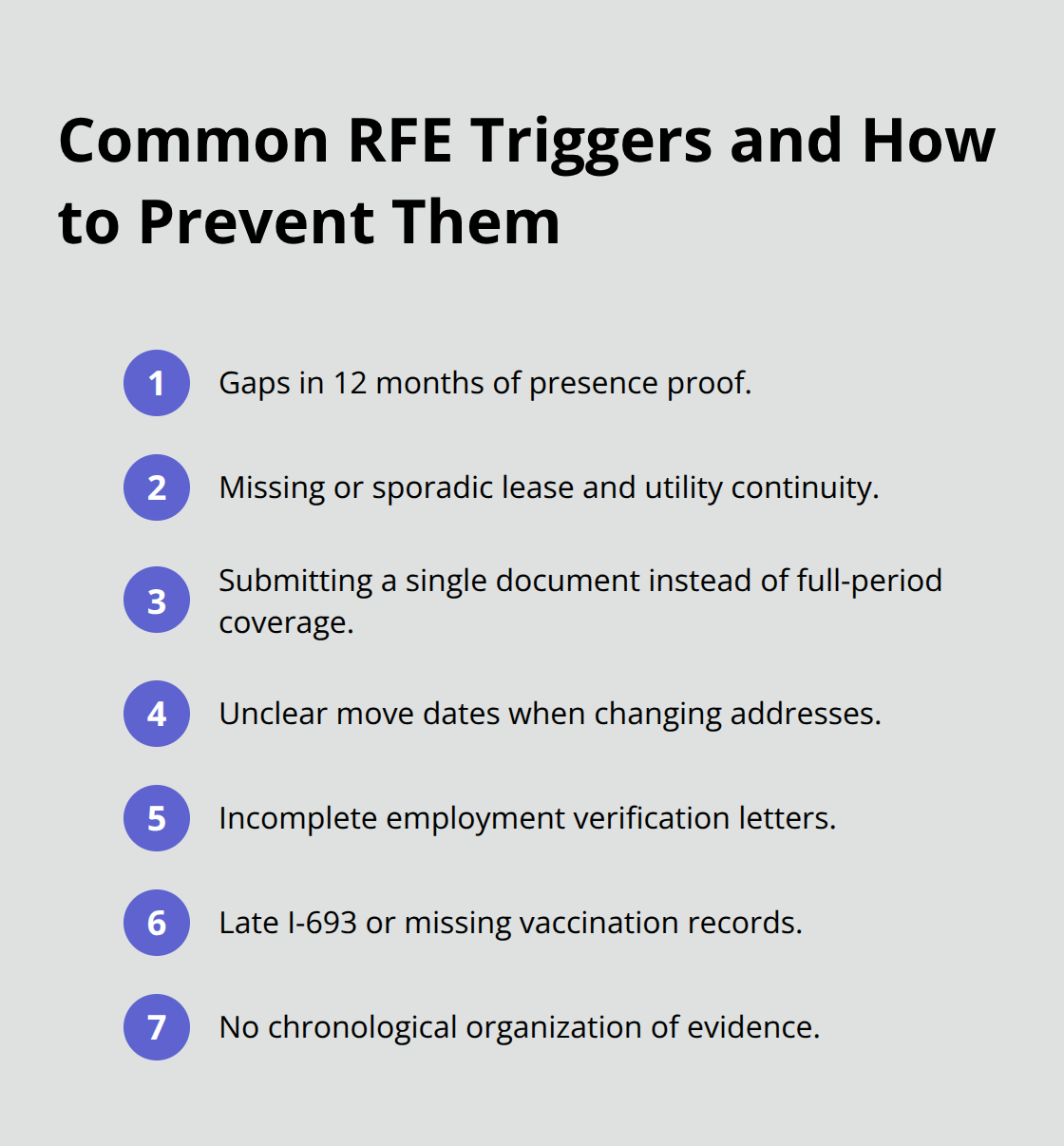
Take photos of your lease on the day you sign it. Request pay stubs monthly instead of scrambling for copies later. If you moved during your one-year period, you must gather documentation from both addresses and show the transition dates. USCIS examines these documents chronologically, so gaps create suspicion that triggers additional inquiries.
Responding to RFE Requests Promptly
When an RFE arrives, you must respond promptly and completely rather than delaying. USCIS receives hundreds of thousands of these requests annually, and officers prioritize cases where applicants respond promptly and completely. You should provide exactly what they request plus relevant supporting materials that address the underlying concern. If they ask for proof of residence and you submit only a single utility bill, you have answered the literal question but failed to address the actual problem they are investigating. You must submit multiple documents covering the full period they are questioning.
Medical Examination Timing and Vaccine Records
Medical examination delays represent another frequent challenge. Asylees sometimes wait weeks for civil surgeon appointments or discover their vaccination records are incomplete. You should schedule your medical exam appointment at least two months before you plan to file your I-485. This buffer allows time to address vaccine gaps if your records show missing immunizations. The civil surgeon will advise which vaccines you need, and those typically take two to four weeks to administer and take effect.
You should not assume your childhood vaccinations are documented with USCIS. You must request your vaccination records from your country of origin if possible, or you can provide letters from previous employers or schools confirming your medical history. If records are genuinely unavailable, the civil surgeon can note this on Form I-693 and explain what vaccines you received during your U.S. residence, which often satisfies USCIS requirements for asylees who have limited access to historical documentation (a common situation for individuals who fled persecution and had limited time to gather records before departure).
Final Thoughts
Your asylum adjustment of status transforms your immigration position from temporary protection into lasting stability. USCIS approves your adjustment, and your green card serves as proof of permanent resident status for employment, travel, and identification purposes. You can sponsor eligible family members including your spouse and unmarried children under 21 to join you in the United States, and you become eligible to apply for U.S. citizenship after four years of permanent resident status (faster than the standard five-year requirement for most immigrants).
The adjustment process involves complexity, but you do not have to navigate it alone. We at Law Offices of Jeffrey A. Thompson specialize in immigration matters and assist clients through every stage of the asylum adjustment process, from paperwork to overcoming legal hurdles. Our team provides compassionate, knowledgeable, and dedicated legal representation tailored to your specific needs.
Contact us to discuss your case and move forward with confidence toward permanent resident status and your American future.
Share this post: