How to Get Work Permit Through Adjustment of Status
February 16, 2026
Getting an adjustment of status work permit opens doors to legal employment while your immigration case moves forward. At Law Offices of Jeffrey A. Thompson, we help clients navigate this process with clarity and confidence.
The path from application to employment authorization doesn’t have to be confusing. This guide walks you through each step, from filing the right forms to avoiding costly mistakes.
What Adjustment of Status Actually Is
The Basics of Adjustment of Status
Adjustment of status lets you become a lawful permanent resident (green card holder) without leaving the United States. You file Form I-485 with USCIS while physically present in the country, rather than going through consular processing abroad. This approach matters because you stay and work while your case moves forward, instead of waiting overseas for months or years. USCIS processes adjustment cases at service centers across the country, and processing times vary significantly by location and workload. The real advantage is that you can apply for work authorization immediately through Form I-765, which means you don’t have to wait for your green card to start earning legally.
Why Adjustment Beats Consular Processing
Consular processing requires you to leave the United States and interview at a U.S. embassy or consulate in your home country. This route typically takes longer and carries real risks-if your case is denied abroad, you may face bars to re-entry or other complications. With adjustment of status, you remain in the U.S. throughout the process, reducing travel costs and eliminating the uncertainty of overseas interviews. You avoid the financial strain and emotional toll of extended separation from family and employment.
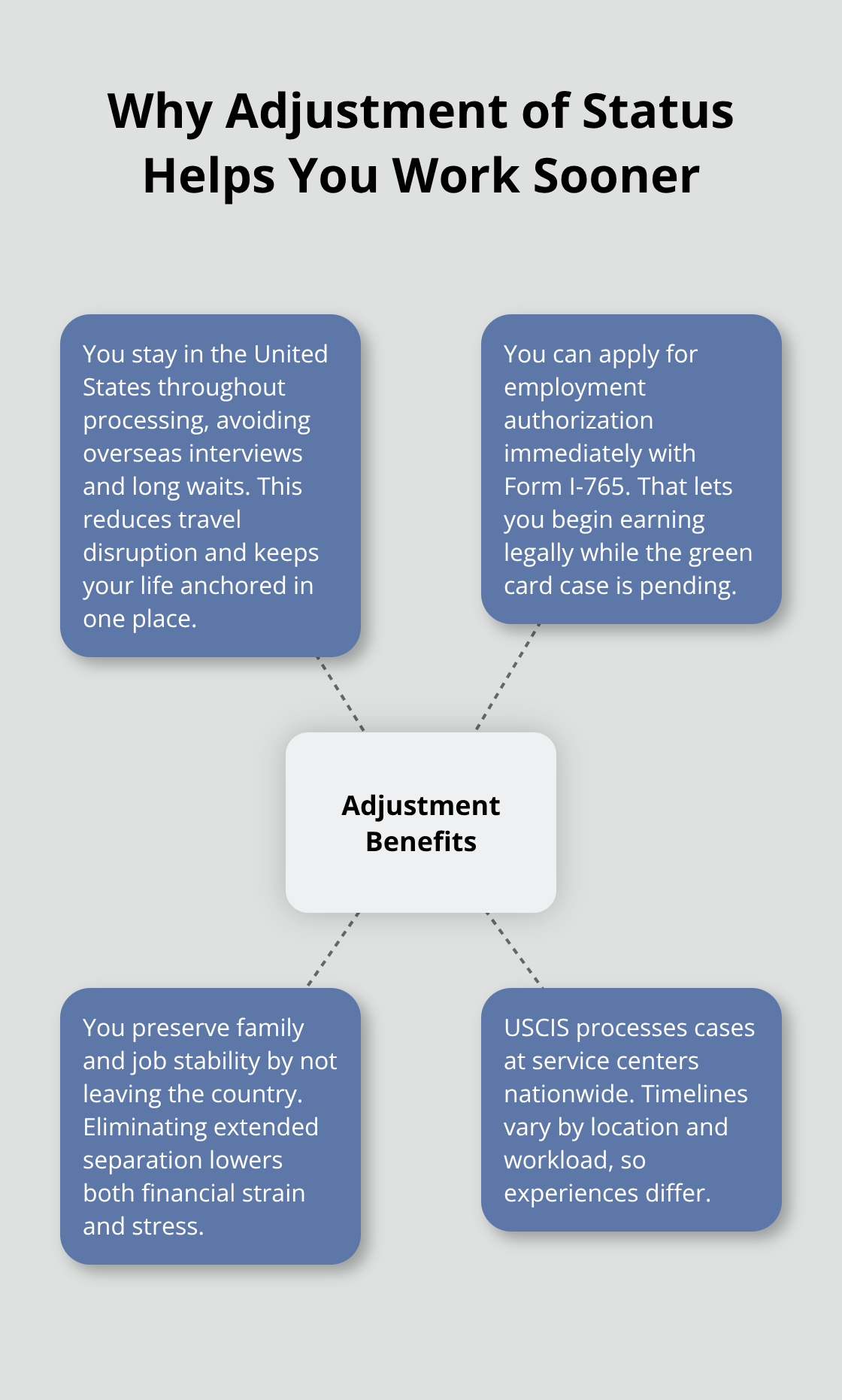
The stability that adjustment provides makes it the preferred path for most applicants who qualify.
Who Qualifies for Adjustment
You qualify for adjustment if you have an immigrant visa number available, maintain valid status (or fall under certain exceptions), and meet health and character requirements. Immediate relatives of U.S. citizens have unlimited visa numbers and can adjust immediately. Employment-based applicants must wait for their priority date to become current according to the Visa Bulletin. Refugees and asylees can adjust after one year of status. Special categories like VAWA self-petitioners, diversity visa winners, and LRIF applicants also qualify. Each category has specific documentation requirements and timelines that affect how quickly you can move forward.
Work Authorization While You Wait
The critical advantage of adjustment of status is that you can apply for work authorization right away. Form I-765 lets you work legally while your green card application is pending, which means you build your career and financial stability without interruption. You don’t have to choose between waiting for permanent residency and earning a living-you can do both at the same time. This flexibility transforms the adjustment process from a period of uncertainty into a time when you can move your life forward.
Understanding how adjustment of status works sets the foundation for the next step: actually filing for your work permit and knowing what to expect along the way.
Getting Your Work Permit While Adjusting Status
File Form I-765 Concurrently With Your Adjustment Application
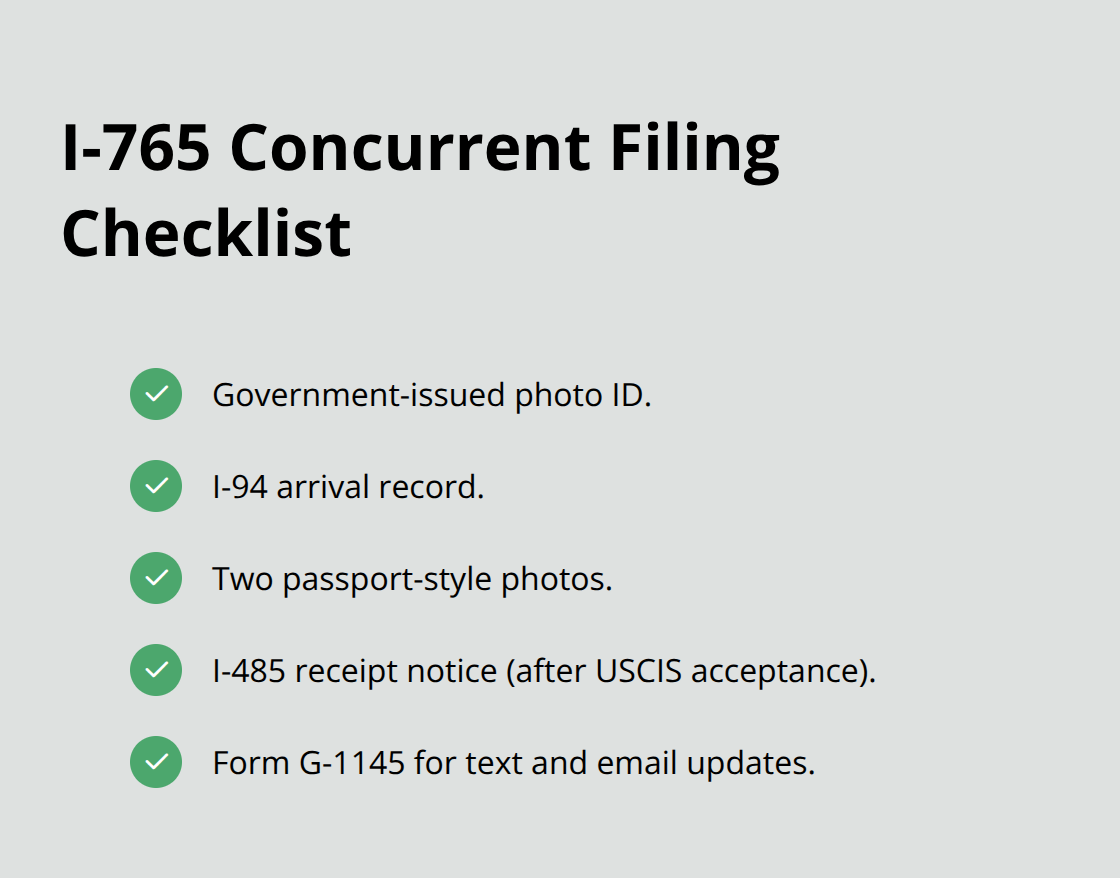
Filing Form I-765 alongside Form I-485 accelerates your path to work authorization. USCIS accepts concurrent filing, and this approach saves you months-you can start working far earlier than if you waited for your adjustment application to receive initial review. The form requires straightforward documentation: your government-issued photo ID, your I-94 arrival record, two passport-style photos, and your I-485 receipt notice once USCIS accepts your case. Attach Form G-1145 to receive email and text notifications when USCIS accepts your application, eliminating uncertainty about whether your forms arrived safely.
Understand the Filing Fee and Payment Requirements
Adjustment-of-status applicants pay a reduced I-765 fee of $260 as of 2026, significantly lower than the standard fee. However, certain categories qualify for complete fee exemption, including asylees and refugees, so verify your specific eligibility category before submitting payment. Pay your filing fee through Pay.gov using a credit or debit card, as USCIS no longer accepts paper checks or money orders for most filings. This online payment method produces an instant receipt, protecting you if questions ever arise about whether payment was received.
Track Your Processing Timeline and Card Arrival
Most adjustment-of-status EADs receive approval within two to three months after you file Form I-765 with your I-485. Once approved, USCIS produces your card within approximately two weeks and mails it via USPS Priority Mail, which you can track through Case Status Online. The entire process from approval to receiving your card typically takes about four weeks. Do not attempt to work while waiting-you have no legal work authorization until the card arrives and you physically hold it.
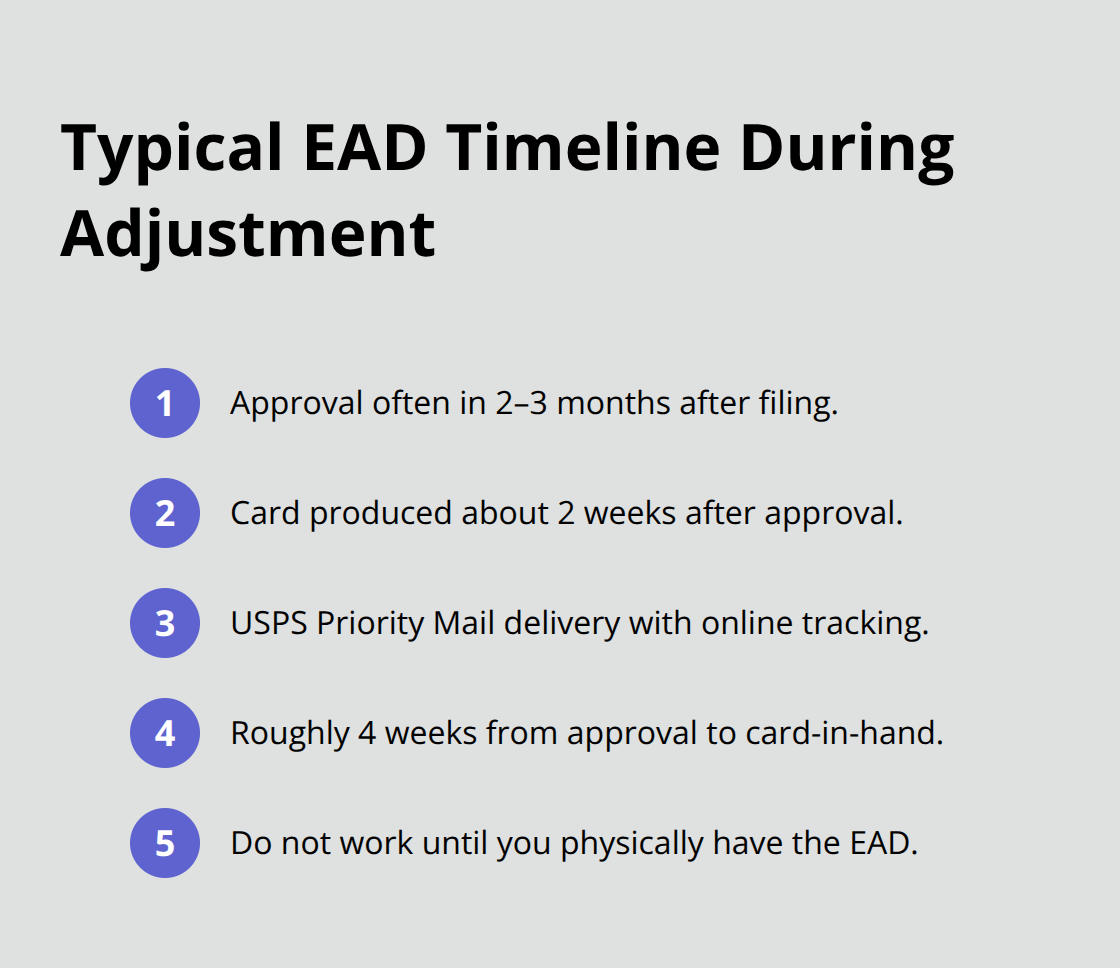
Some applicants mistakenly believe that a pending I-765 allows them to work, creating serious legal and employment risks.
Maximize Your Waiting Period and Prepare for Employment
Use the time before your EAD arrives strategically: research potential employers in your field, update your resume, and strengthen your professional network. When your EAD arrives, it displays your employment authorization category and an expiration date, typically one or two years from issuance. Your work permit allows you to work for any employer in any lawful job with no restrictions tied to your immigration status-this freedom represents one of the genuine advantages of adjustment of status. If you move before your EAD arrives, notify USCIS immediately and update your address with USPS to prevent your card from being lost in the mail.
Handle Card Delays and Replacements Promptly
If your card does not arrive within the expected timeframe, contact USCIS through their online case tracker or request a replacement. If the delay resulted from USCIS or postal service error, you typically won’t owe a new filing fee. Address delays immediately rather than waiting, as gaps in work authorization can disrupt your employment and financial stability. Once you hold your valid EAD, you transition from preparation to action-the next step involves navigating common pitfalls that derail many adjustment applications before they reach approval.
Common Mistakes That Derail Your Adjustment Application
Form Errors and Submission Problems
Incomplete or inaccurate form submissions represent the fastest way to delay or deny your adjustment case. USCIS rejects applications with missing signatures, blank required fields, or inconsistent information across forms, forcing you to resubmit and losing months in the process. Form I-485 demands precision-every date, address, and yes-or-no answer must match your supporting documents exactly. If you list employment history on your I-485 but your I-765 shows different dates, USCIS will flag the discrepancy and request clarification, adding 30 to 60 days to your timeline.
The Form I-693 medical examination report causes particular problems when applicants fail to submit it with their initial I-485 package. USCIS policy requires the I-693 to accompany your adjustment application, and submitting it separately triggers an automatic rejection. Many applicants waste weeks resubmitting after learning this requirement too late.
Form I-864 (Affidavit of Support) must meet strict income thresholds-your sponsor’s household income must reach at least 125 percent of the federal poverty guideline for your household size, and submitting insufficient documentation means USCIS will deny your case outright. Translation errors create another category of rejections that applicants overlook. Any document not in English requires a certified English translation with the translator’s certification of accuracy. Submitting an uncertified translation or relying on a family member’s translation gives USCIS grounds to reject your entire application.
Missing Documentation and Criminal History Disclosures
Missing documentation and evidence represents the second major failure point, particularly with criminal history disclosures and vaccination records. USCIS requires certified police and court records for every arrest or criminal charge regardless of how the case ended-even dismissed charges, acquittals, or sealed records must be disclosed and documented. Applicants who omit arrests believe they can hide them because charges were dropped, but USCIS conducts independent background checks and will discover the omission, resulting in fraud findings that destroy your case permanently.
Form I-693 must include proof that you received required vaccinations against measles, polio, tetanus, and other communicable diseases according to CDC guidelines. If your medical examination shows vaccination gaps, you must obtain the missing vaccinations before USCIS will approve your adjustment.
Visa Number Availability and Priority Dates
Failing to meet eligibility requirements often stems from misunderstanding visa number availability and priority dates. Employment-based applicants frequently file I-485 before their priority date becomes current according to the Visa Bulletin, believing they can start the process early. USCIS will reject premature filings, and you cannot simply resubmit when your date becomes current-you must file an entirely new application, wasting filing fees and processing time.
Immediate relatives of U.S. citizens have unlimited visa numbers and can adjust immediately, but all other categories require a current priority date listed in the monthly Visa Bulletin. Verifying your exact eligibility category and timeline before you file a single form prevents these costly mistakes that force reapplication and delay your work authorization by months.
Final Thoughts
The adjustment of status work permit process demands accuracy and attention to detail at every stage. File Form I-765 with your I-485 application, verify your eligibility category, pay the correct fee, and submit complete documentation without errors. USCIS Case Status Online tracks your case progress, and you can prepare for employment while waiting for your card to arrive in the mail.
Professional legal guidance protects you from the mistakes that derail applications: incomplete forms, missing criminal history disclosures, vaccination gaps, and premature filings before your priority date becomes current. These errors cost months and filing fees that proper preparation could have prevented. The adjustment of status work permit involves complex immigration law and strict procedural requirements that change regularly, making expert assistance invaluable.
We at Law Offices of Jeffrey A. Thompson help clients navigate the adjustment of status process from start to finish. Contact us today to discuss your adjustment application and work permit strategy with someone who understands the real complexities you face.
Share this post: