
How to Adjust Status from K1 Visa to Permanent Resident
January 26, 2026
Getting married to a U.S. citizen on a K1 visa opens the door to permanent residency, but the adjustment of status process involves multiple steps and strict deadlines. We at Law Offices of Jeffrey A. Thompson help couples navigate this complex path successfully.
The good news is that with proper preparation and documentation, most K1 visa holders complete their adjustment within 8 to 12 months. This guide walks you through each requirement so you can avoid delays and rejections.
What Happens When You Marry on a K1 Visa
A K1 visa is a fiancé visa that allows a U.S. citizen to bring their foreign partner into the country for the purpose of marriage. The critical requirement is that you must marry within 90 days of entering the United States. This 90-day window is not flexible, and missing it makes you ineligible to adjust status and can force you to leave the country. Once you marry within this timeframe, you become classified as an immediate relative, which means no visa bulletin delays apply to your case. Immediate relatives have unlimited visa availability, so you can file your adjustment application immediately after marriage without waiting for visa numbers to become available like employment-based immigrants do.
The 90-Day Marriage Requirement is Non-Negotiable
Your K1 visa approval notice shows your port of entry and admission date. Count 90 days from that date on your arrival stamp or I-94 record. If you marry on day 91, USCIS will deny your adjustment application.
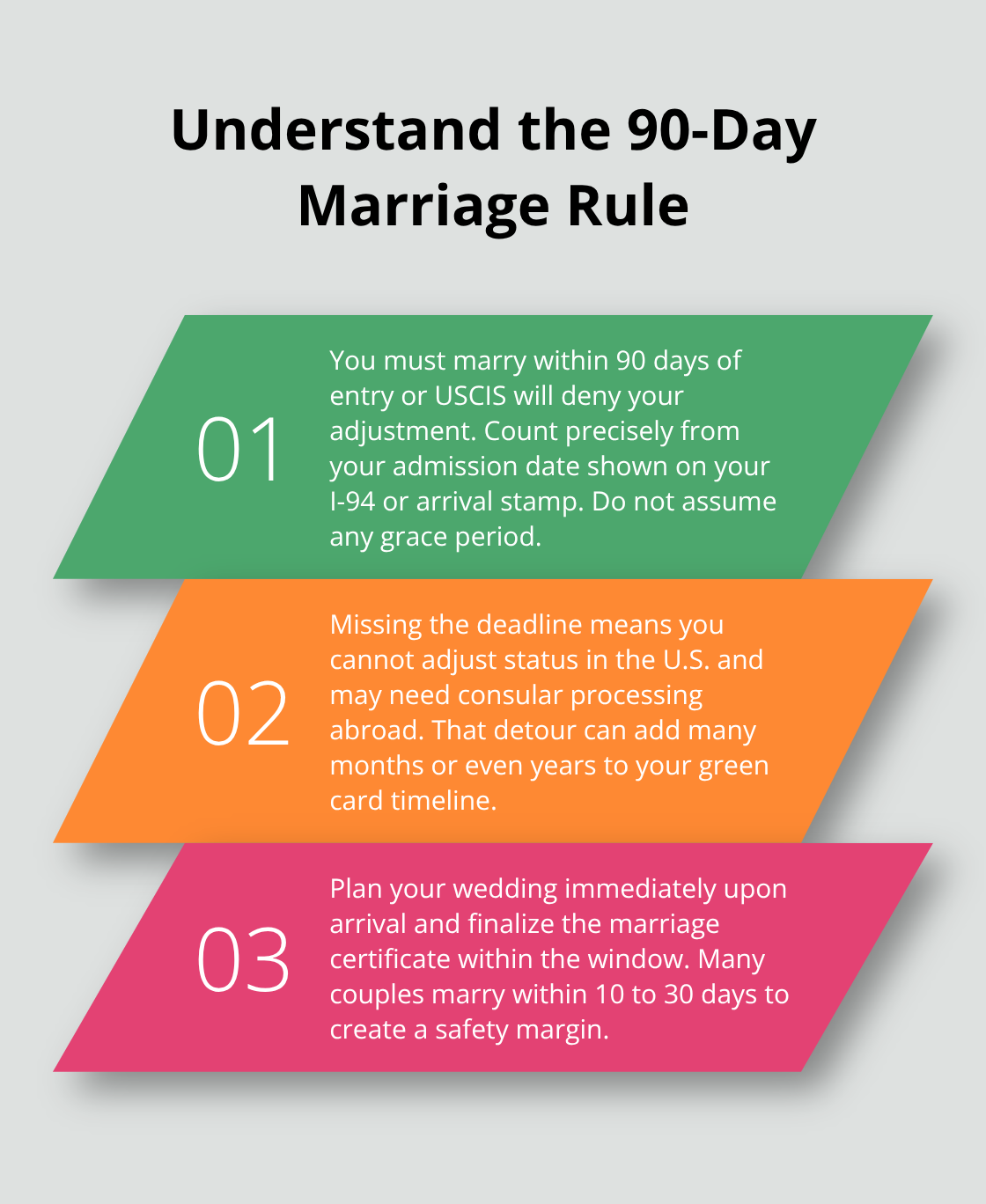
Couples who miss this deadline due to document delays or scheduling issues with their ceremony face severe consequences. You cannot adjust status in the United States if you miss this window. Instead, you would need to depart and pursue permanent residency through consular processing abroad, adding months or years to the process. Plan your wedding immediately upon arrival and complete the marriage certificate within those 90 days. Many couples marry within 10 to 30 days of arrival to build in a safety margin.
What Adjustment of Status Actually Means
Adjustment of status is the legal process of applying for a green card while already in the United States. You file Form I-485 along with supporting documents to request that USCIS change your status from K1 nonimmigrant to permanent resident. This happens entirely within the U.S., so you do not need to go a consulate or leave the country. Your case moves through biometrics appointments, background checks, and possibly an interview before a final decision. If your marriage is less than two years old when your green card is approved, you receive conditional permanent residence for two years and must file Form I-751 later to remove those conditions. After that removal, you obtain a standard 10-year green card.
Immediate Relative Status and Visa Availability
When you marry a U.S. citizen, your immigration category changes to immediate relative. This status eliminates the visa bulletin delays that affect employment-based immigrants and other family-sponsored categories. Visa numbers for immediate relatives are always available, meaning USCIS can process your I-485 without waiting periods. This advantage significantly speeds up your timeline and allows you to file your adjustment application as soon as you submit your marriage certificate and other required documents. The immediate relative classification is one of the most significant benefits of marrying a U.S. citizen on a K1 visa.
Conditional vs. Permanent Residence
The length of your marriage at the time of green card approval determines whether you receive conditional or permanent residence. If your marriage is less than two years old when USCIS approves your I-485, you receive a conditional green card valid for two years. You must then file Form I-751 within 90 days before the card expires to remove the conditions and obtain permanent residence. If your marriage is two years or older at approval, you receive a permanent 10-year green card immediately. Either way, your adjustment application moves forward with the same process and documentation requirements.
Moving Forward with Your Application
Understanding these foundational rules positions you to file your adjustment application correctly and on schedule. The next phase involves gathering the specific documents and forms that USCIS requires to process your case.
What Documents USCIS Requires for Your K1 Adjustment
Gather Your Core Identity and Arrival Documents
Start with your marriage certificate-obtain an official certified copy from the vital records office in the state where you married, not a photocopy from your wedding ceremony. USCIS also requires your birth certificate, passport pages showing your biographical information and all visa stamps, and your arrival record (I-94 or CBP admission stamp). Your U.S. citizen spouse must submit a copy of their birth certificate or passport as well. Two passport-style photos measuring exactly 2 by 2 inches complete this section.
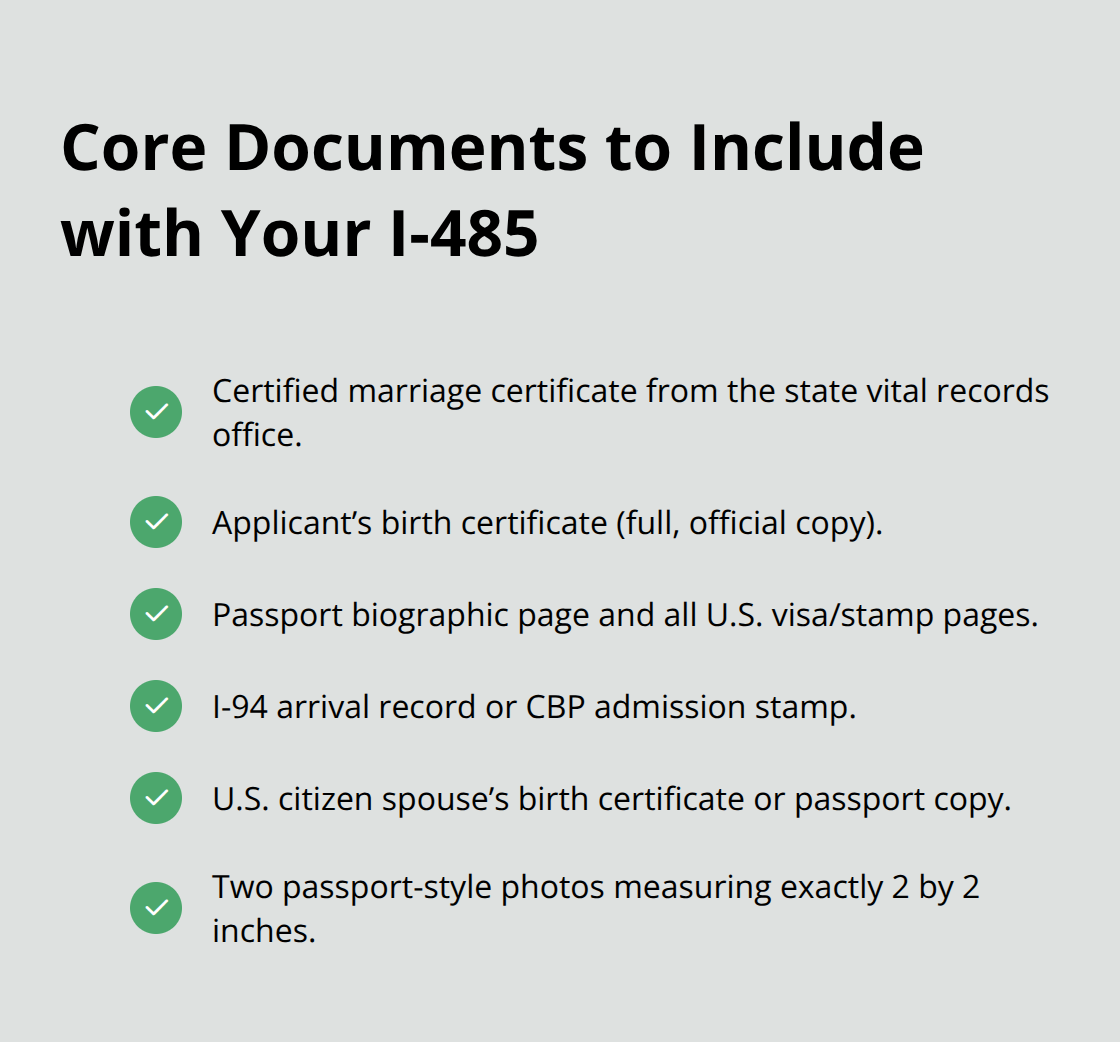
Submitting these items upfront prevents routing delays and rejections caused by missing foundational documents.
Prove Your Genuine Relationship
USCIS scrutinizes relationship evidence to confirm your marriage is legitimate and not fraudulent. Provide joint bank account statements, shared lease or mortgage documents, and photographs of you together spanning your time together. Include any children’s birth certificates if applicable. These documents demonstrate commingled finances and shared living arrangements over time. Many couples overlook this step and later face requests for evidence that extend their processing timeline by several months.
Complete Your Medical Examination
The medical examination through Form I-693 must be performed by a USCIS-approved civil surgeon in your area. According to USCIS policy, Form I-693 must be filed concurrently with Form I-485. If you already completed a medical exam during consular processing for your K1 visa, you do not need to repeat it. However, you must still provide evidence of required vaccinations with your I-485 package.
Submit Financial Support Documentation
Your U.S. citizen spouse must complete Form I-864 Affidavit of Support, demonstrating they earn enough to sponsor you financially. If your spouse does not meet the income threshold, they can add a co-sponsor with their own income and assets. Include recent tax returns, W-2 forms, and pay stubs from both your spouse and any co-sponsor to prove financial capacity.
Handle Criminal Records and File Your Application
Criminal and police records must be submitted if you have any prior convictions or arrests, obtained from the courts or police departments where the incidents occurred. Filing fees for Form I-485 run approximately $1,440, though certain applicants may qualify for fee waivers based on income. Submit your complete package to the correct USCIS lockbox address for your state. Once you file, USCIS schedules your biometrics appointment and begins its background investigation process.
Submitting Your I-485 and Moving Through USCIS Processing
Filing Form I-485 marks the official start of your adjustment process, and submitting this form correctly determines whether USCIS accepts your case or returns it for corrections. USCIS processes I-485 applications at lockbox facilities, not at local field offices, so you must mail your complete package to the correct address for your state. The filing fee is approximately $1,440 as of early 2026, though you can request a fee waiver if your household income falls below 200 percent of the federal poverty line. Include Form G-1450 with your payment information if you pay by credit or debit card, or Form G-1650 if you pay from a U.S. bank account. Many couples file Form I-765 at the same time to request work authorization while their case is pending, which allows you to start employment immediately rather than waiting months for approval. Attach Form G-1145 to your package so USCIS sends you email and text notifications when they receive your application at the lockbox.
Receiving Your Receipt Number and Scheduling Biometrics
Within 7 to 14 days of USCIS receiving your I-485, you will receive a notice of action showing your case was accepted and assigned a receipt number. This receipt number appears on Form I-797 and becomes your identifier throughout the entire process. USCIS will schedule your biometrics appointment within 4 to 8 weeks, sending you a separate notice with the date, time, and location of your local Application Support Center.
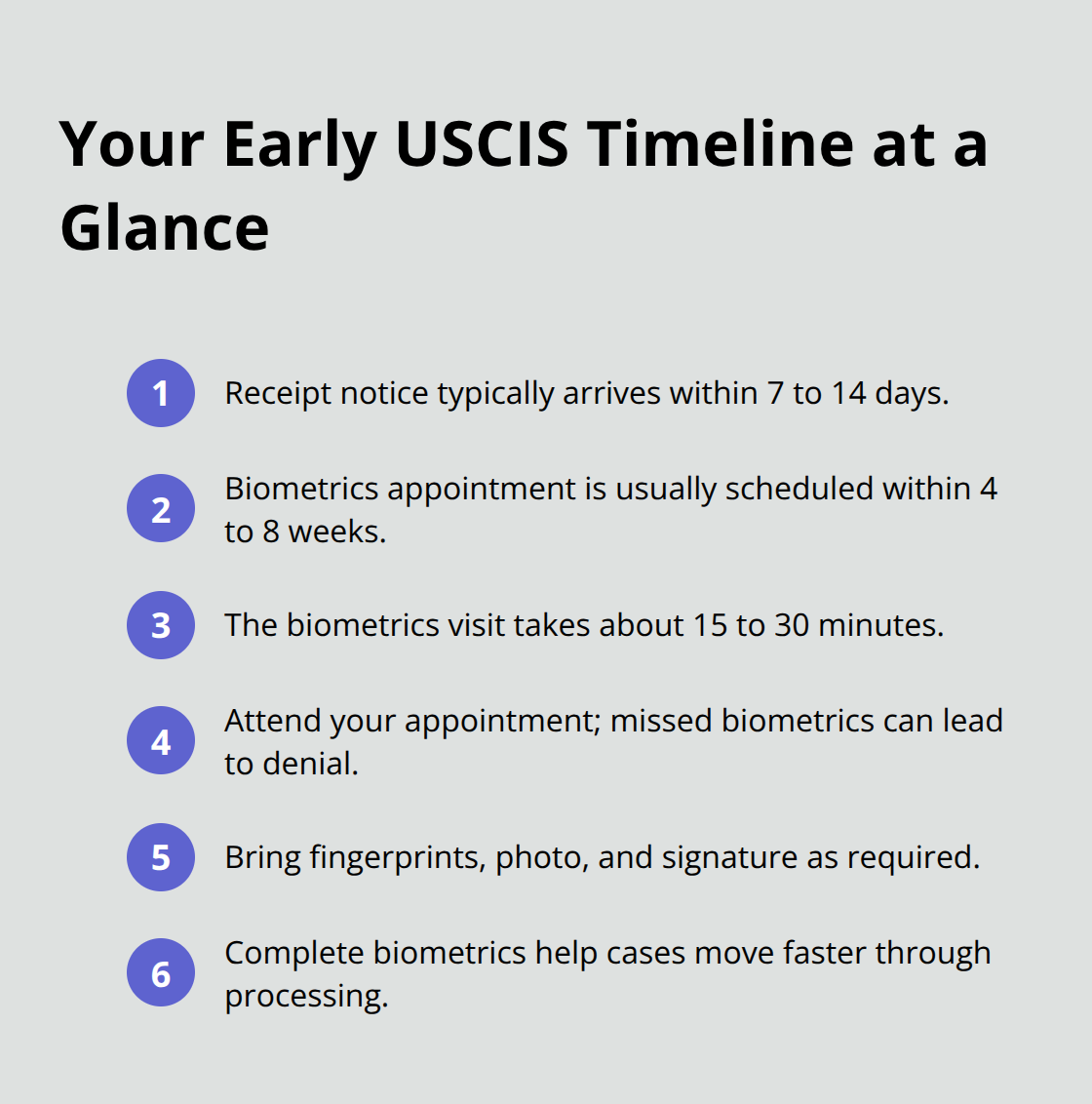
You must attend this appointment without fail because failure to appear can result in case denial. At biometrics, you provide fingerprints, a photograph, and your signature, which USCIS uses for background checks and identity verification. The entire appointment typically takes 15 to 30 minutes. According to USCIS data, cases with complete biometrics on file process significantly faster than those with missing appointments, so treat this deadline as non-negotiable.
Preparing for Your USCIS Interview
USCIS may schedule you for an interview, though many K1 adjustment cases are approved without one if your documentation is complete and your background check clears. If you receive an interview notice, the USCIS officer will ask you standard questions about your relationship, your marriage ceremony details, your spouse’s employment and income, and how you met. The officer may ask when you moved in together, whether you have joint accounts, and specifics about your wedding. You must bring original documents to your interview including your passport, marriage certificate, birth certificate, and any other documents you submitted with your I-485. Do not bring copies; USCIS wants to see originals. The interview typically lasts 15 to 45 minutes and focuses on confirming your marriage is genuine and that you meet all eligibility requirements. Most couples pass interviews without issue when they have prepared their relationship documentation thoroughly and answer questions honestly and directly.
Final Thoughts
Your adjustment of status from K1 visa to permanent resident succeeds when you meet the 90-day marriage deadline, submit complete documentation, and attend all USCIS appointments without fail. Missing the marriage window eliminates your ability to adjust status in the United States, and incomplete relationship evidence or missing original documents at your interview will delay your case by months. The adjustment of status K1 process moves fastest when you prepare thoroughly upfront and follow each requirement with precision.
Common mistakes that derail applications include submitting copies instead of original documents, failing to obtain certified marriage certificates, and underestimating the importance of Form I-864 financial documentation with proper tax returns and pay stubs. Many couples also neglect to provide joint bank account statements and shared residence proof that demonstrate a genuine relationship. Once USCIS approves your I-485, you receive your green card within weeks, though conditional cards require you to file Form I-751 within 90 days before expiration if your marriage is less than two years old.
We at Law Offices of Jeffrey A. Thompson help couples navigate this complex adjustment process and avoid costly mistakes that extend timelines. If you need expert guidance on your adjustment application or have questions about your specific situation, contact our immigration law team to discuss your case.
Share this post: