How to Adjust Status from Humanitarian Parole to Permanent
January 23, 2026
Humanitarian parole gives you temporary protection in the United States, but it’s not a permanent solution. At Law Offices of Jeffrey A. Thompson, we help clients understand that humanitarian parole adjustment of status is possible-and it’s often the right next step.
The path from temporary parole to permanent residency involves specific requirements and careful paperwork. This guide walks you through exactly what you need to do.
What Humanitarian Parole Actually Means for Your Status
Humanitarian parole is a temporary entry mechanism under the Immigration and Nationality Act that allows certain individuals to enter the United States outside of normal visa processing. The Department of Homeland Security grants parole based on urgent humanitarian reasons or significant public benefit, which means the decision hinges on whether your situation meets a specific threshold. Urgent humanitarian reasons typically include time-sensitive medical needs, such as critical treatment unavailable in your home country, or the need to care for a dying family member. Significant public benefit might cover participation in legal proceedings or other matters that serve the public interest. What matters most is that parole is not an admission to the United States-you exist technically outside the normal immigration system, which creates both opportunities and constraints as you move toward permanent status. The parole grant comes with an I-94 document showing your arrival and departure dates, and this document becomes essential evidence when you later file for adjustment of status.
Duration and Work Authorization During Parole
Humanitarian parole typically lasts no more than one year, though USCIS can extend it if circumstances warrant a longer period. Your parole ends in three ways: when the authorized period expires, when you depart the United States, or when you obtain a different immigration status like asylum or a visa.
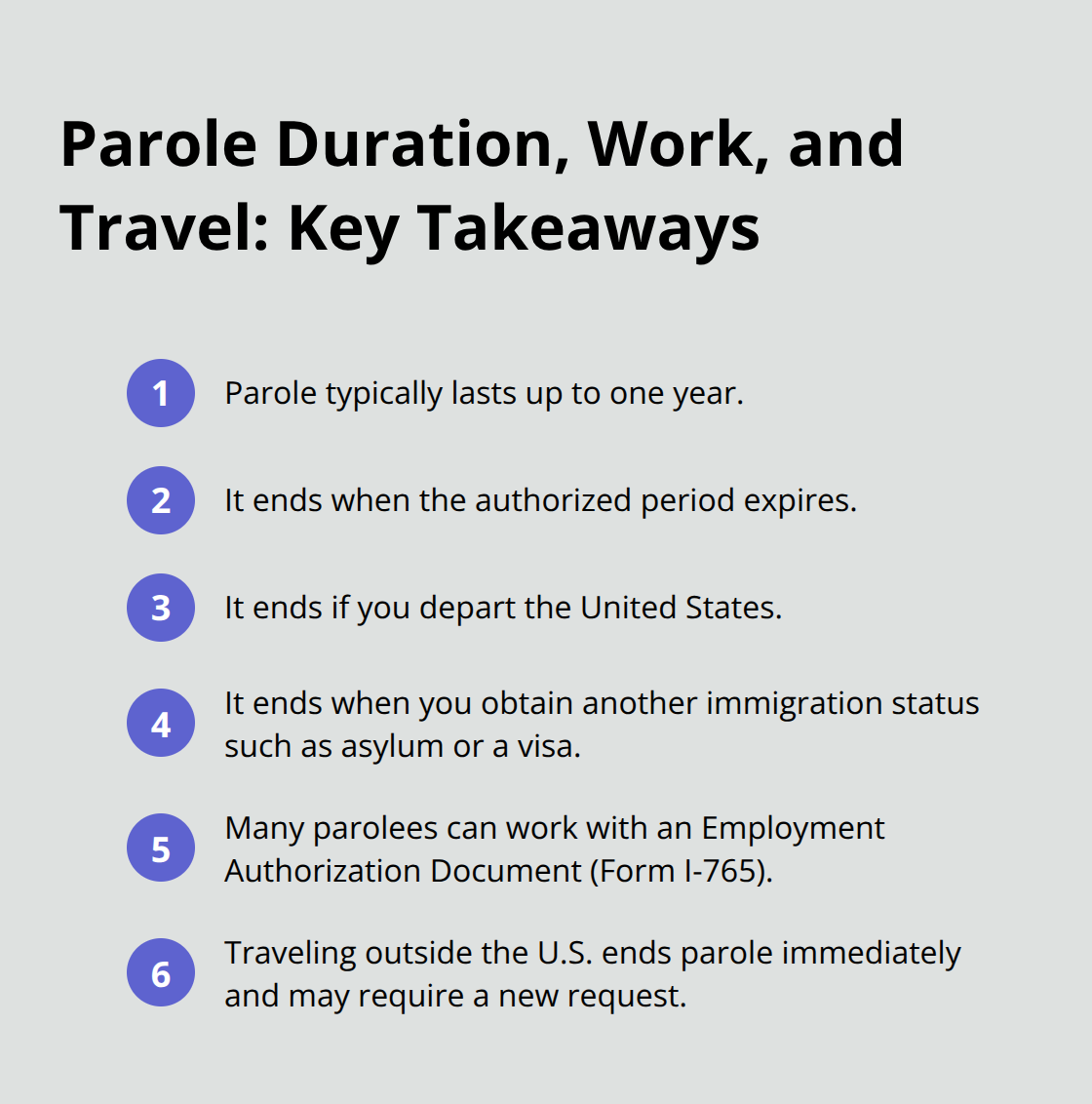
One practical advantage is that parole often includes temporary employment authorization, meaning you can apply for an Employment Authorization Document using Form I-765 and work legally while your status is temporary. This is significant because many parolees use this work period to establish employment history and income records that later support their adjustment applications. If you need to travel outside the United States while on parole, your parole ends immediately upon departure, and you would need to file a new parole request from outside the country or pursue a different status. This travel restriction is strict, so if you have family obligations abroad, you must plan carefully before your parole period starts.
Why Parole Is Not Permanent and What That Means
Parole is explicitly a temporary measure, not a substitute for visa processing or refugee resettlement. This distinction matters because it means you cannot stay on parole indefinitely-you must transition to another status or you’ll eventually have no legal standing. The advantage is that parole creates a pathway to adjustment of status, allowing you to file Form I-485 from within the United States without returning home for consular processing. However, you must act during your parole period because once it expires, your legal status ends unless you’ve already obtained approval for a different status. Treat your parole period as a window of opportunity rather than a long-term solution. Many clients make the mistake of waiting to file their adjustment application, thinking they have unlimited time, only to face complications when their parole nears expiration.
Taking Action Before Your Parole Expires
The sooner you gather your financial documentation, medical records, and other required evidence, the sooner you can file your I-485 and begin the formal path to permanent residency. Your parole period is not indefinite, and USCIS processes adjustment applications at varying speeds depending on your category and current case volume. Starting your preparation now (rather than waiting until your parole is about to expire) gives you a significant advantage. The next section covers the specific eligibility requirements you must meet to qualify for adjustment of status, including income thresholds, medical examinations, and background check considerations. Understanding these requirements before you file helps you avoid delays and strengthens your application from the start.
What Qualifies You to Adjust Status
Adjustment of status from humanitarian parole requires meeting three distinct eligibility categories: financial support, medical admissibility, and background clearance. These are not suggestions or guidelines-USCIS treats them as hard requirements, and failing to meet even one can result in denial. The good news is that none of these requirements are hidden or subjective; you can assess your eligibility right now by comparing your situation against specific standards.
Financial Support Requirements
Financial support is perhaps the most concrete threshold. You must demonstrate that someone (either you or a sponsor) has sufficient income to support you at or above the federal poverty line. According to the Health and Human Services Federal Poverty Guidelines, a single person in 2024 needs roughly $15,060 in annual income; a family of four needs approximately $31,200.
If your sponsor is a U.S. citizen or lawful permanent resident, USCIS views their income more favorably than if they hold another status. Your sponsor files Form I-134, Declaration of Financial Support, and must submit recent pay stubs (typically the last 30 days), tax returns from the past two years, and an employer letter confirming current employment and salary.
If one sponsor’s income falls short, you can use multiple supporters, but each must file a separate I-134 form. Many parolees underestimate how strictly USCIS reviews these documents; if your tax returns show self-employment income, prepare for detailed scrutiny and requests for business records.
Medical Examination Standards
Medical admissibility is straightforward in theory but requires precision in execution. You must complete Form I-693, Report of Medical Exam and Vaccination Record, conducted by a USCIS-designated civil surgeon. As of April 2024, a properly completed I-693 signed on or after November 1, 2023 does not expire, meaning you can submit a medical exam completed months before your I-485 filing without needing an updated exam.
The civil surgeon screens for certain communicable diseases and conditions that would normally render you inadmissible, but refugee and humanitarian parole applicants benefit from modified grounds of inadmissibility, and waivers exist for many medical conditions. Vaccination records must be current; if you lack documentation of childhood vaccinations from your home country, the civil surgeon can administer them during your exam.
The examination itself costs between $300 and $800 depending on your location and whether additional testing is required. Schedule your appointment at least two months before you plan to file your I-485, since civil surgeons sometimes have scheduling delays and USCIS may request that you obtain the exam if it’s missing from your initial filing.
Background Checks and Criminal History
Background clearance is the category where small mistakes become major problems. USCIS will conduct name-based and biometric checks, and any criminal history-even minor arrests that didn’t result in conviction-must be disclosed on your I-485. Provide certified copies of all court records for any arrest or conviction, no matter how minor.
Traffic violations typically do not appear on your I-485 unless they involved alcohol or drugs. Crimes of moral turpitude, controlled substance violations, and certain aggravated felonies create bars to adjustment that may be impossible to overcome. If you have been arrested but charges were dismissed or you were acquitted, still provide documentation proving the outcome; omitting this information and having USCIS discover it later is far more damaging than disclosing it upfront.
Consult with an immigration attorney if you have any criminal history before filing, because some convictions that seem minor in state court carry severe consequences in immigration law. For example, a simple assault conviction in some states qualifies as a crime of moral turpitude under federal immigration standards, creating potential deportability even after adjustment approval. USCIS runs checks against the National Crime Information Center database and state criminal records; if something exists in the system, they will find it.
Honesty and completeness on your I-485 is not optional-it is the foundation of a successful adjustment application. Once you confirm that you meet these three eligibility categories, you can move forward with confidence to the next phase: preparing and filing your Form I-485 with all required documentation.
Filing Your I-485 and Moving Forward
Preparing Your Complete I-485 Package
Form I-485 initiates your adjustment of status from humanitarian parole to permanent residency. You must file this form only after confirming that you meet all three eligibility categories and have gathered your required documentation. USCIS processes I-485 applications from parolees at varying speeds depending on case volume and your specific category, but processing times remain slow in 2026, with some cases taking months or years.
The most effective strategy involves submitting all required initial evidence with your I-485 rather than waiting for USCIS to request documents later. Incomplete filings trigger rejections or requests for evidence that delay your case by months, so this approach reduces delays and accelerates your timeline significantly. Your I-485 package must include your completed Form I-485, two passport-style photos, a copy of your government-issued photo identification, your birth certificate, the passport page showing your parole stamp, a copy of your Form I-94 arrival document, your completed Form I-693 medical examination (signed on or after November 1, 2023), and certified copies of any court records if you have been arrested. Include translations of any foreign-language documents as well.
Submitting Your Application Correctly
Determine your correct filing address using the USCIS Direct Filing Addresses page because submitting to the wrong location causes delays. If you file through a USCIS lockbox location, understand that you may not receive an A-number on your initial receipt notice; USCIS issues the A-number in a subsequent notice after acceptance.
Payment must be made electronically using Form G-1450 for credit or debit card payment or Form G-1650 for ACH bank transfers; personal checks are generally not accepted. If you cannot afford the filing fee, file Form I-912 requesting a fee waiver. Attach Form G-1145 to enable e-notifications so you receive email or text updates about your case status. If an attorney represents you, your representative must submit Form G-28 Notice of Entry or Appearance with your I-485.
Biometrics and Interview Procedures
After you file, USCIS will schedule you for a biometrics appointment where they collect your fingerprints, photograph, and signature for background checks. This appointment typically occurs within two to four months of filing, though current delays mean some applicants wait longer. Attend this appointment on the scheduled date; missing it without rescheduling can result in case denial.
Once USCIS completes biometrics processing, you may receive an interview notice or USCIS may issue an approval decision without an interview depending on your case. If you receive an interview notice, bring original copies of all documents you submitted with your I-485, your valid passport, your travel documents, and your I-94.
Responding to USCIS Requests and Maintaining Your Address
USCIS may request additional evidence during processing; if they issue a request for evidence, submit the required materials by the stated deadline without exception. If you move during the adjustment process, notify USCIS within ten days using Form AR-11, preferably filing online. You can monitor your case status online using your receipt number and A-number at no cost through USCIS accounts.
If USCIS denies your I-485, you have options: file a motion to reconsider or reopen using Form I-290B within thirty-three days, or file a new Form I-485 with new evidence. There is no limit to how many times you can file Form I-131 if your parole expires before a decision, allowing you to request additional parole periods while your I-485 remains pending.
What Happens After Approval
Upon approval, you will receive a notice followed by delivery of your actual Green Card, which officially establishes your lawful permanent resident status.
Final Thoughts
Adjusting from humanitarian parole to permanent residency requires you to act strategically before your parole period expires. You must submit all required documentation with your initial I-485 filing to avoid requests for evidence that extend your timeline significantly, and you must disclose any criminal history with certified court records because omitting this information creates far worse consequences when USCIS discovers it later. Processing delays in 2026 mean your case could take months or longer, so starting your humanitarian parole adjustment of status application immediately rather than waiting until expiration gives you a critical advantage.
Common mistakes derail otherwise strong applications: filing to the wrong USCIS address, missing your biometrics appointment without rescheduling, submitting incomplete financial documentation, and failing to notify USCIS of address changes within ten days. Each of these errors adds months to your case or results in denial, so you must treat every requirement as non-negotiable. Your Green Card, once approved, serves as proof of employment authorization and allows you to travel internationally while establishing your lawful permanent resident status.
We at Law Offices of Jeffrey A. Thompson help clients navigate immigration matters from paperwork to overcoming legal hurdles. Contact our office in Brockton, Massachusetts to discuss your specific situation and receive guidance tailored to your case.
Share this post: