Green Card Renewal Timeline: When to Begin the Process
July 17, 2026
Your green card renewal timeline matters more than most people realize. Missing deadlines can jeopardize your legal status and create unnecessary complications.
At Law Offices of Jeffrey A. Thompson, we help permanent residents navigate this process correctly. This guide walks you through exactly when to file, what documents you need, and what happens at each stage.
How Long Your Green Card Stays Valid
Understanding Your Card’s Validity Period
Green cards issued after May 2017 remain valid for 10 years from the date of issuance, according to USCIS guidelines. If you received your card before that date, it may only be valid for 5 years. Your expiration date appears on the front of your card in the bottom right corner, printed as a month and year. This is the hard deadline you cannot ignore.
Why Six Months Matters More Than You Think
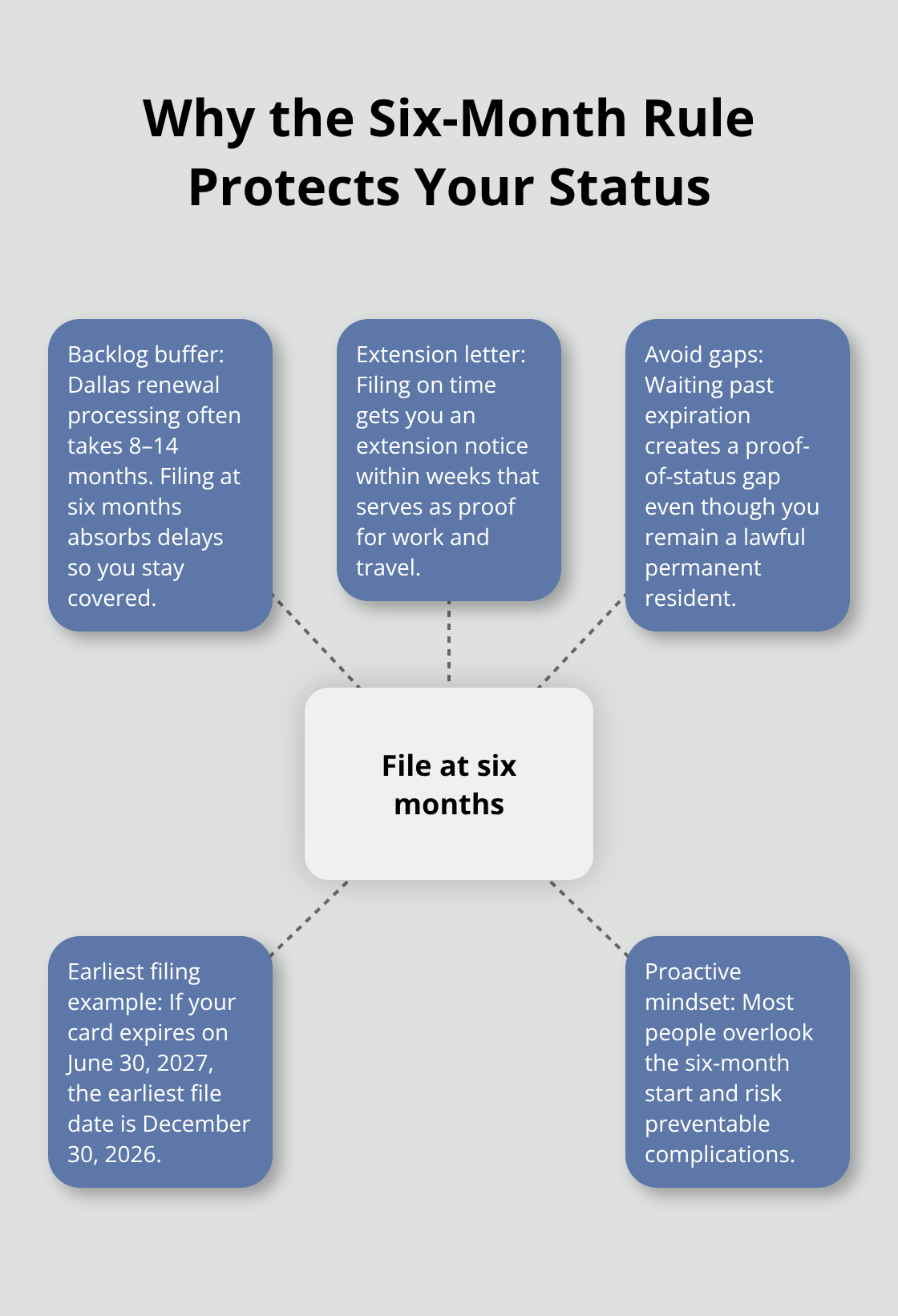
Most people don’t realize they should start the renewal process six months before expiration, not when the card actually expires. If your card expires on June 30, 2027, you should file your Form I-90 application by December 30, 2026. Starting early matters because Dallas processing times for green card renewals currently range from 8 to 14 months, according to USCIS data. If you wait until your card is already expired, you create a gap where you technically lack valid proof of permanent resident status, even though you remain a lawful permanent resident.
The Real Costs of Expired Cards
This gap disrupts your employment, travel, and ability to obtain state identification. Your employer may question your work authorization despite your status remaining unchanged. Airlines and border agents will reject your expired card for international travel, forcing you to arrange emergency documentation or temporary travel documents through USCIS. Some states refuse to renew driver’s licenses or issue state IDs without a valid green card, leaving you without proper identification for everyday activities. You cannot apply for citizenship while your card is expired, which delays any naturalization timeline.
Taking Action Today
The worst part is that none of these problems are necessary-they’re entirely preventable with early action. Check your card today and write down the expiration date. If it expires within the next six months, you should file immediately. USCIS does not send automatic reminder notices, so the responsibility falls entirely on you to track this deadline and act on it. Once you understand when your card expires and why timing matters, the next step involves knowing exactly when to file your application and what the current processing backlog means for your timeline.
When to File Your Green Card Renewal
The Six-Month Window Is Your Only Safe Option
The six-month window before your card expires is not a suggestion-it’s the only safe approach given current USCIS processing realities. Filing too early creates unnecessary complications, while filing too late almost guarantees you’ll face a gap in valid documentation. USCIS allows you to file Form I-90 up to six months before your card expires, which means if your card expires on June 30, 2027, the earliest you can file is December 30, 2026. This timing window exists for a reason: it aligns with actual processing speeds. Dallas processing times for green card renewals currently range from 8 to 14 months according to USCIS data, though some cases extend well beyond this range.
Why Filing at the Six-Month Mark Protects You
If you file at the six-month mark, you’ll receive your extension letter within weeks, which serves as proof of status for employment and travel while your actual replacement card is being processed. Filing earlier than six months means USCIS will reject your application or hold it until the six-month window opens, wasting time and creating confusion about your case status. The extension notice becomes your lifeline during the months-long wait for the actual card.
The Current Backlog Changes Everything
The current backlog has fundamentally changed what timing means for renewal. Many applicants report waiting 12 to 24 months or longer for their physical replacement card to arrive, even after receiving their extension letter. This is why the extension notice matters so much-it provides your proof of status while USCIS processes your actual card. If you wait until your card is already expired to file, you lose leverage and face immediate employment verification problems.
What Happens When You Miss the Window
Your employer may accept your receipt notice as proof of work authorization for up to 24 months after expiration, but the burden of explaining this falls on you, not USCIS. International travel becomes complicated without a valid card, forcing you to arrange emergency travel documents. Some people in this situation have needed to request emergency InfoPass appointments at the Dallas USCIS office to obtain temporary proof of status. The practical reality is this: file when your card has six months remaining, not when it expires. This single decision eliminates nearly every problem that creates stress during renewal.
Moving Forward With Your Application
Once you understand the timing window and commit to filing at the six-month mark, you need to know exactly what documents USCIS requires and how to submit your Form I-90 correctly.
How to File Your Form I-90 and Navigate the Approval Process
Gather Your Documents Before You Submit
Small mistakes in your Form I-90 submission create months of delays, so document preparation matters more than most people realize. You must have your current green card and a valid government-issued ID like a Texas driver’s license before you file anything. If your name changed since you received your card, include certified copies of court or marriage documents that prove the legal change. Many applicants submit poor-quality photocopies that USCIS rejects, which forces you to refile and restart the entire timeline. Use a document checklist from USCIS and make legible copies of everything, but never submit originals unless USCIS specifically requests them in writing.
Understand the Costs and Payment Options
The total cost is $540 as of 2024: $455 for the Form I-90 itself plus $85 for biometrics. You can pay by credit card, debit card, personal check, or money order, but never send cash through the mail.
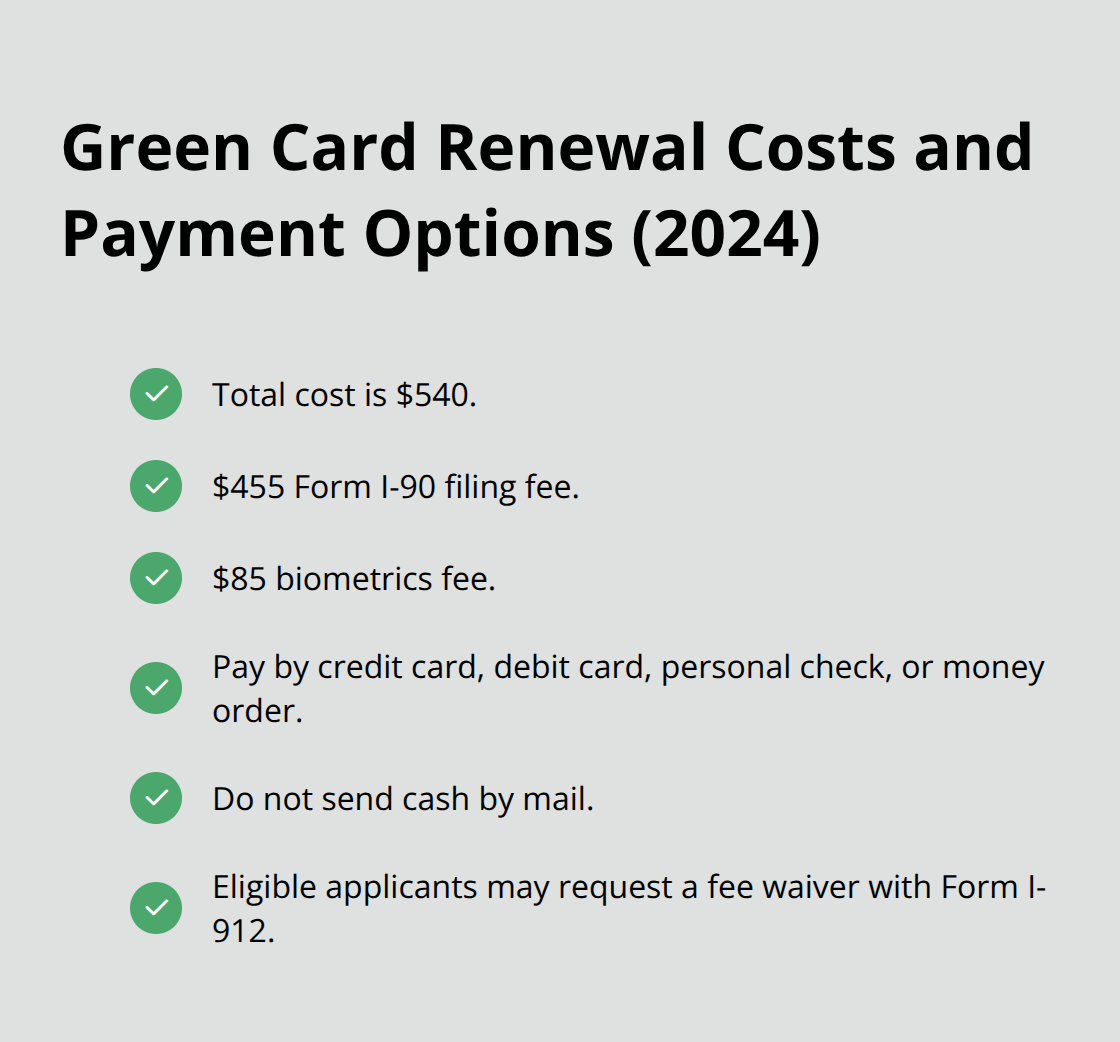
If your income falls below poverty thresholds or you receive means-tested benefits like SNAP or Medicaid, file Form I-912 to request a fee waiver with comprehensive supporting documentation. This option can eliminate your filing fees entirely if you qualify and submit proper proof of your financial situation.
File Online for Faster Processing
File your Form I-90 online through your USCIS account whenever possible because online filing produces faster notices and status updates than paper applications. USCIS will send you a receipt notice within days if you filed online, sometimes within a week. This receipt notice acts as your proof of status and extends your work authorization for up to 24 months after your card expires. Within two to three weeks, USCIS will schedule a biometrics appointment at one of the Dallas-area Application Support Centers, typically the Stemmons Freeway ASC or North Dallas ASC.
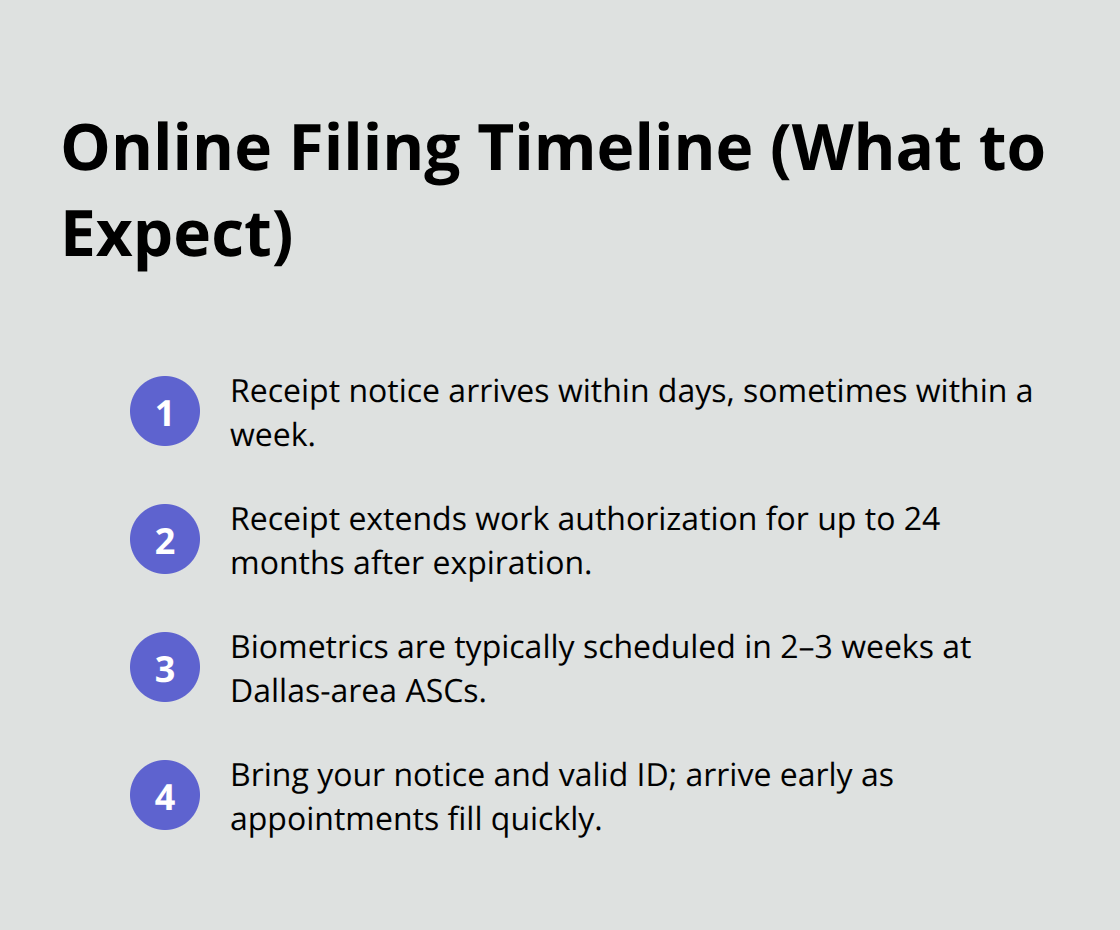
Bring your biometrics appointment notice and valid ID, and arrive early because appointments fill quickly.
Track Your Case and Handle Address Changes
Some cases skip biometrics entirely, though you won’t know this until USCIS notifies you. The actual replacement card typically takes 8 to 14 months or longer to arrive, with many cases extending to 12 to 24 months due to current backlogs. Update your mailing address immediately through your USCIS Online Account if you move during processing, since a wrong address means your new card gets lost in transit. Check your case status online after 72 hours of filing using your receipt number, or call the USCIS Contact Center if you need immediate answers about your specific case.
Final Thoughts
Your green card renewal timeline determines whether you maintain uninterrupted work authorization, travel ability, and legal status. The six-month window before expiration is not flexible-it’s the only approach that works given current USCIS processing realities. Filing at this mark gives you the extension letter you need while your replacement card processes over the coming months.
The practical steps are straightforward: check your card’s expiration date today, mark your calendar for six months before that date, gather your documents, and file Form I-90 online. Pay the $540 fee, attend your biometrics appointment at a Dallas-area Application Support Center, and monitor your case status through your USCIS account. The extension notice you receive within weeks becomes your proof of status during the long wait for your physical card.
If you face complications during renewal, have questions about your specific situation, or need guidance navigating your green card renewal timeline, we at Law Offices of Jeffrey A. Thompson can help. Contact our office to discuss your renewal and protect your status throughout the process.
Share this post: