
How to Adjust Your TPS Status Successfully
February 13, 2026
Temporary Protected Status offers a lifeline for nationals from countries facing humanitarian crises, armed conflict, or natural disasters. If you’re eligible for TPS or need to adjust your TPS status, understanding the process is the first step toward stability.
At Law Offices of Jeffrey A. Thompson, we’ve guided countless clients through TPS adjustment applications. This guide walks you through eligibility requirements, filing procedures, and critical mistakes to avoid.
What Makes You Eligible for TPS
Temporary Protected Status exists because ordinary immigration processes cannot respond fast enough to humanitarian emergencies. When armed conflict erupts, natural disasters strike, or epidemics spread, countries receive TPS designations through Federal Register notices issued by the Department of Homeland Security. As of now, approximately 1.3 million people hold TPS in the United States. However, the landscape is shifting rapidly. Since March 2025, the Trump administration has terminated or announced intent to terminate TPS for over 1 million beneficiaries, including 600,000 Venezuelans, 330,000 Haitians, and 50,000 Hondurans. These terminations face court challenges with outcomes still unclear, making it critical to understand your current standing and deadlines. TPS designations currently cover Burma, El Salvador, Ethiopia, Haiti, Lebanon, Somalia, South Sudan, Sudan, Syria, Ukraine, and Yemen. Haiti’s designation terminated September 2, 2025, while Venezuela’s 2023 designation ended April 7, 2025, though the earlier 2021 Venezuela designation remains active until September 10, 2025.
Who Actually Qualifies
To qualify for TPS, you must be a national of a designated country or stateless with last habitual residence there. You also need continuous physical presence in the U.S. since your country’s designation date and continuous residence since the Secretary-specified date. You cannot have certain criminal convictions-specifically felonies or two or more misdemeanors-nor can you face bars for national security reasons.
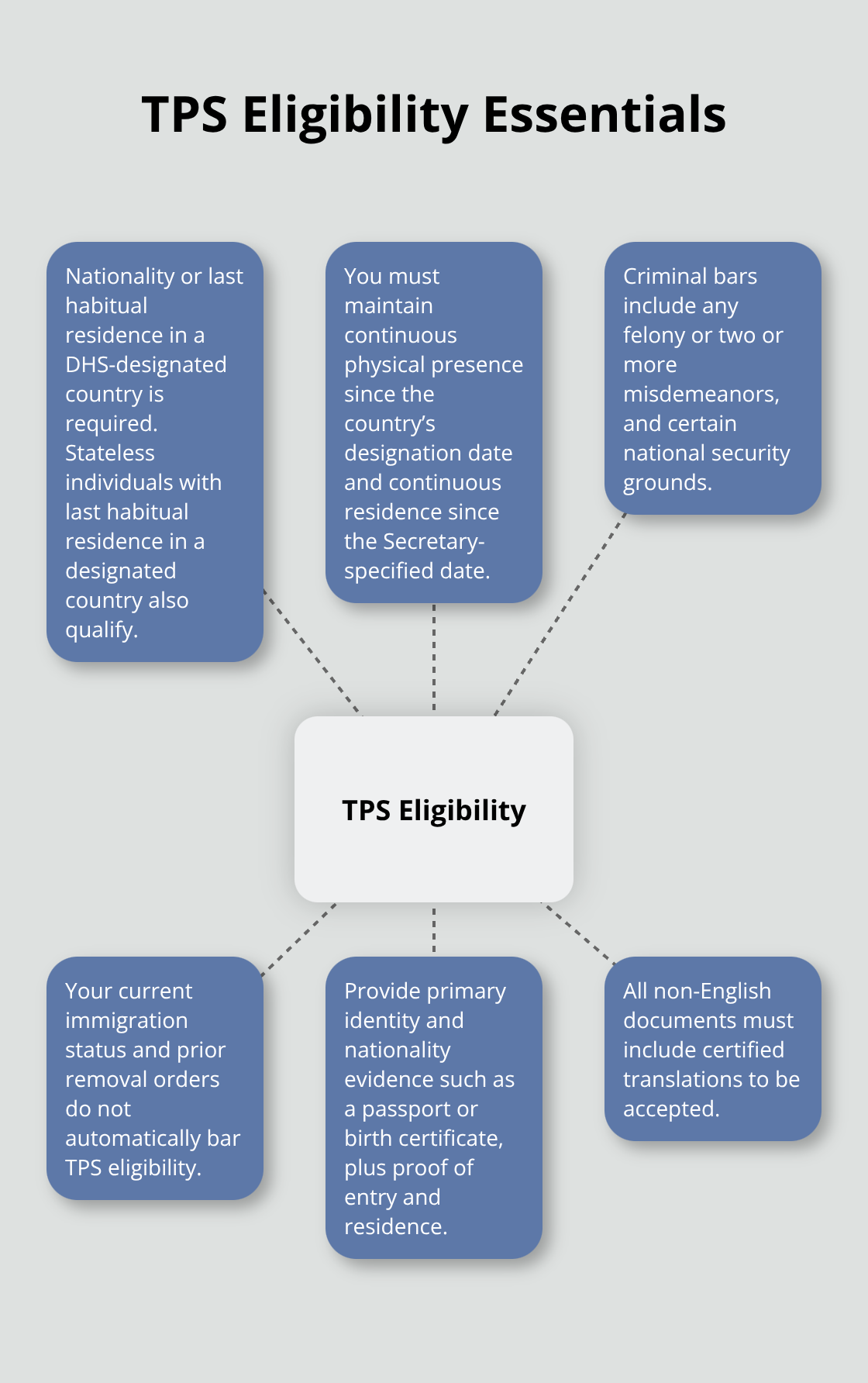
This means someone with a single misdemeanor may still qualify, but two misdemeanors disqualifies you entirely. Your status at application does not affect eligibility, and prior removal orders do not automatically bar TPS. This is significant because many people believe their past immigration violations eliminate them, when in fact TPS provides a separate pathway. Documentation requirements include primary evidence of identity and nationality like a passport or birth certificate, plus evidence of your entry date and continuous residence through utility bills, rent receipts, or school records. All non-English documents must be translated.
Deadlines Control Your Fate
TPS designations typically last 6, 12, or 18 months and require renewal through Federal Register notices at least 60 days before expiration. If DHS fails to publish a renewal 60 days in advance, the designation automatically extends for six months. You lose eligibility entirely if you miss your country’s registration period. Initial registration periods are narrow windows, and late filing is only allowed under specific good cause circumstances. Re-registration periods also close, and late re-registration with good cause can be accepted, but processing delays and work authorization gaps may result. The fee structure changed significantly on July 18, 2025 under HR 1, so verify current amounts on the USCIS Fee Schedule. Form I-821 carries an initial filing fee not charged for re-registration, while Form I-765 for work authorization and Form I-601 for waivers involve additional fees. Online filing speeds processing compared to paper applications, and you can file Form I-821 and Form I-765 simultaneously online.
What Documents You Must Provide
You need to submit evidence of identity and nationality as your primary documentation. A passport or birth certificate works best, though suitable secondary evidence can substitute if primary documents are unavailable. You must also provide evidence of your date of entry into the United States and proof of continuous residence since the Secretary-specified date. Utility bills, rent receipts, school records, and employment letters all serve as residence evidence. The USCIS requires that all non-English documents include certified translations. Incomplete or poorly translated documents cause delays and can result in denials, so invest time in this step before you submit your application.
Your TPS eligibility depends on meeting these requirements precisely. Understanding them now positions you to move forward with confidence into the application process itself.
Filing Your TPS Application the Right Way
Organize Your Documents Before You Submit
Methodical preparation beats panic every time. You have a registration window, and missing it eliminates your eligibility entirely, so timing matters more than speed. Gather every document that proves your identity, nationality, and continuous U.S. residence before you file anything. A passport or birth certificate serves as your primary identity document, but if those are unavailable, secondary evidence like a national ID card or driver’s license from your home country works. For residence proof, collect utility bills, lease agreements, rent receipts, employment letters, school enrollment records, and tax documents spanning from your country’s TPS designation date to now. USCIS requires continuous residence documentation, meaning gaps in your records raise red flags.
Non-English documents need certified translations, not informal ones. Many applicants lose their cases because they submit translations from family members or online services rather than professional translators. The cost of professional translation is negligible compared to a denial.
Complete Your Forms Accurately
Once you have your documents organized, file Form I-821 (Temporary Protected Status) as your primary application. This form requires precise information about your entry date, continuous presence, and residence. Errors here cascade into delays or denials. Form I-765 (Employment Authorization) should be filed simultaneously if you need work authorization, since processing together speeds approval. If you have grounds of inadmissibility like prior criminal issues, file Form I-601 (Waiver of Grounds of Inadmissibility) along with your package.
Online filing through USCIS accelerates processing compared to paper submission, so submit electronically whenever possible. Pay close attention to the fee schedule published on USCIS, which changed significantly in July 2025. Initial TPS filing carries a specific fee, re-registration typically does not, and employment authorization adds additional costs. Request a fee waiver using Form I-912 only if you genuinely cannot afford the fees; provide substantial financial documentation or your waiver request gets denied.
Track Your Application Through Seven Critical Stages
After submission, you receive a receipt notice with a case number that tracks your application through seven stages: initial filing, receipt and entry, biometrics notice, biometrics appointment, work eligibility review, adjudication, and final decision. Attend your biometrics appointment without fail.
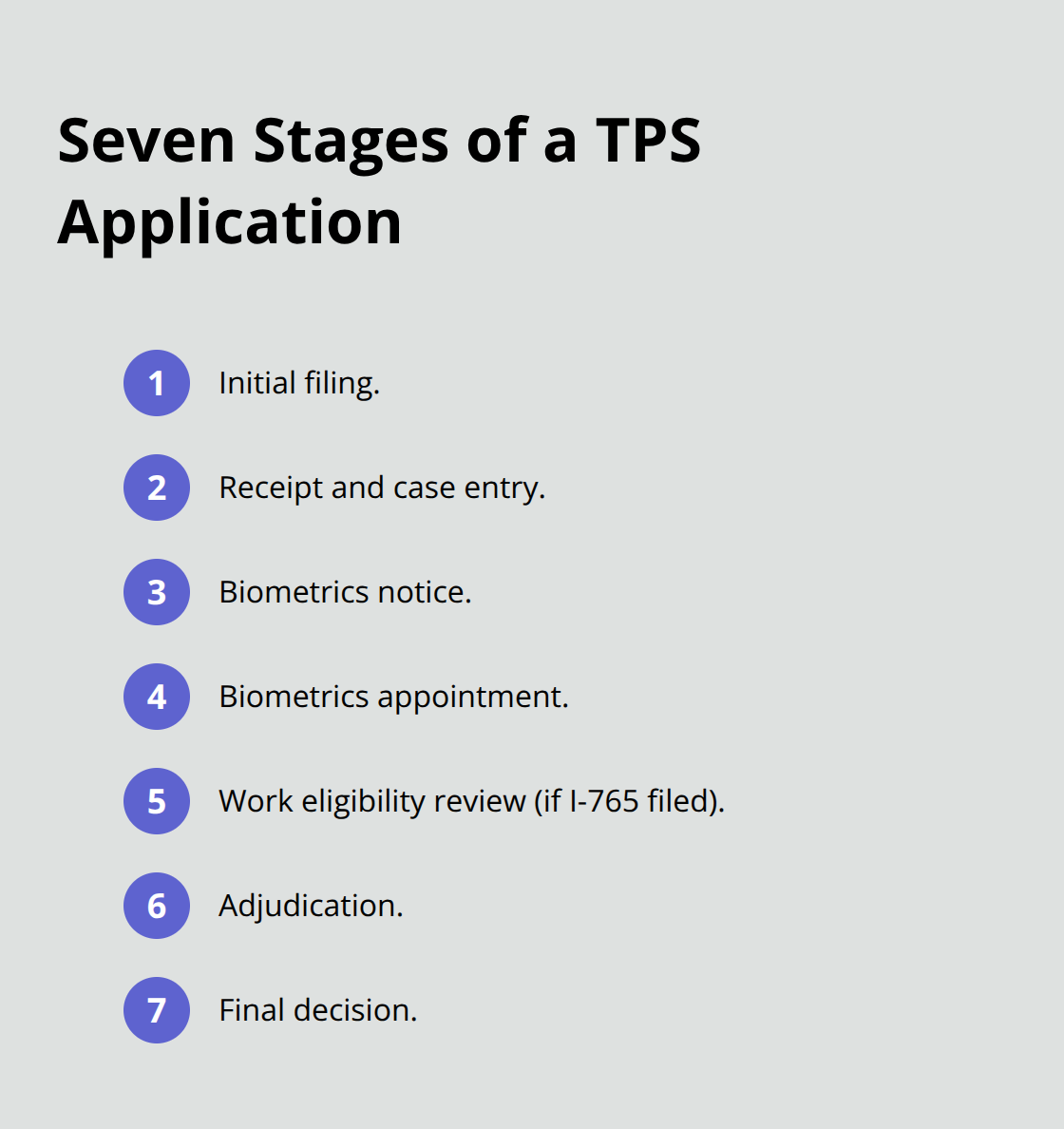
Missing this appointment results in automatic denial for abandonment, and you cannot recover from this mistake. Bring your receipt notice and valid identification to the appointment. USCIS may waive biometrics if you previously provided them for another TPS or related application, so ask.
After biometrics, USCIS conducts a work eligibility review if you applied for Form I-765. Once adjudication begins, USCIS either approves your TPS and issues an Employment Authorization Document, or denies your application. If denied, you have 30 days to appeal to the USCIS Administrative Appeals Office using Form I-290B, or request reconsideration.
Maintain Communication With USCIS
Keep copies of every document you submit and every notice USCIS sends you. Track your case status online using your receipt number at the USCIS website. Update your address with USCIS immediately if you move, since missing notices due to address changes can result in case abandonment. Many applicants lose their cases not because of eligibility issues, but because they failed to receive a notice demanding additional evidence or attend a scheduled appointment.
Your application now moves through USCIS processing, but your work does not end at submission. The next chapter covers the mistakes that derail even well-prepared applications-and how to avoid them entirely.
Common Mistakes That Derail TPS Applications
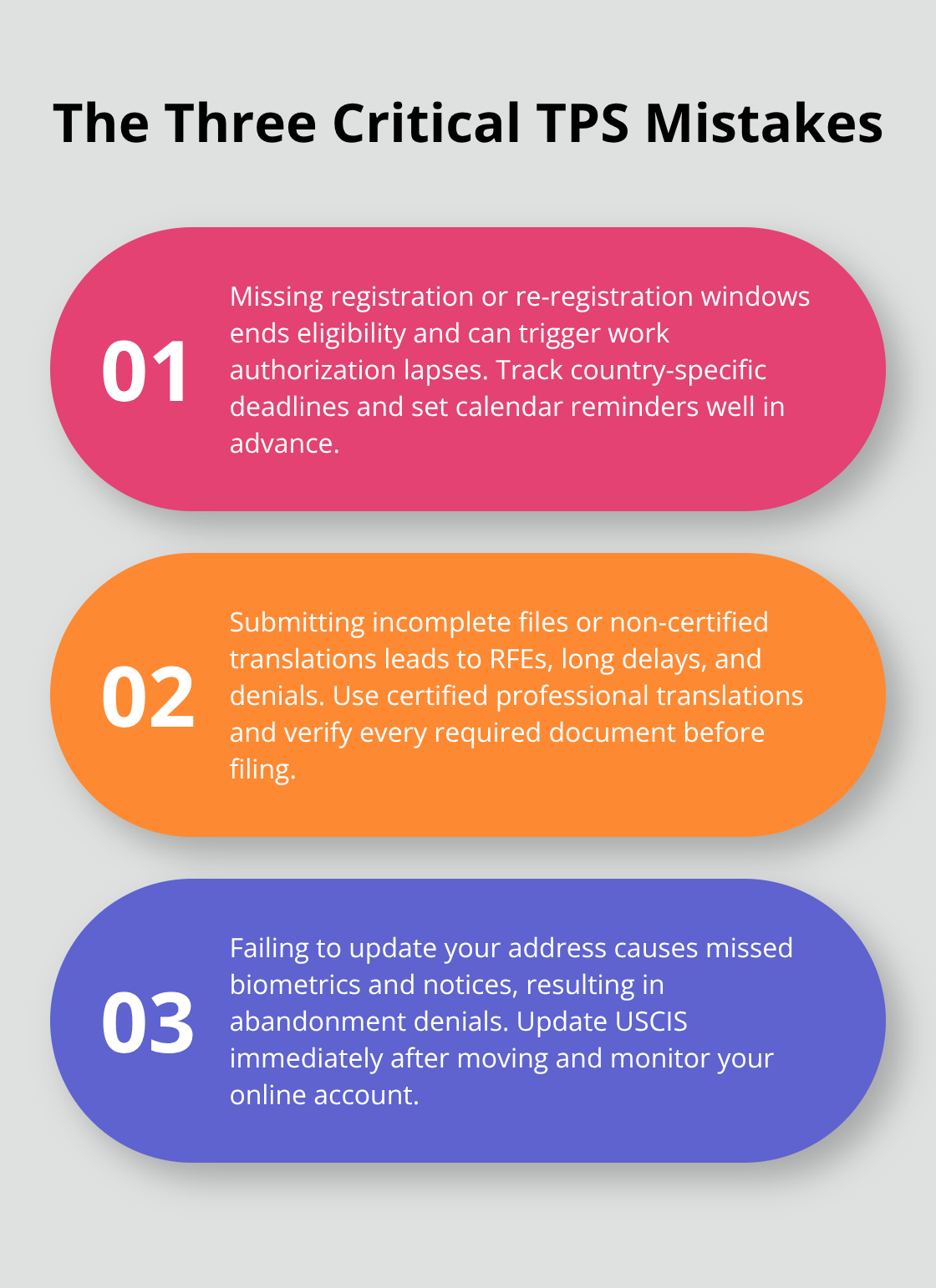
The gap between filing an application and receiving approval is where most TPS cases collapse. You can have perfect eligibility and solid documentation, but three critical mistakes destroy even the strongest applications. Understanding these pitfalls positions you to avoid them entirely.
Missing Your Registration Deadline
TPS designations come with fixed registration windows announced in Federal Register notices, and these windows close hard. Initial registration periods vary by country, but once they close, you cannot file late unless you can prove good cause to USCIS-and good cause is narrowly defined. A job conflict, family emergency, or simple confusion about the deadline does not qualify. You must have documentation showing circumstances beyond your control prevented timely filing, such as a serious medical hospitalization or a natural disaster that made filing impossible.
Missing a re-registration deadline carries similar consequences. If your TPS designation gets extended and you fail to re-register during the open period, your work authorization lapses and you lose legal status. Check your country-specific web page for your exact deadline and mark it on your calendar 90 days in advance. This single step prevents the most common TPS disaster.
Submitting Incomplete or Poorly Translated Documents
USCIS receives thousands of TPS applications, and case officers spend minutes, not hours, reviewing each one. Missing documents force them to send you a Request for Evidence, which adds 60+ days to processing and creates a new deadline you must meet. Many applicants fail to respond to these requests and lose their cases through abandonment.
Non-English documents without certified professional translations get rejected outright. The translator must certify that they are competent to translate and that the translation is accurate and complete. This certification costs money (typically $50 to $150 per document), but skipping it guarantees rejection. The investment in professional translation pays for itself by preventing delays and denials.
Failing to Update Your Address With USCIS
Your receipt notice and all subsequent correspondence goes to the address you provided on your application. If you move without notifying USCIS, you miss biometrics appointments, requests for additional evidence, and approval notices. Missing a biometrics appointment results in automatic denial for case abandonment, and you cannot appeal this decision.
Update your address online through your USCIS account or call USCIS within days of moving. This action takes minutes but protects your entire case. Many applicants lose their cases not because of eligibility issues, but because they failed to receive a notice demanding additional evidence or attend a scheduled appointment.
Why These Mistakes Matter Most
These three mistakes account for the vast majority of TPS denials, and all three are entirely preventable with basic planning and attention to detail. Deadline tracking, document preparation, and address maintenance require no legal expertise-only organization and follow-through. The applicants who succeed are those who treat their TPS application as a project with specific milestones, not a form to complete whenever convenient.
Conclusion
TPS adjustment of status requires you to verify your eligibility, gather comprehensive documentation with certified translations, complete your forms accurately, and submit during your registration window. You must track your application through all seven stages, attend your biometrics appointment without exception, and maintain your address with USCIS. The three mistakes that destroy most applications-missing deadlines, submitting incomplete documents, and failing to update your contact information-are entirely preventable through basic planning and attention to detail.
TPS designations can be extended, redesignated, or terminated based on conditions in your home country, and the current landscape remains volatile with multiple terminations announced or in litigation. This reality makes you act quickly on your TPS application critical, since delays cost you months of work authorization and legal protection you could otherwise have secured. An experienced immigration attorney reviews your specific situation, identifies potential issues before they become problems, and represents you if USCIS requests additional evidence or denies your application.
Contact Law Offices of Jeffrey A. Thompson for a consultation and receive expert guidance tailored to your TPS situation. We help you understand your options, deadlines, and obligations so you protect your status and your future. TPS registration windows close, and once they do, your opportunity disappears-reach out today.
Share this post: