
How to Apply for Green Card Adjustment of Status
February 2, 2026
Green card adjustment of status is one of the most common paths to permanent residency in the United States. The process involves multiple forms, medical exams, interviews, and background checks that can feel overwhelming without proper guidance.
At Law Offices of Jeffrey A. Thompson, we’ve helped countless clients navigate this complex journey successfully. This guide walks you through each step so you know exactly what to expect.
What Adjustment of Status Actually Means
How Adjustment of Status Works
Adjustment of Status lets you become a lawful permanent resident while staying inside the United States rather than going through consular processing abroad. This approach keeps your life stable-you don’t need to leave the country, interrupt your job, or uproot your family while waiting for visa approval. USCIS handles the entire process domestically once you file Form I-485, which is your application to register permanent residence or adjust status. The key requirement is that an immigrant visa must be available for your category before you can file.
Checking Visa Availability Through the Visa Bulletin
You determine visa availability by checking the monthly Visa Bulletin from the Department of State, which publishes two charts: Dates for Filing Applications and Application Final Action Dates. As of February 2026, both Family-Sponsored and Employment-Based preference categories use the Dates for Filing chart, meaning you can file earlier if your priority date falls within that window. Your priority date is generally the date your immigrant petition was filed, or if a labor certification was required, the date the Department of Labor accepted it. For example, if you’re applying under the F2A family-sponsored category, the February 2026 filing date is July 15, 2024-if your priority date is on or before that date, you’re eligible to file now.
Petition Requirements and Concurrent Filing Options
Most applicants need an immigrant petition filed on their behalf first. Family-based applicants typically file Form I-130 through a relative, while employment-based applicants file Form I-140 through an employer. Some categories allow concurrent filing, meaning you can submit your I-485 at the same time as your petition rather than waiting for approval. Other categories, like Cuban Adjustment Act applicants, don’t require an underlying petition at all.
Processing Times and Backlogs by Category
Processing times vary significantly by location and category. USCIS quarterly reporting data tracks I-485 cases by field office and service center, with some locations processing significantly faster than others. Employment-based cases often take longer than family-based cases due to higher volumes, particularly for India and China-born applicants who face separate per-country visa caps. The backlog for employment-based adjustment is substantial-USCIS publishes Pending Applications for Employment-Based Preference Categories data showing current inventory by category and country of chargeability. EB-2 applicants from India face much longer waits than those from other countries. If your case falls into a high-demand category, expect 12 to 24 months or longer.
Important Requirements During Processing
You must update USCIS within 10 days if you move during the process using Form AR-11. If you’re outside the United States when you need to file, you must pursue consular processing instead, which is an entirely different pathway. These requirements affect your eligibility and timeline, so understanding them now prevents complications later. With these foundational concepts in place, you’re ready to explore the specific eligibility requirements and visa categories that determine whether you can pursue adjustment of status.
Preparing Your Application and Required Documents
Organize Your Documentation to Avoid Delays
Incomplete or disorganized documentation triggers a Request for Evidence from USCIS, which delays your case by months. Form I-485 requires specific documents, and USCIS publishes an optional checklist that shows exactly what to include at filing. Cases with complete initial evidence move through adjudication faster than those submitted piecemeal. Start by gathering your passport, travel documents, and Form I-94 arrival record, which you’ll need for your interview. Your birth certificate must be an official certified copy, not a photocopy. Marriage certificates, divorce decrees, and any name change documents belong in your file. Employment history requires letters from your employers confirming dates of employment and positions held. If you’ve been self-employed, bring tax returns for the past three years.
Complete Your Medical Examination Early
USCIS requires a Form I-693 completed by a USCIS-designated civil surgeon. Form I-693 signed on or after November 1, 2023 remains valid for your adjustment of status case. Schedule this appointment early because civil surgeons often have long wait times, sometimes booking appointments two to three months out. The examination includes vaccinations, chest X-rays, and tests for certain communicable diseases. Bring your vaccination records to this appointment to avoid delays. Background checks happen automatically through biometrics collection at an Application Support Center, where USCIS collects your fingerprints, photograph, and signature. This step typically occurs within two to three months after filing.
Gather Financial Documentation and Affidavit of Support
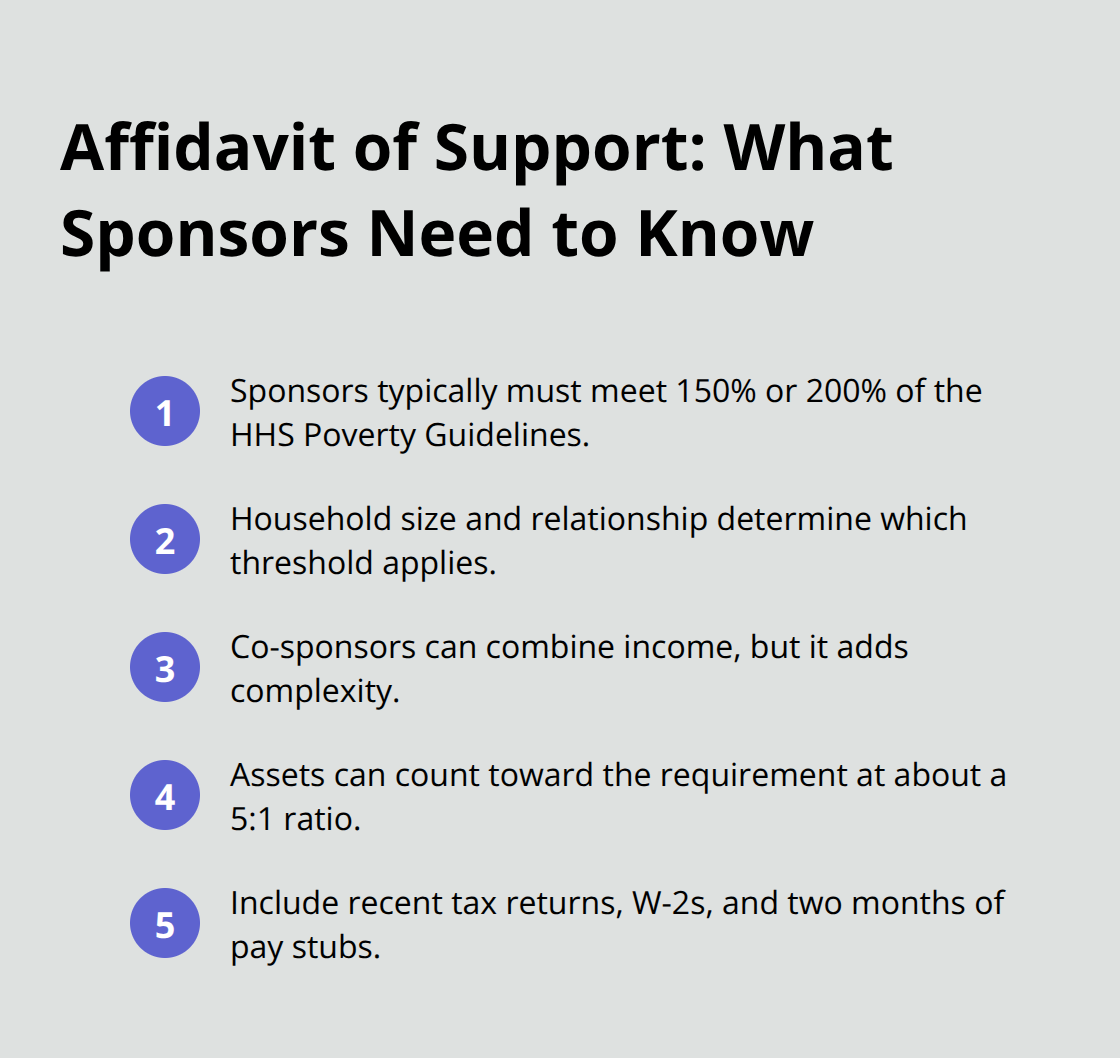
USCIS requires proof that you won’t become a public charge through Form I-864, the Affidavit of Support. A sponsor must complete this form and meet income thresholds. For 2026, income thresholds are based on the HHS Poverty Guidelines, with sponsors typically required to earn 150 percent or 200 percent of the poverty line depending on household size and relationship. If your sponsor doesn’t meet the threshold, they can combine income with a co-sponsor, though this complicates the process considerably. Gather recent tax returns, W-2 forms, and pay stubs covering the last two months. If your sponsor is self-employed, include business tax returns and profit-and-loss statements. Bank statements showing liquid assets can help if income alone falls short, since USCIS allows assets to count toward the requirement at a ratio of approximately five to one. Store all financial documents in a separate folder and organize them chronologically. Do not submit originals of financial documents unless USCIS specifically requests them during an interview-copies suffice for the initial filing.
File Supplemental Forms and Payment Correctly
If you’re filing Form I-485 based on an approved I-140 employment petition and you’re not the principal beneficiary, include Form I-485 Supplement J to establish your derivative status. This form prevents unnecessary delays. For those eligible under INA 245(i), file Form I-485 Supplement A along with your main application. File everything electronically using Form G-1450 if you’re using a credit or debit card, or Form G-1650 for ACH payments. USCIS no longer accepts paper checks. Attach Form G-1145 to the first page of your mailed application if you want email and text alerts when USCIS receives your filing at the lockbox. Sign every page of Form I-485 before mailing; unsigned applications get rejected immediately. Use the official USCIS Direct Filing Addresses page to determine whether your category files at a lockbox or field office, as this varies by eligibility type. Submit everything at once rather than trickling documents in later, since late submissions often get lost in case files or create confusion about what was originally filed. With your documents organized and your medical exam scheduled, you’re ready to move forward with the actual filing process.
What Happens After You Submit Your Application
Receipt Notice and Initial Processing
USCIS processes filings based on the edition date visible on every page of your forms, so ensure all pages match the same edition and no pages are missing before mailing. Within two to three weeks of USCIS receiving your application, you’ll receive a receipt notice with your case number. If you attached Form G-1145 requesting email and text notifications, USCIS will alert you electronically when they accept your filing at the lockbox. This notification matters because filing at a lockbox sometimes delays receipt of your A-number, which appears in a second notice rather than the initial receipt.
Biometrics Appointment and Background Checks
Your next major milestone arrives when USCIS schedules your biometrics appointment, typically within two to three months after filing. USCIS will mail you an appointment notice specifying the date, time, and Application Support Center location. Arrive early and bring your appointment notice, passport, and state ID. The appointment takes roughly 30 minutes and involves fingerprinting, a digital photograph, and signature capture. Background checks run automatically during this process, so USCIS uses your biometrics to verify your identity and conduct security screening.
Requests for Evidence and Interview Scheduling
Some cases proceed directly to an interview after biometrics, while others receive a Request for Evidence if USCIS needs additional documentation, outdated information, or clarification on submitted materials. USCIS reports monthly I-485 processing data by field office and service center, revealing significant variation in timeline expectations. Cases processed at certain service centers move 40 to 50 percent faster than others handling similar categories. If you receive an RFE, respond within the stated deadline without fail-missing the deadline results in case denial with limited options for reopening. Your interview, if scheduled, typically occurs four to eight months after filing, though this varies widely by location and category.
Interview Preparation and Conduct
Bring original versions of all documents you submitted with your I-485, including your passport, travel documents, and Form I-94 arrival record. USCIS interviews focus on verifying information in your application, confirming your eligibility, and assessing admissibility. Expect straightforward questions about your employment history, family relationships, and reasons for seeking permanent residence. The interview itself usually lasts 20 to 45 minutes.
Final Decision and Address Updates
After your interview or final review, USCIS issues a written decision. If approved, you’ll receive a notice and later your physical Green Card in the mail. If denied, the notice explains the specific reasons and your options, which typically include filing Form I-290B for a Motion to Reopen or Reconsider within 30 days of the denial. Approval doesn’t end your responsibilities-you must update your address with USCIS within 10 days of any move using Form AR-11, and the online submission method is fastest.
Final Thoughts
Green card adjustment of status succeeds when you submit complete documentation, meet all deadlines, and stay organized throughout the process. The most common mistake applicants make involves filing incomplete applications and hoping to submit missing documents later-USCIS treats these as requests for evidence, which delays your case by months and creates unnecessary complications. Another frequent error occurs when applicants miss the deadline to respond to USCIS requests or fail to update their address within 10 days of moving, actions that can result in case denial.
Your success depends on understanding which Visa Bulletin chart applies to your category, gathering all required documents before you file, scheduling your medical exam early, and responding promptly to any USCIS communications. Track your case status regularly using your receipt number and A-number through the USCIS online portal, and keep copies of everything you submit. The adjustment of status process involves complex immigration law, strict filing requirements, and timing considerations that vary significantly by category and country of birth.
While many applicants navigate this successfully on their own, the stakes remain high-a single mistake can delay your case by years or result in denial. We at Law Offices of Jeffrey A. Thompson assist clients in navigating this process from paperwork preparation to overcoming legal hurdles, helping them achieve their American dreams. Contact us to discuss your specific situation and determine whether legal representation makes sense for your circumstances.
Share this post: