
How to Determine Adjustment of Status Eligibility
January 30, 2026
Adjustment of status eligibility determines whether you can become a permanent resident without returning to your home country. The process involves strict requirements around visa availability, health standards, and background checks.
We at Law Offices of Jeffrey A. Thompson help clients navigate these requirements every day. This guide breaks down what you need to know to move forward with confidence.
What Makes You Eligible to Adjust Status
The seven core requirements for adjustment of status form the foundation of your eligibility, and you must understand each one. You must have been inspected and admitted or paroled into the United States, properly filed Form I-485, be physically present in the country, be eligible to receive an immigrant visa, have a visa available at both filing and final adjudication, be admissible or qualify for a waiver, and merit favorable discretion from USCIS.
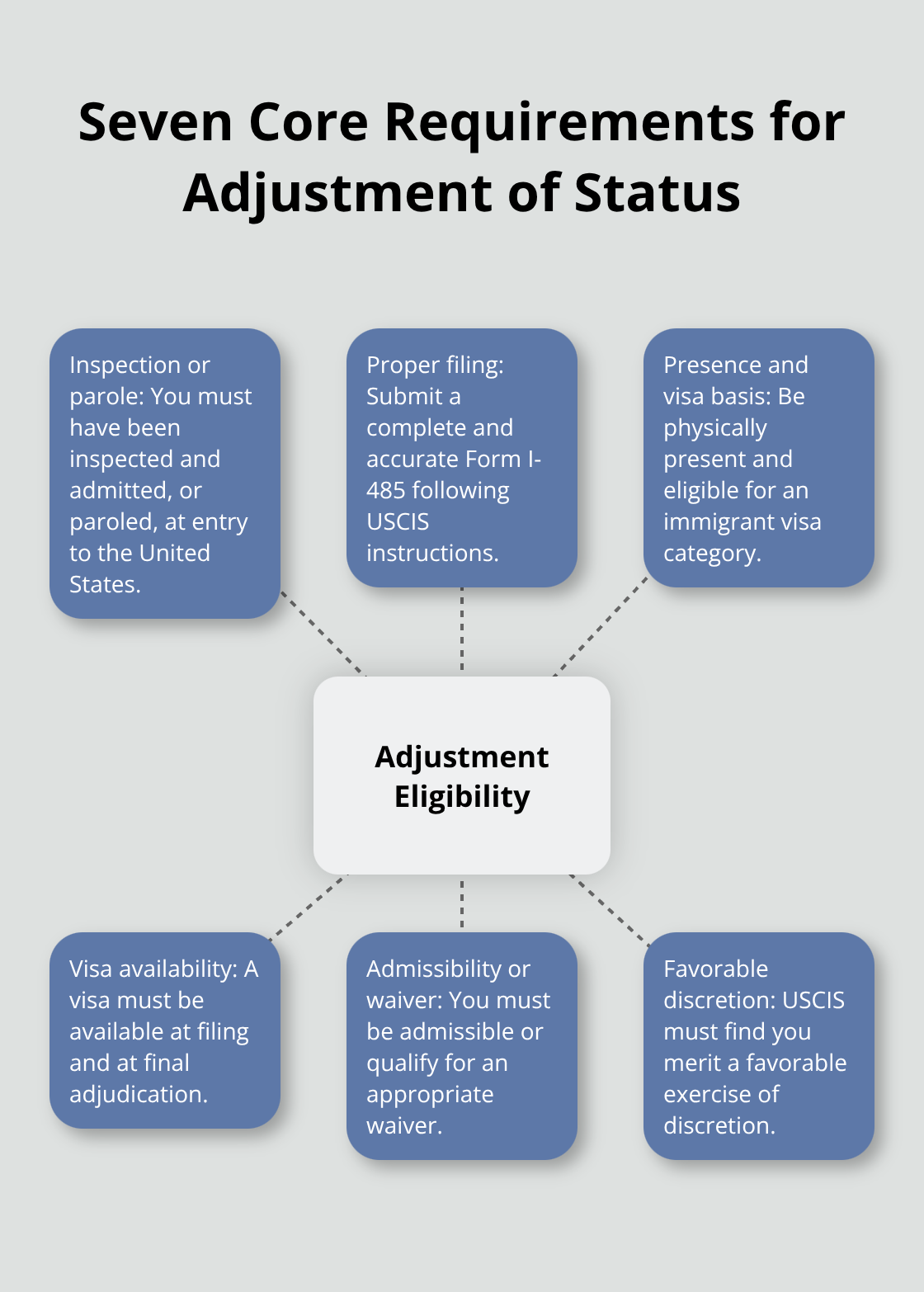
Most people focus only on the visa availability piece, but that’s a dangerous mistake. The inspection and admission requirement eliminates many applicants who entered the country without going through a port of entry. However, exceptions exist for certain populations. If you fall under INA 245(i), you may bypass some of these hurdles. Special immigrants, including those under the Violence Against Women Act, also have pathways that standard applicants lack.
Visa Availability Controls Your Timeline
Visa availability is the single most important factor that determines when you can file. According to the Department of State Visa Bulletin, immediate relatives of U.S. citizens have visas available without waiting periods, which is why this category moves fastest. All other categories face annual numerical limits and potential waiting periods measured in years or even decades. Family-based categories beyond immediate relatives and most employment-based categories operate under these quotas. Check the current Visa Bulletin before you invest time and money into your adjustment application, because filing when no visa is available results in automatic rejection.
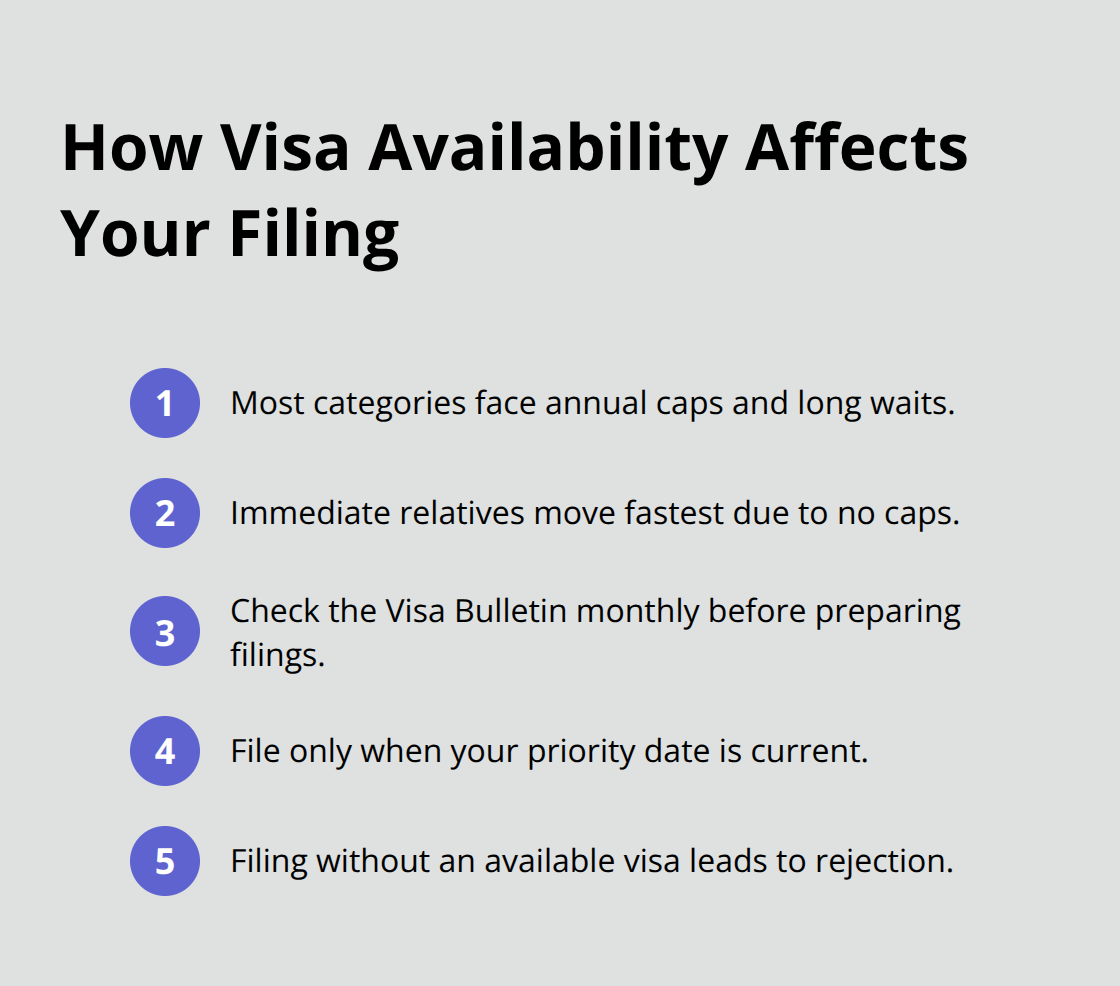
The Visa Bulletin updates monthly, and your priority date must be current in your category to proceed with filing Form I-485.
Medical Examinations and Health Standards
USCIS requires a Form I-693 medical examination from a USCIS-designated civil surgeon before your adjustment interview. The examination screens for communicable diseases, mental and physical health conditions that could make you ineligible, and vaccination status. You should schedule your medical exam strategically because delays in submitting it can slow your overall case. The civil surgeon must be on USCIS’s official list, and exams performed by other physicians won’t be accepted.
Criminal History and Admissibility Bars
Criminal convictions present serious obstacles to adjustment. Certain crimes trigger automatic bars under INA 245(c), including crimes of moral turpitude, multiple criminal convictions involving sentences of five years or longer, and controlled substance offenses. Even minor convictions can trigger bars if classified as crimes of moral turpitude. You must disclose any criminal history on your I-485. USCIS will discover convictions through background checks regardless, and failure to disclose creates fraud allegations that guarantee denial. Some applicants qualify for waivers under INA 212(i) for criminal grounds, but waivers are discretionary and far from guaranteed. Security-related grounds like terrorism support or persecution of others offer no waivers whatsoever. The key practical step is to obtain your complete criminal records from every jurisdiction where you’ve lived and consult with an immigration attorney about whether waivers apply to your specific convictions before you file.
Inspection and Admission Requirements
You must have been inspected and admitted or paroled into the United States to qualify for adjustment. This requirement eliminates applicants who entered without inspection at a port of entry. However, the law recognizes several exceptions. If you were waved through at a port of entry, you may still qualify as inspected and admitted if you provide credible evidence that an officer inspected you and admitted you as an alien. The burden falls on you to prove the admission. Parole is discretionary and temporary, not an admission, but it can satisfy the inspection requirement in specific circumstances. The CNMI (Commonwealth of the Northern Mariana Islands) has a unique parole-adjustment pathway recognizing its transitional status, and parole under this pathway can satisfy the inspection requirement for adjustment in certain cases. Understanding whether you meet this requirement early in the process prevents wasted effort on an application you cannot file.
What Documents USCIS Actually Requires
USCIS demands specific documents to verify your identity, financial stability, medical health, and background. Submitting incomplete paperwork triggers a Request for Evidence, which delays your case by months. Applicants often gather wrong documents or submit expired certificates, wasting valuable time. Your success depends on understanding exactly what USCIS accepts and what it rejects.
Identity and Vital Records
Your birth certificate must be a certified copy from the vital records office in your country of origin, not a photocopy or school record. USCIS rejects uncertified versions immediately. Your passport serves as your primary identity document and must be valid or recently expired. If your passport expired more than five years ago, obtain a new one before filing because USCIS treats very old passports with suspicion during background checks.
Police Clearance and Background Documentation
Police clearance certificates from every country where you lived for more than six months are mandatory. These certificates take months to obtain in many countries, so start this process at least four months before you plan to file your I-485. Contact the police or judicial authorities in each jurisdiction directly, as third-party services often deliver documents that USCIS rejects for lacking proper government seals or signatures.
Financial Documentation and Sponsorship
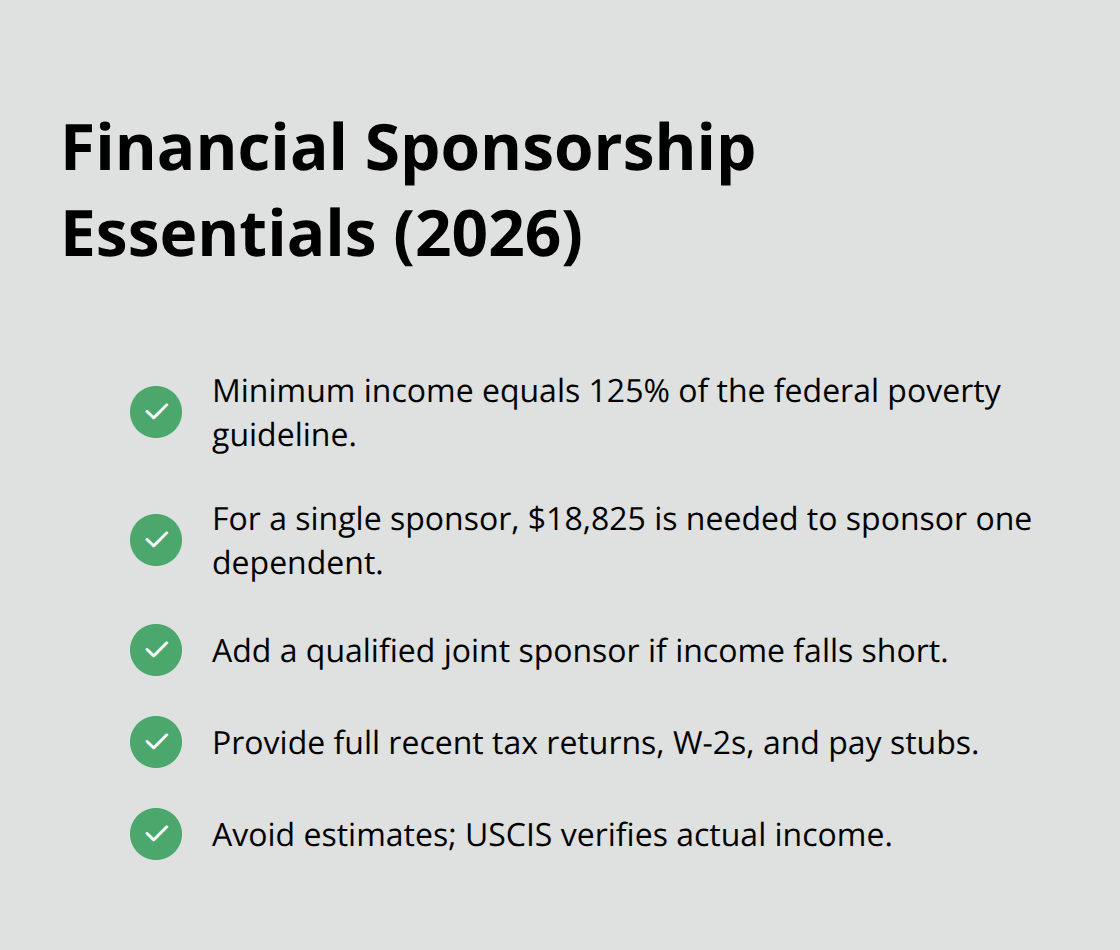
Financial documentation requires an Affidavit of Support on Form I-864, which your sponsoring family member or employer must complete. The sponsor’s income must reach 125 percent of the federal poverty guideline for their household size. For 2026, the poverty guideline for a single sponsor is approximately $15,060, meaning the sponsor must earn at least $18,825 annually to sponsor one dependent. If your sponsor’s income falls short, add a co-sponsor whose income meets the threshold. USCIS requires recent tax returns, W-2s, and recent pay stubs to verify income, not verbal promises or estimates.
Medical Examination Requirements
The medical examination on Form I-693 must be completed by a USCIS-designated civil surgeon within a specific timeframe before your interview. As of April 4, 2024, a properly completed I-693 signed after November 1, 2023 no longer expires, meaning you can submit it years after completion without requesting a new exam. This change saves applicants thousands of dollars in unnecessary repeat medical exams. Schedule your civil surgeon appointment early because wait times in major cities exceed 60 days, and delays here directly delay your entire case.
Interview Preparation and Document Originals
Gather originals of all documents you submitted with your I-485 for your interview because USCIS will ask you to verify signatures and dates. Missing originals at your interview raises red flags about document authenticity and can jeopardize your entire application. The next section covers the specific reasons USCIS denies adjustment applications and how to avoid these pitfalls before you file.
Why USCIS Denies Adjustment Applications
Financial Sponsorship Failures
Financial sponsorship failures rank as the leading reason USCIS denies adjustment of status applications, and the numbers are stark. The Affidavit of Support requirement exists precisely because USCIS refuses to admit immigrants who will burden public assistance programs. Your sponsor’s income must reach 125 percent of the federal poverty guideline, and USCIS verifies this through tax returns, W-2 forms, and pay stubs spanning two years. A sponsor earning $50,000 annually might appear sufficient until USCIS reviews their actual tax returns and discovers unreported income, business losses, or self-employment deductions that reduce their taxable income below the threshold. The solution is straightforward: obtain your sponsor’s last two years of complete tax returns before you file and calculate their actual income yourself using the IRS definition, not their gross salary. If the math doesn’t work, add a co-sponsor immediately rather than gambling on USCIS accepting marginal cases. Too many applicants file with sponsors whose income falls short by just $2,000 annually, only to receive denials months later when correction becomes impossible.
Medical Inadmissibility and Health Grounds
Medical inadmissibility presents the second major denial category, though many applicants underestimate this risk. USCIS-designated civil surgeons report communicable diseases as grounds for inadmissibility, and applicants with these conditions face mandatory denial unless they obtain a waiver under INA 212(i). Vaccinations matter too: applicants who refuse required vaccines without medical or religious exemptions documented before the exam will be found inadmissible. Mental and physical health conditions that USCIS deems serious can also trigger denial, though the threshold for what constitutes “serious” remains fact-specific. The civil surgeon’s report carries substantial weight in USCIS’s decision, so applicants with known health concerns should consult an immigration attorney before scheduling their medical examination.
Criminal Convictions and Permanent Bars
Criminal convictions form the third denial category and carry the heaviest weight because many convictions offer no waivers whatsoever. Crimes of moral turpitude, controlled substance offenses, and crimes of violence trigger permanent bars for most applicants. A single felony conviction for theft, fraud, or drug possession can destroy your adjustment case regardless of how strong your other qualifications appear. Even misdemeanor convictions can create problems if they fall within the moral turpitude category, which varies by jurisdiction and requires careful legal analysis. Multiple convictions with sentences totaling five years or longer automatically bar adjustment under INA 245(c)(8), and this bar applies regardless of whether the sentences were served consecutively or concurrently.
How to Address Criminal History Before Filing
The critical step is obtaining your complete criminal history from every jurisdiction where you have lived and consulting an immigration attorney about your specific convictions before filing Form I-485. Waiting to address criminal history until after USCIS requests evidence guarantees denial because waivers require discretionary approval and USCIS rarely grants them retroactively. Some applicants qualify for waivers under INA 212(i) for certain criminal grounds, but waivers are discretionary and far from guaranteed. Security-related grounds like terrorism support or persecution of others offer no waivers whatsoever. Contact the police or judicial authorities in each jurisdiction directly to obtain certified records, as third-party services often deliver documents that USCIS rejects for lacking proper government seals or signatures.
Final Thoughts
Adjustment of status eligibility rests on seven core requirements that work together, not in isolation. You must have been inspected and admitted or paroled, file Form I-485 properly, remain physically present in the United States, qualify for an immigrant visa category, have a visa available at both filing and adjudication, meet admissibility standards or obtain waivers, and demonstrate that USCIS should exercise favorable discretion in your case. Missing even one requirement results in denial, and the documents you gather determine whether USCIS approves or rejects your application.
Certified birth certificates, valid passports, police clearance certificates from every country where you lived for more than six months, financial documentation proving your sponsor meets income thresholds, and medical examination results from a USCIS-designated civil surgeon form the foundation of your case. Incomplete or incorrect documents trigger requests for evidence that delay your case by months. If you have not yet verified visa availability for your category, check the Department of State Visa Bulletin immediately because filing without an available visa guarantees rejection.
If you have criminal history, obtain certified records from every jurisdiction and consult an immigration attorney before filing. If your sponsor’s income falls short of the 125 percent poverty guideline threshold, identify a co-sponsor now rather than filing a weak application. We at Law Offices of Jeffrey A. Thompson help clients navigate adjustment of status eligibility and overcome legal obstacles that block approval, and Attorney Thompson can discuss your specific situation to move you forward with confidence.
Share this post: