
How to Prepare for Adjustment of Status Interview Questions
February 23, 2026
Your adjustment of status interview is one of the most important moments in your immigration journey. We at Law Offices of Jeffrey A. Thompson know that preparation makes the difference between approval and denial.
This guide walks you through the adjustment of status interview questions you’ll face, what USCIS officers are really looking for, and proven strategies to help you succeed.
What USCIS Officers Actually Verify During Your Interview
USCIS officers pursue three primary goals during your adjustment of status interview: they confirm your identity, validate that you meet eligibility requirements, and detect fraud. The officer will systematically work through your I-485 form, asking questions to verify the information you submitted. Most interviews last between 20 and 25 minutes, though complexity varies by case.
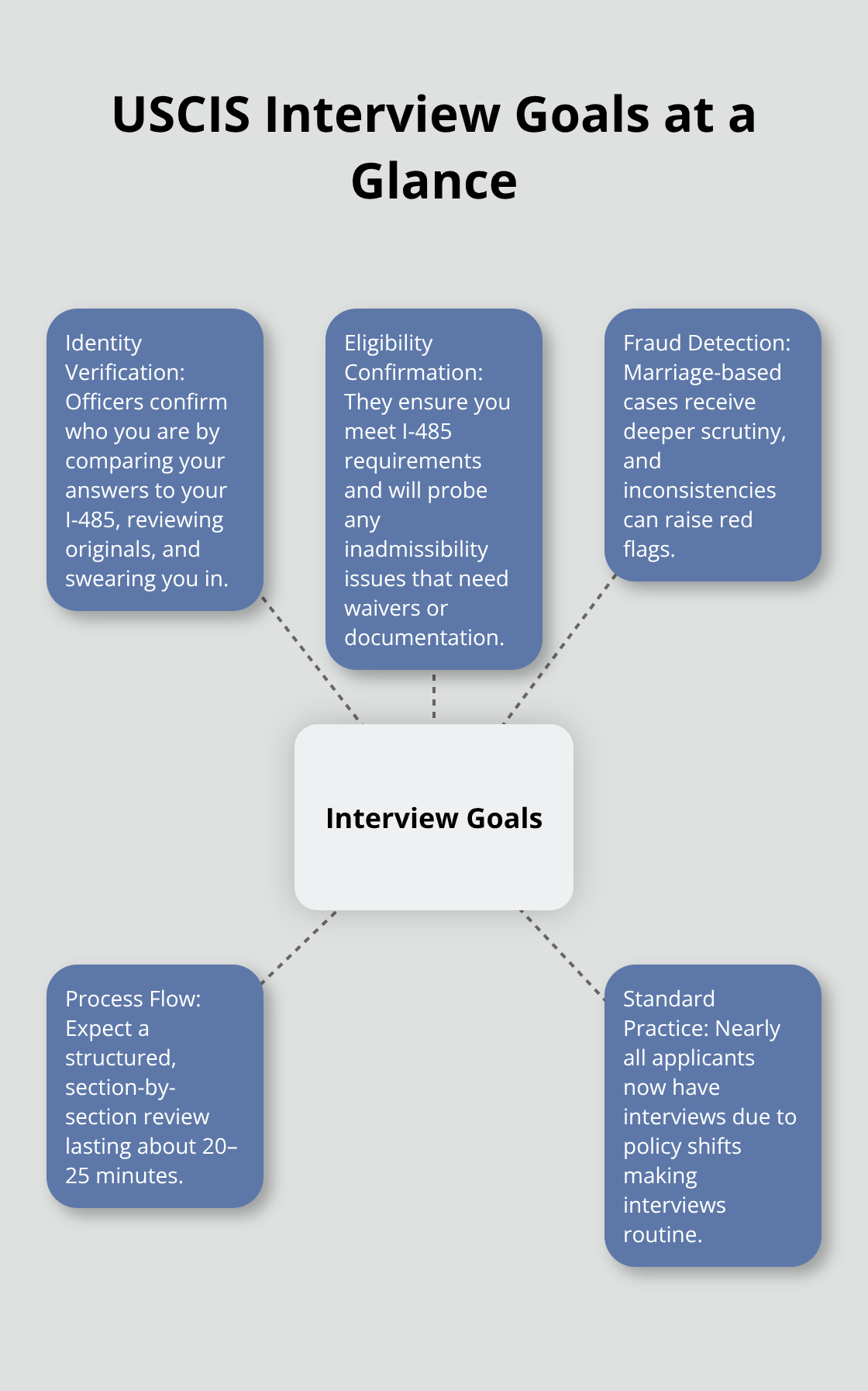
The officer swears you in at the start, reviews your application section by section, requests original documents, and takes notes on your responses. If you apply based on marriage, expect more personal questions because USCIS specifically assesses whether your relationship is genuine or fraudulent. The officer will also probe any inadmissibility issues-if you answered yes to any eligibility question on your I-485, prepare clear explanations and supporting documentation. Nearly all adjustment of status applicants now face interviews since policy shifts in recent years made interviews standard practice rather than exceptional. This means your interview will happen, so plan accordingly.
Organize Your Documents Before the Interview
You must bring the original documents you submitted with your I-485, including birth certificates, marriage certificates, divorce decrees, and death certificates. Your appointment notice lists specific required documents, but you should also bring a complete copy of your adjustment packet, including your I-130, I-864, I-131, I-765, and any other forms you filed. Bring your passport and government-issued photo ID, even if your passport has expired.
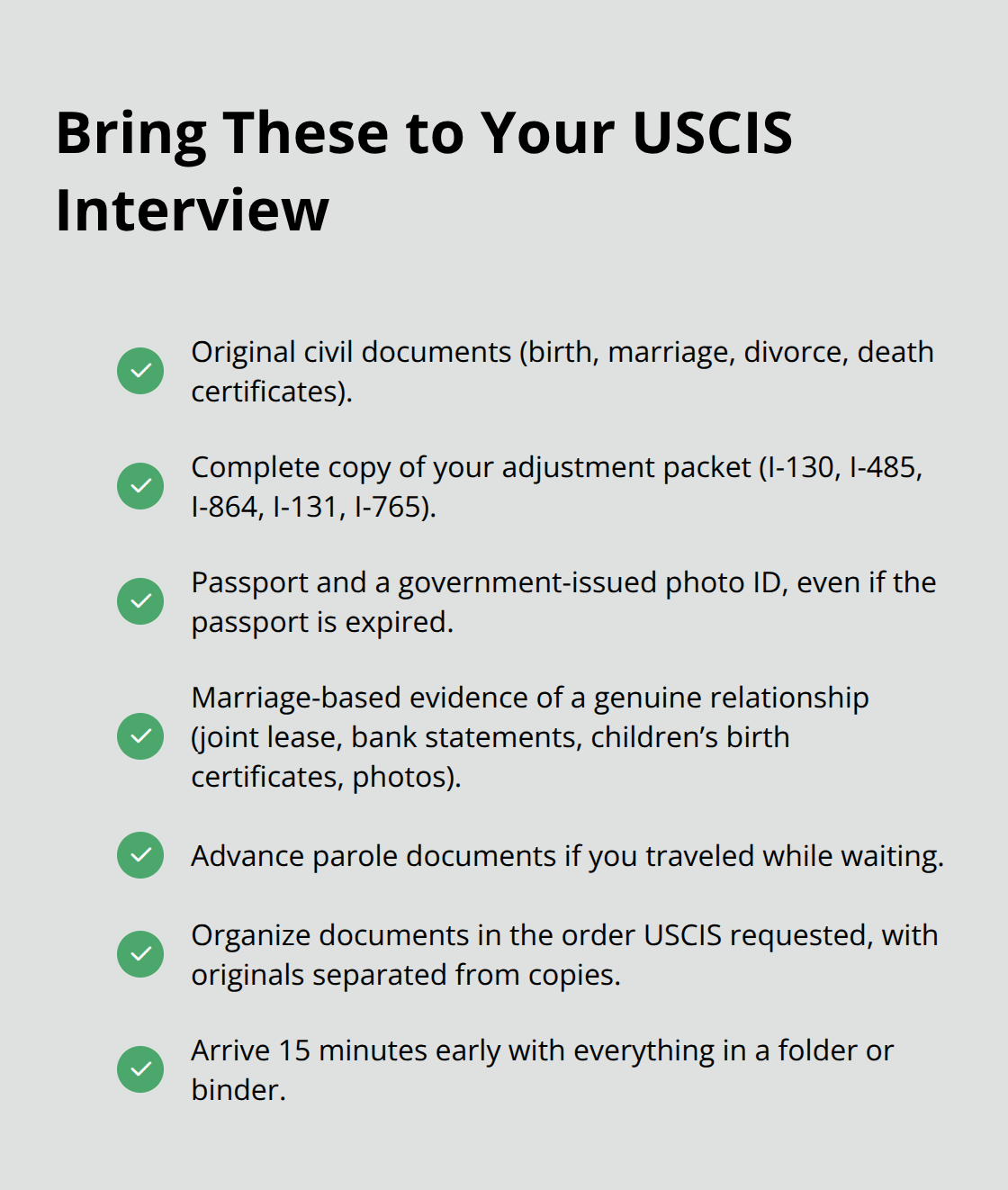
For marriage-based cases, bring evidence of a genuine relationship such as a joint lease or mortgage, joint bank account or credit statements, children’s birth certificates, and photos together. If you traveled while waiting for your interview, bring advance parole documents. You should organize everything in the order USCIS requested rather than randomly. This small step saves time during your interview and demonstrates you take the process seriously. Arrive at your USCIS office 15 minutes early with all documents in a folder or binder.
Schedule and Location Details
USCIS schedules interviews at the field office nearest your residence, which may require an overnight stay if you live far from the office. Your appointment notice specifies the exact date, time, and location. You should plan travel arrangements early because rescheduling proves difficult and delays your case. If you need an interpreter because English is not your native language, bring a competent, disinterested interpreter with valid government-issued ID. The interpreter must translate word-for-word without adding opinions. USCIS may disqualify an interpreter if integrity or competence is questionable, so you should avoid using friends or family members when possible.
Disclose Any Changes Since You Filed
If circumstances have changed since you filed your application, you must document these changes with supporting evidence and disclose them at the interview. A new job, new address, or new child all require documentation. The USCIS officer will ask about any changes, and you should provide honest answers with proof. This transparency prevents complications later in your case.
The questions you face at your interview fall into distinct categories-your background, your relationships, and your financial situation. Understanding what officers ask in each area helps you prepare responses that are consistent, truthful, and complete.
What Officers Ask and How to Answer Strategically
USCIS officers follow a structured interrogation pattern during adjustment of status interviews, and your answers must align perfectly with what you submitted on your I-485 form. Officers ask about your background and immigration history first because they need to verify your identity and entry into the United States.
Background and Immigration History Questions
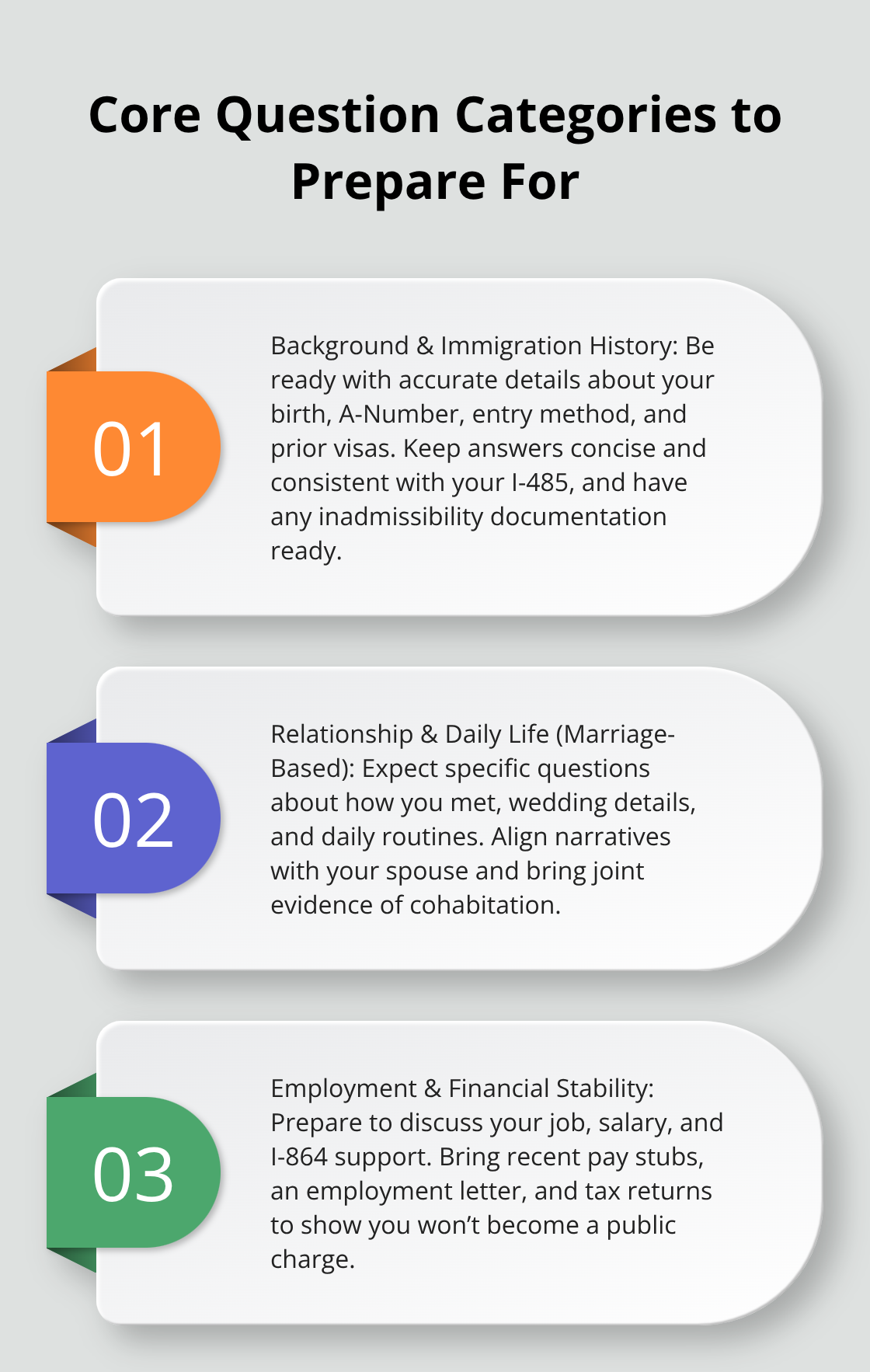
Expect detailed questions about where you were born, your passport number, your A-Number, how you entered the country, and what visa you held when you arrived. If you entered without inspection, the officer will explore this directly because entry without inspection creates inadmissibility issues that require waivers or legal solutions. Answer these questions concisely without volunteering extra information the officer did not ask for. If you answered yes to any inadmissibility question on your I-485, organize your supporting documentation and have it ready to present immediately.
Relationship and Daily Life Questions for Marriage-Based Cases
For marriage-based cases, officers shift quickly into relationship questions because fraud detection is their priority. They ask where you met, how long you dated before marriage, who proposed, what your spouse wore at the wedding, where you honeymooned, and intimate details about your daily life together. These questions test whether your story remains consistent and whether you actually know your spouse. Data from USCIS shows that inconsistent answers between spouses during interviews rank among the top reasons for fraud findings. Review your submitted I-130 form with your spouse and align your narratives about key relationship milestones before your interview date.
The officer will also ask about your living arrangements, who does household chores, what you eat for breakfast, and who wakes up first. These mundane questions reveal whether you cohabitate genuinely or maintain separate lives. Bring joint bank statements, lease agreements, and utility bills showing both names as proof of shared residence.
Employment and Financial Stability Questions
Employment and financial questions come last because they assess whether you can support yourself and not become a public charge. Officers ask about your current job, your employer, your salary, and whether you filed an I-864 Affidavit of Support. If you have a joint sponsor, the officer reviews their income and assets. Bring recent pay stubs, an employment verification letter from your employer confirming your position and salary, and tax returns from the past two years. If your income is insufficient, your I-864 sponsor must demonstrate assets or income that meet the federal poverty guidelines for adjustment of status sponsors. Calculate whether your household meets this threshold before your interview.
Critical Consistency and Interview Conduct
The most critical strategy is consistency. Officers compare your interview answers to your I-485 form, your I-130 form if marriage-based, and your spouse’s answers if both of you attend. Any discrepancy raises fraud suspicion and can trigger a request for evidence or an outright denial. Never answer more than what the officer asks, never make jokes during the interview, and never answer questions meant for your spouse. Bring a pen and notepad so you can jot down the officer’s name and any follow-up requests immediately after your interview concludes.
If the officer requests additional documents, you typically have 12 to 14 days to submit them. Missing this deadline results in a denial, so mark your calendar and submit evidence early rather than at the last moment. Most interviews conclude with an approval notice, meaning you receive an ADIT stamp in your passport or your green card arrives by mail within 2 to 4 weeks. If no decision arrives within 90 days of your interview, contact USCIS at 1-800-375-5283 to request an in-person appointment and check your case status.
What happens after approval depends on your specific circumstances and whether USCIS identifies any remaining issues that require resolution before your green card is issued.
Preparing Your Evidence Package
The difference between approval and denial often comes down to how well you organize your documentation before walking into that USCIS office. Most applicants arrive with papers scattered across multiple folders or missing critical originals entirely. You need a system that mirrors exactly what USCIS requested in your appointment notice, with originals separated from copies and everything labeled clearly.
Create a Master Documentation Checklist
Start with your I-797C appointment notice and extract every document USCIS explicitly demands. Then add supplementary documents that strengthen your case beyond what USCIS requested. For marriage-based cases, this means joint bank statements from the past 12 months, utility bills showing both names, lease or mortgage documents, and photos together spanning years rather than just months. USCIS officers spend roughly 20 to 25 minutes per interview, so presenting organized evidence reduces time wasted searching and demonstrates you respect the process.
One practical tactic involves using page tabs with labels like Birth Certificate, Marriage Certificate, and Employment History so the officer navigates your packet without asking where things are located. Bring certified English translations of any foreign-language documents because USCIS will not accept originals without professional translations attached. Immigration attorneys identify potential issues before they become costly problems and can review your complete package to ensure nothing critical is missing.
Update Employment and Financial Documentation
If you changed jobs since filing, bring a current employment verification letter from your new employer stating your position, salary, and start date on company letterhead. For the I-864 Affidavit of Support, calculate whether your household income meets federal poverty guidelines before your interview date. If household income falls short, your sponsor must document assets worth at least 125 percent of the poverty line according to USCIS guidelines.
Conduct Mock Interviews Before Your Real Interview
Mock interviews with immigration attorney reveal gaps in your knowledge and inconsistencies in your story before you sit across from a USCIS officer. Many applicants think they can handle relationship questions because they lived with their spouse, but USCIS officers ask specific details that catch people off guard. Practice with a trained attorney who knows exactly what questions officers ask and how they probe for fraud.
Your spouse should participate in separate mock interviews if both of you will attend the real interview, because USCIS compares your answers for contradictions. If you live far from a USCIS office and need an overnight stay, arrive the day before your interview rather than rushing to make the appointment. This eliminates travel stress and gives you time to review your documents one final time.
Consider Legal Representation at Your Interview
An immigration attorney can attend your interview with you, which provides significant protection if the officer asks unexpected questions or if complications arise. Officers often ask follow-up questions designed to test your consistency, and an attorney can object if a question exceeds the scope of your adjustment petition or if the officer misinterprets your answer. Immigration attorneys understand how USCIS officers conduct these interviews and can help you navigate difficult moments that might otherwise result in a denial or request for additional evidence.
Final Thoughts
Your adjustment of status interview represents the final critical step before you receive your green card, and the preparation strategies outlined in this guide directly determine whether you walk out approved or face delays and requests for additional evidence. Officers verify your identity, confirm your eligibility, and detect fraud through systematic questioning about your background, relationships, and finances. You now understand what adjustment of status interview questions to expect, how to answer strategically, and which documents prove most valuable when presented clearly and professionally.
Schedule your mock interview with an immigration attorney at least two weeks before your real appointment, as this practice session reveals gaps in your preparation and builds confidence when facing the actual officer. Update your employment documentation if circumstances have changed since filing, and organize your complete packet using page tabs and labels so the officer navigates your evidence without asking questions. If you live far from your USCIS office, arrive the day before your interview to eliminate travel stress and give yourself time to review your documents one final time.
We at Law Offices of Jeffrey A. Thompson understand that immigration matters involve complex legal requirements and high stakes for your future. If you need expert guidance navigating your specific situation or want an attorney present at your interview, contact Law Offices of Jeffrey A. Thompson in Brockton, Massachusetts, and our team will help you achieve your American dream with confidence.
Share this post: