Family Based Green Cards: A Guide to K-1, K-3, and More
August 3, 2026
Family-based green cards offer a direct path for U.S. citizens and permanent residents to bring loved ones to America. The process involves several visa categories, each with distinct requirements and timelines.
We at Law Offices of Jeffrey A. Thompson help families navigate these options every day. This guide breaks down K-1 fiancé visas, K-3 spousal visas, and other family-based pathways so you understand what comes next.
How Family-Based Green Cards Work
Family-based green cards represent permanent residency sponsorships that U.S. citizens or permanent residents file for their relatives. The sponsoring citizen or permanent resident submits a petition, typically Form I-130, that states their relationship to the beneficiary and demonstrates their financial ability to support them. Once approved, the beneficiary can obtain permanent residency through consular processing abroad or adjustment of status if already in the United States. The system operates on two main tracks: immediate relatives of U.S. citizens, who face no numerical caps and can proceed immediately, and preference-based categories for more distant relatives, who must wait for visa availability determined by the Department of State Visa Bulletin.
Who Qualifies as an Immediate Relative
U.S. citizens can sponsor spouses, unmarried children under 21, and parents without waiting. These categories have no annual caps, so an approved petition moves forward immediately. Permanent residents cannot sponsor parents, but they can sponsor spouses and unmarried children under 21. This distinction matters significantly because immediate relatives skip the preference queue entirely. If you are married to a U.S. citizen, your path moves faster than a sibling or adult child of a citizen, even if that sibling’s petition was filed years earlier. The Department of State processes immediate relative visas continuously throughout the year without numerical restrictions.
Preference Categories and Wait Times
All other family relationships fall into preference categories F1 through F4, each with annual numerical limits. F1 covers unmarried adult children of U.S. citizens, F2A covers spouses and young children of permanent residents, F2B covers unmarried adult children of permanent residents, F3 covers married children of U.S. citizens, and F4 covers siblings of U.S. citizens. The Department of State publishes monthly visa availability in the Visa Bulletin, showing priority dates and Final Action Dates that determine when your application can move forward. Wait times vary dramatically by country of birth and category. Siblings of U.S. citizens often wait 10 to 20 years, while spouses of permanent residents in the F2A category typically wait 1 to 3 years. Processing times have nearly doubled in the past five years, with I-130 petitions now averaging 13.5 to 50 months (depending on the service center).
Understanding Your Timeline
The visa availability system creates unpredictable delays for preference-based applicants. Your priority date-the date USCIS receives your petition-determines your place in line. When the Department of State Visa Bulletin shows a Final Action Date that matches or exceeds your priority date, your case becomes eligible for adjudication. Some applicants wait years before their priority date becomes current. Others move through quickly. Country of birth plays a major role in this calculation, as certain nations experience higher demand in specific family categories and therefore longer backlogs.
Next Steps in Your Family-Based Journey
Understanding which category applies to your situation determines how quickly you can bring your family member to the United States. The immediate relative path offers speed and certainty, while preference categories require patience and careful attention to visa bulletin updates. An immigration attorney can review your specific circumstances and identify the fastest, most efficient pathway for your family.
K-1 and K-3 Visas: Which Path Fits Your Situation
The K-1 fiancé visa and K-3 spousal visa both allow U.S. citizens to bring foreign partners to America, but they operate on fundamentally different timelines and costs. A K-1 visa applies to engaged couples who have met in person within the past two years and plan to marry within 90 days of arrival. A K-3 visa applies to couples already married, allowing the foreign spouse to enter the U.S. while waiting for an I-130 immigrant visa petition to process. The critical difference lies in speed and expense. The K-3 route costs approximately $2,025 to reach lawful permanent resident status, while the standard immigrant visa route costs about $1,200, making K-3 roughly $825 more expensive according to immigration cost analyses.
Processing Times and Real Advantages
Processing times tell a more nuanced story. I-130 petitions now average 13.5 to 50 months depending on the service center, while I-129F filings for K-3 visas average 4.5 to 19 months. In some cases, K-3 petitions move about three months faster than I-130, particularly with certain service centers like Nebraska, but this advantage has shrunk significantly over the past five years as I-130 processing speeds improved initially before recent delays expanded timelines. The K-3’s original purpose was to bypass long immigrant visa backlogs, but that edge has largely disappeared. If both your I-130 and I-129F are approved and sent to the National Visa Center, processing may shift directly to the immigrant visa path, potentially eliminating the need for K-3 altogether. This means filing K-3 sometimes wastes time and money rather than accelerating your case.
Filing Requirements and Documentation
Filing for K-3 requires submitting Form I-130 for your spouse and Form I-129F for the K-3 visa itself. There is no filing fee for the I-129F when filed for a spousal K-3 visa, which helps offset some costs. You can file both forms together or file I-129F after I-130 is submitted. If you have children under 21, you list them on the I-129F as K-4 derivatives without separate I-129F filings, though you must file I-130 for each child before they can apply for a green card later. K-3 and K-4 visa holders receive automatic work authorization, so your spouse can immediately seek employment in the U.S. with an Employment Authorization Document filed on Form I-765. The visa itself is valid for two years and allows multiple entries.
Status Changes and Conditional Residency
Once in the U.S., your spouse can apply for adjustment of status on Form I-485 to become a permanent resident, either while I-130 is pending or after approval. If your marriage is less than two years old when the I-485 is approved, the green card becomes conditional for two years, requiring you both to file Form I-751 jointly within 90 days before expiration to remove conditions. Failing to file I-751 terminates permanent resident status entirely.
When K-3 Actually Makes Sense
K-3 visas make practical sense in limited scenarios. If your I-130 processing is genuinely stalled at a slow service center and you need your spouse in the U.S. immediately for employment, family, or other urgent reasons, K-3 can be worth the extra cost and complexity. If your service center shows I-130 timelines exceeding 20 months while I-129F averages 10 months in your region, the math might work. However, most couples find that filing I-130 directly and waiting for an immigrant visa is faster and cheaper overall. The K-3 route only makes financial sense if you absolutely need your spouse in the U.S. sooner rather than later. One practical tip: check the USCIS processing times for your specific service center before deciding. Service centers vary dramatically. Nebraska and Texas show different timelines than California or New York. An immigration attorney can review your exact circumstances and analyze your service center’s specific processing data to help you determine whether K-3 or immediate I-130 filing saves you time and money.
Beyond K Visas: Your Other Family Pathways
Immediate relatives of U.S. citizens-spouses, unmarried children under 21, and parents-skip the entire preference queue and face no waiting for visa availability. A U.S. citizen sponsoring their spouse files Form I-130, and once approved, that spouse moves directly to permanent residency without numerical caps slowing the process. Permanent residents have fewer options; they can sponsor spouses and unmarried children under 21, but cannot sponsor parents or siblings. If you are a permanent resident trying to bring a sibling to America, that sibling falls into the F4 preference category, where current wait times exceed 10 to 20 years depending on country of birth.
Immediate Relatives vs. Preference Categories
The difference between these pathways is stark. An immediate relative petition filed today could result in permanent residency within months, while an F4 sibling petition might not become current for a decade or longer. The Department of State publishes monthly visa availability data in the Visa Bulletin, which shows exactly where each preference category stands. For F1 unmarried adult children of U.S. citizens, typical waits run 2 to 5 years. F2A spouses and children of permanent residents move faster, usually 1 to 3 years. F3 married children of U.S. citizens often wait 5 to 10 years. Check the Visa Bulletin before filing to understand realistic timelines for your specific situation and relationship category.
Adjustment of Status vs. Consular Processing
Your location in the U.S. versus your beneficiary’s location determines whether you use adjustment of status or consular processing, and this choice affects both timeline and complexity. Adjustment of status means your family member files Form I-485 while physically present in the United States after inspection and admission or parole, converting their status to permanent resident without leaving the country. Consular processing requires your family member to interview at a U.S. consulate abroad and receive an immigrant visa before entering America as a permanent resident.
Adjustment of status typically moves faster because it happens entirely within USCIS, avoiding the additional step of Department of State consular processing. However, adjustment requires that your family member already be in the U.S. with valid status-they cannot have overstayed a visa or entered without inspection. If your spouse is currently abroad with no U.S. entry, consular processing is your only option. If your adult child is already in the U.S. on a student visa or work visa, adjustment of status likely saves time.
The cost difference matters too. Adjustment of status involves USCIS filing fees for Form I-485 plus medical examination costs, typically totaling $600 to $1,500 depending on your location and medical provider. Consular processing requires Department of State visa fees, consular interview fees, and medical examination abroad, with similar total costs but different payment structures.
Critical Rules That Families Overlook
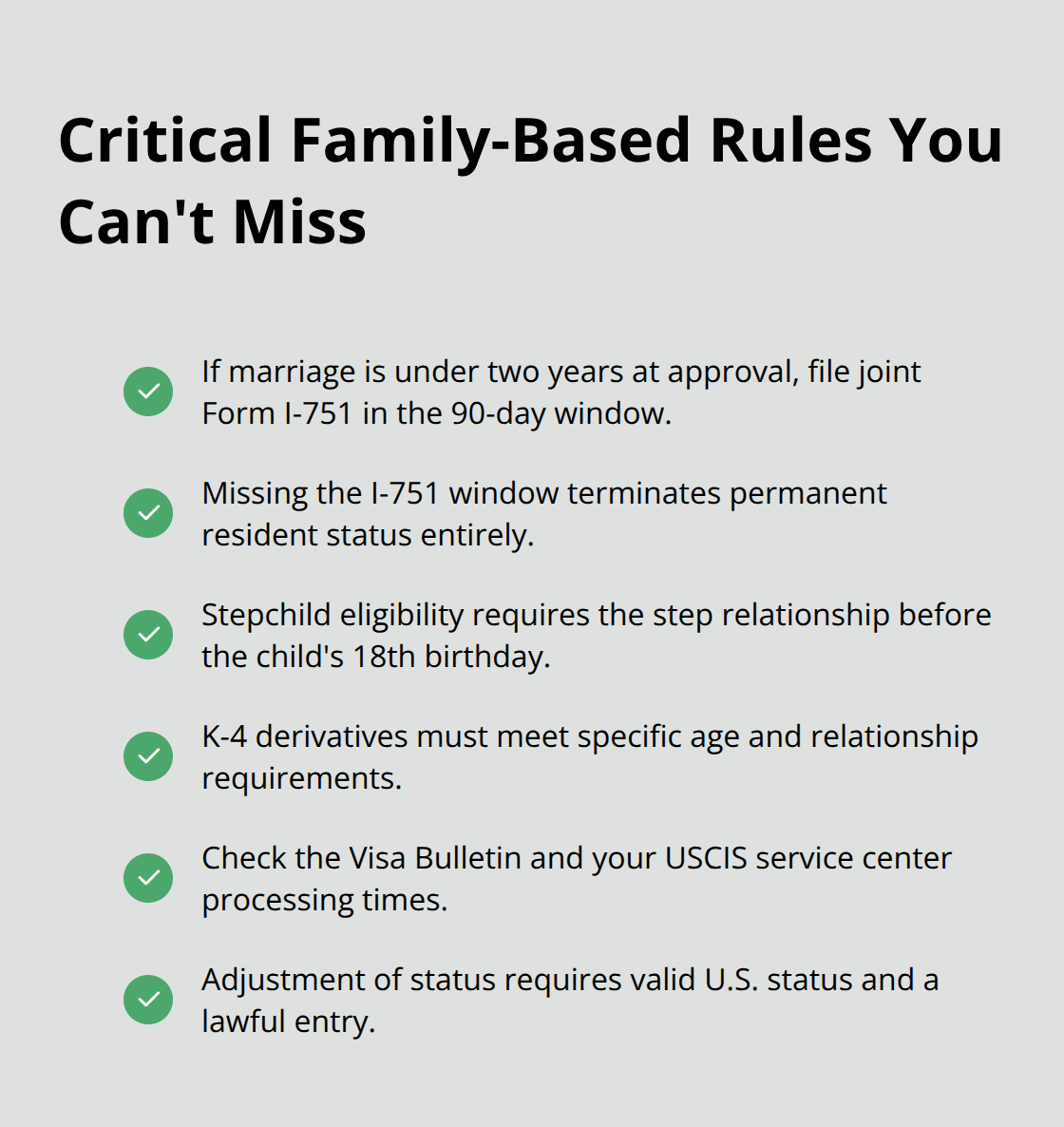
Many families make critical mistakes by handling immigration paperwork alone, particularly when preference categories or conditional residency rules apply. If your marriage is less than two years old when your spouse receives a green card, that card becomes conditional, requiring both spouses to file Form I-751 jointly to remove conditions within a 90-day window before expiration. Missing this deadline terminates permanent resident status entirely-there is no grace period.
Similarly, if you sponsor a stepchild, the step-parent relationship must have been created before the child’s 18th birthday, or the child becomes ineligible for K-4 or immediate relative status. These rules contain no flexibility.
An immigration attorney reviews your specific relationship circumstances, your family member’s current immigration status, your service center’s processing times, and the visa bulletin data for your beneficiary’s country of birth. This analysis reveals which pathway-immediate relative, preference category, K-1, K-3, or adjustment of status-actually gets your family member to permanent residency fastest and most cost-effectively. The difference between choosing the right path and choosing wrong can be years of waiting or thousands of dollars in unnecessary fees.
Final Thoughts
Family-based green cards offer multiple pathways to permanent residency, each with distinct advantages depending on your circumstances. Immediate relatives of U.S. citizens move fastest, skipping preference queues entirely and reaching permanent residency within months, while preference categories require patience but remain viable for siblings, adult children, and married children of citizens. K-1 and K-3 visas serve specific situations-K-1 for engaged couples and K-3 for married couples facing I-130 delays-but often cost more and take longer than direct immigrant visa filing.
The rules governing family-based immigration contain no flexibility. Conditional green cards require joint I-751 filings within 90 days or permanent resident status terminates, stepchild relationships must be established before age 18, and K-4 derivatives must meet specific age and relationship requirements. Missing deadlines or misunderstanding eligibility rules costs years of waiting or thousands in wasted fees.
Your next step involves identifying which pathway fits your family’s situation by checking the Department of State Visa Bulletin for your beneficiary’s country of birth and preference category, reviewing USCIS processing times for your specific service center, and determining whether your family member is currently in the U.S. with valid status or abroad. We at Law Offices of Jeffrey A. Thompson assist clients in navigating family-based immigration from paperwork to overcoming legal hurdles, and our team helps you understand which pathway works best for your family and guides you through every step toward permanent residency. Contact us at jeffreyathompsonlaw.com to discuss your family’s immigration journey.
Share this post: