Family Immigration Case Evaluation: Is This Path Right for Your Family?
April 27, 2026
Family immigration decisions shape your future, and getting them wrong can cost years and thousands of dollars. At Law Offices of Jeffrey A. Thompson, we help families navigate these complex pathways with clarity and confidence.
A proper family immigration case evaluation examines your eligibility, financial capacity, and realistic timeline before you invest time and resources. This guide walks you through the key factors that determine whether a family immigration pathway is right for your situation.
Which Family Relationship Qualifies for Immigration Sponsorship
The relationship between you and your relative determines everything in family immigration. U.S. citizens can sponsor spouses, unmarried children under 21, unmarried adult children, married children, parents, and siblings. Lawful permanent residents have fewer options-they can only sponsor spouses and unmarried children. This distinction matters enormously because it affects your timeline, visa availability, and overall feasibility.
If you’re a permanent resident hoping to sponsor a parent or sibling, that path simply doesn’t exist under current law. Immediate relatives of U.S. citizens face the shortest waits. According to USCIS data from early 2026, the median processing time for an I-130 petition filed by a U.S. citizen reaches about 14.5 months, while petitions filed by lawful permanent residents average around 35 months. Spouses of U.S. citizens typically see processing times between 11 and 17 months, and parents of U.S. citizens fall in the 10 to 13 month range. Unmarried children under 21 of U.S. citizens process in roughly 10 to 13 months as well.
When Visa Quotas Create Years of Waiting
Everything changes when you move beyond immediate relatives. Unmarried adult children of U.S. citizens face 52 to 100 months of waiting. Married children of U.S. citizens wait around 13 to 14 years.

Siblings of U.S. citizens experience the longest delays, typically 14 to 16 years. These aren’t theoretical numbers-they reflect real visa queue wait times by country and preference category.
Your country of origin dramatically affects your position in this queue. If your relative is from Mexico and falls into the married-child category, you’ll face substantially longer waits than someone from a lower-demand country. The Department of State’s Visa Bulletin updates monthly with current cutoff dates by country and preference category, so your actual wait depends on both your relationship type and your nationality.
Spousal Sponsorship and Conditional Residence
Marriage-based immigration carries additional rules that catch many families off guard. Foreign spouses of U.S. citizens receive conditional permanent residence for two years rather than immediate permanent status. Within 90 days before your second anniversary, you and your spouse must file a joint petition to remove conditions. If you’re in a bona fide marriage, this process moves forward smoothly, but if USCIS questions the legitimacy of your relationship, you face additional scrutiny and potentially denial.
The Child Status Protection Act shields children sponsored by U.S. citizens from aging out of their category if they marry before the petition approves, but children sponsored by permanent residents lack this protection. If your unmarried child turns 21 while a lawful permanent resident’s petition is pending, the child may shift to a lower preference category with longer waits. Age matters, and timing matters significantly.
Adoption-Based Immigration Requirements
Adoption-based immigration follows different rules entirely. If you’re adopting a foreign child, the child must be under 16 at the time of adoption petition filing and must have been orphaned or abandoned. Intercountry adoptions require approval from your state and from the child’s country of origin, adding months or years to the process. These pathways overlap and interact in ways that demand careful planning.
Your specific circumstances-your relationship type, your nationality, your sponsor’s immigration status, and whether you’re already in the United States-determine which pathway makes sense for your family. Understanding these distinctions helps you evaluate whether family immigration is feasible for your situation and what realistic timeline you should expect.
Can You Afford Family Immigration
Income Requirements and the Affidavit of Support
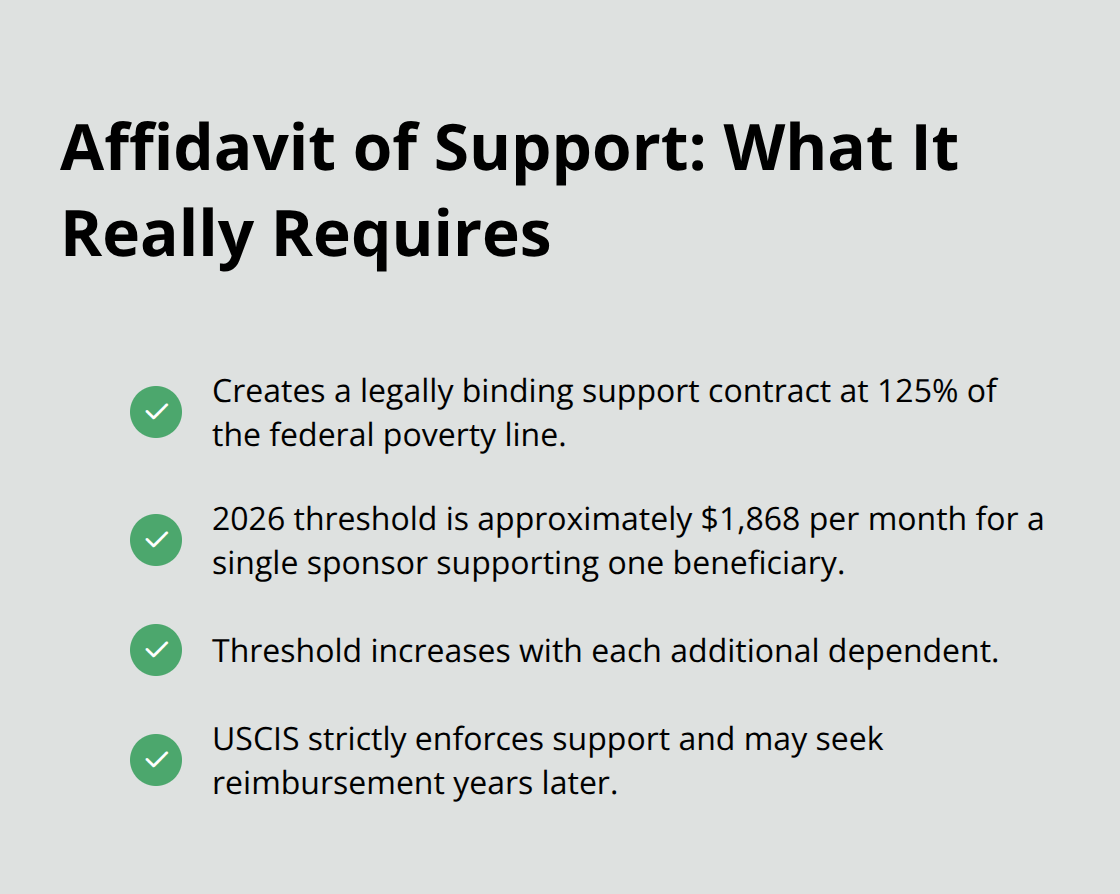
Your income determines whether your family immigration petition moves forward or stalls before it starts. The Affidavit of Support, Form I-864 income requirements, creates a legally binding contract that commits you to support your relative at 125 percent of the federal poverty line for the duration of their green card. As of 2026, that threshold stands at approximately $1,868 monthly for a single sponsor supporting one beneficiary, rising significantly with each additional dependent. USCIS enforces this requirement strictly, and sponsors face pursuit for unpaid support obligations years after their relative received permanent residence.
Your tax returns, W-2s, and recent pay stubs must prove consistent income meeting these thresholds. Self-employed applicants encounter heightened scrutiny; you must provide two years of tax returns and possibly a CPA letter documenting business income. Many families discover mid-process that they need a joint sponsor, which delays everything by weeks or months while they locate someone willing to sign and then verify that person’s financial qualifications.
Finding a Joint Sponsor When Your Income Falls Short
If your income falls short, you cannot proceed without a joint sponsor-someone with sufficient income who agrees to share financial responsibility. This isn’t optional paperwork. A joint sponsor financial obligations and legal responsibility assumes the same legal obligations as the primary sponsor and must meet the same income thresholds. The process of locating a qualified joint sponsor, obtaining their financial documentation, and verifying their commitment adds substantial time to your case. Many families underestimate how difficult this step becomes, particularly when relatives lack the income or willingness to take on legal liability.
Medical Examinations and Background Clearances
Medical and background clearances happen alongside financial verification and carry their own timelines and costs. Your relative must complete Form I-693, the medical examination, with a USCIS-designated civil surgeon who charges between $300 and $800 for the evaluation. This exam cannot occur until after your I-130 petition receives approval, so you cannot rush it. Background checks run through multiple databases and can flag issues you didn’t anticipate-prior arrests, immigration violations, or inconsistencies in biographical information all trigger Requests for Evidence that add months to processing.
If your relative has criminal history, even minor offenses, consult an attorney immediately because some convictions make someone permanently ineligible for immigration benefits. The stakes here demand professional guidance to assess whether your relative’s background creates obstacles that require waivers or alternative pathways.
Processing Delays and Recent Policy Changes
Processing delays stem not from your actions but from USCIS capacity constraints and policy changes. As of early 2026, USCIS backlogs remain substantial, and the agency implemented new fee structures, including a $250 consular visa stamping fee introduced in February 2026. Additionally, in January 2026, the Department of State paused immigrant visa issuance for roughly 75 countries, affecting family-based visas processed abroad with no clear timeline for resumption.
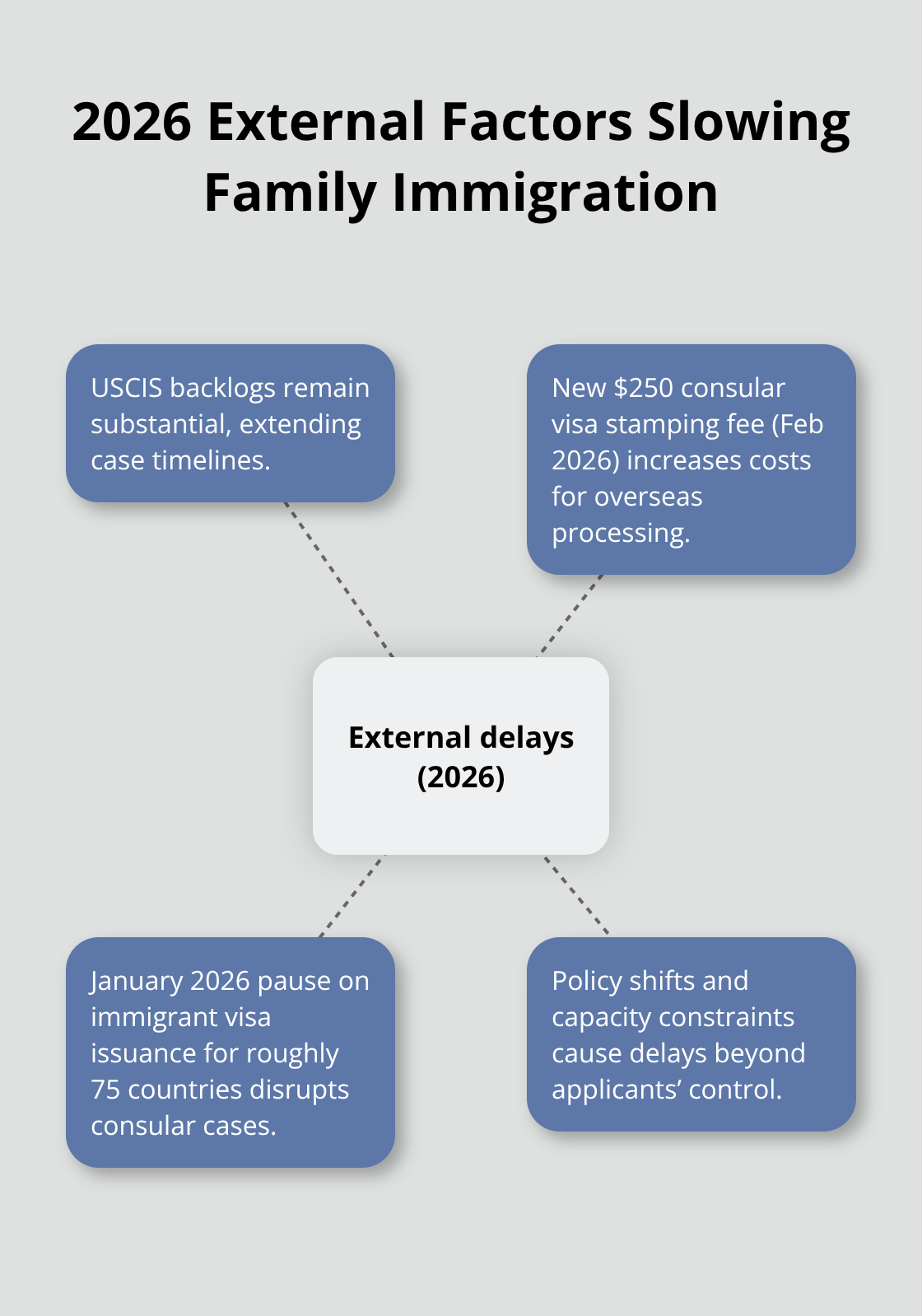
These external factors create uncertainty that extends beyond your control.
If your relative is already in the United States, adjustment of status through Form I-485 may bypass consular processing delays, but you must act quickly because immigration enforcement activity intensified throughout 2025 and 2026, creating genuine risk for mixed-status families. The window for certain relief options narrows rapidly, and waiting costs time you cannot recover. Understanding your financial capacity and your relative’s eligibility sets the foundation, but evaluating your specific circumstances requires professional assessment to identify which pathway minimizes delays and maximizes your chances of success.
What Stops Family Immigration Cases and How to Fix Them
Documentation Errors and How to Prevent Them
Documentation errors derail more family immigration cases than any other single factor. USCIS requests evidence for missing items constantly, and each request adds time to your timeline. Marriage certificates must be originals or certified copies, not photocopies. Birth certificates require official seals from the issuing government. If your relative was adopted, you need court-certified adoption decrees, not hospital paperwork. Divorce decrees must show final judgment dates.
Missing or incomplete documents force USCIS to issue a Request for Evidence, which you have 12 months to answer before they deny your petition. Many families scramble to obtain documents from foreign governments that process requests slowly or demand payment in advance. Start collecting documentation immediately, not after you file. Maintain both physical and digital copies of every document in a secure location, organized by category and clearly labeled with dates. If your relative is from a country with unstable record-keeping systems, obtain certified documents now while you can still access them directly.
Visa Availability and Country-Specific Quotas
Visa availability creates a different obstacle entirely, one you cannot overcome through better paperwork or faster action. The Department of State’s Visa Bulletin determines when visas become available for your category and country, and this process operates on timelines completely outside your control. If you fall into the family-preference categories rather than immediate relatives, your position in the queue depends on your priority date (the date your I-130 petition was filed), your country of origin, and annual per-country caps that limit how many visas go to any single nation.
Mexico, the Philippines, India, and China consistently face the longest waits because demand from these countries exceeds available visas year after year. Your nationality might mean a significantly longer wait for identical family relationships. Understanding current family reunification policy helps you plan your life accordingly rather than hoping the timeline improves.
Responding to Denials and Appeals
Denials happen despite thorough preparation, and your response determines whether you recover or lose years of progress. USCIS denies family immigration petitions primarily for three reasons: insufficient evidence of the qualifying relationship, failure to meet financial requirements, or grounds of inadmissibility affecting your relative. If USCIS denies your I-130, you have no appeal option, but you can file a motion to reopen if you have new evidence or a motion to reconsider if USCIS made a legal error. These motions must be filed within 30 days of denial.
If USCIS denies adjustment of status, you can request administrative review or appeal to the Board of Immigration Appeals within 30 days. The difference between these remedies matters enormously, and choosing the wrong approach wastes your 30-day window. Grounds of inadmissibility include criminal history, fraud, previous immigration violations, and health conditions, and many of these carry permanent bars to immigration unless you obtain a waiver before consular processing. If your relative has prior removal orders, certain waivers are unavailable entirely. Consult with an immigration attorney immediately upon denial rather than attempting to refile without understanding why USCIS rejected your petition the first time. Filing identical paperwork a second time produces identical results.
Final Thoughts
Family immigration decisions require honest assessment of your relationship type, financial capacity, and realistic timeline before you commit resources to the process. A thorough family immigration case evaluation identifies which pathway actually works for your situation rather than which pathway you hope will work. Your relationship to your relative determines everything-immediate relatives face months of waiting while siblings face years, your income determines whether you proceed alone or scramble to find a joint sponsor, and your relative’s background determines whether USCIS approves your petition or requests evidence that delays everything by months.
The obstacles we discussed-documentation errors, visa quotas, processing delays, and policy changes-are not theoretical problems that happen to other families. They happen constantly, and families who ignore them waste years and thousands of dollars pursuing paths that were never feasible from the start. The Department of State paused immigrant visa issuance for 75 countries in January 2026 with no clear resumption date, USCIS implemented new fees and continues processing backlogs that extend timelines beyond your control, and immigration enforcement intensified throughout 2025 and 2026, creating genuine risk for mixed-status families who delay action.
Professional legal guidance transforms this uncertainty into a clear strategy. We at Law Offices of Jeffrey A. Thompson assist clients in navigating the immigration process from paperwork to overcoming legal hurdles, and an attorney reviews your eligibility, identifies obstacles before they derail your case, responds to USCIS requests correctly, and prepares you for interviews that determine your family’s future. Contact us for a family immigration case evaluation to discuss your relationship type, financial situation, your relative’s background, and your timeline expectations-then decide whether to proceed with confidence or explore alternative options.
Share this post: