Brockton Green Card Help: Local Guidance for Residency
May 8, 2026
Getting a green card is one of the most important decisions you’ll make for your future. At Law Offices of Jeffrey A. Thompson, we help Brockton residents navigate the immigration system with clarity and confidence.
Whether you’re applying through family, employment, or another pathway, understanding your options matters. This guide walks you through eligibility requirements, the application process, and how to overcome common obstacles.
Four Pathways to Your Green Card
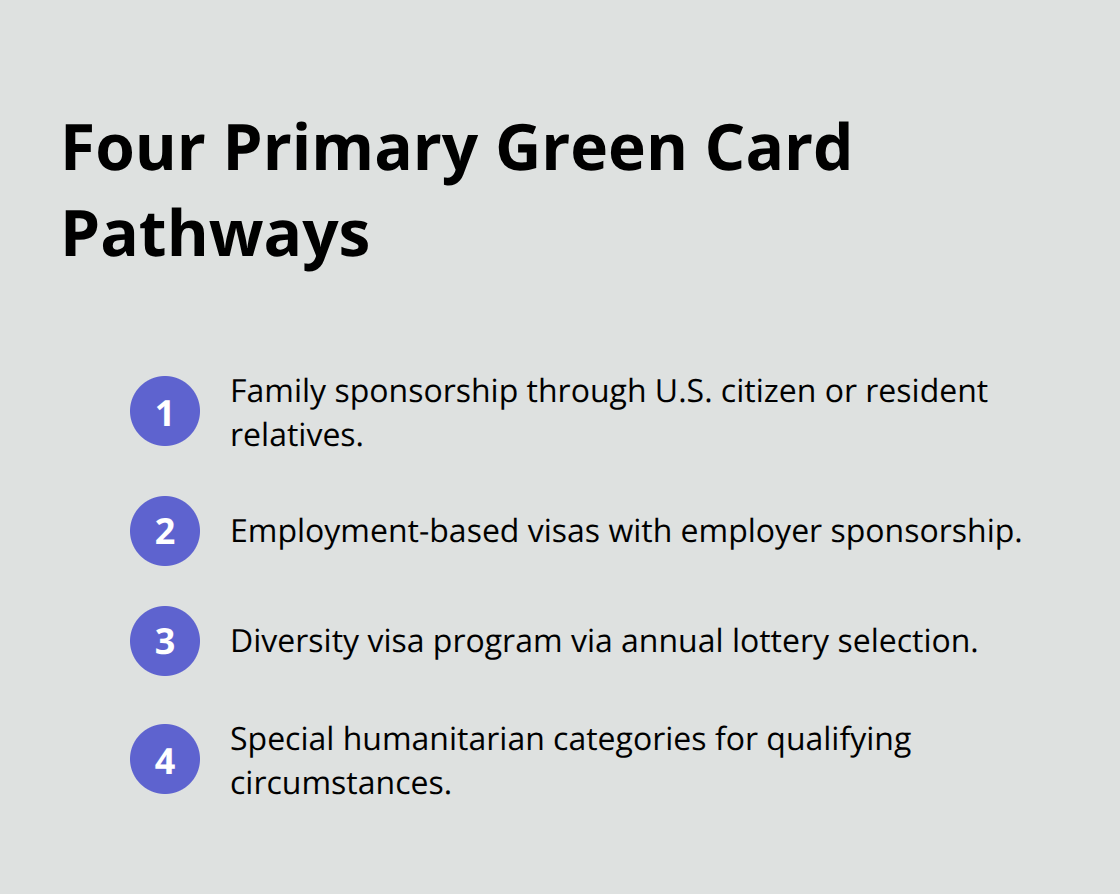
Your eligibility for a green card depends entirely on which category you qualify under, and this choice shapes your entire timeline and strategy. Brockton residents typically pursue four primary routes: family sponsorship, employment-based visas, diversity visas, and special humanitarian categories. Understanding which path fits your situation prevents costly filing mistakes.
Family-Based Sponsorship: The Fastest Route
Family-based green cards move fastest when a U.S. citizen sponsors you directly. According to USCIS data from May 2025, immediate relatives of U.S. citizens complete Form I-130 processing in roughly 14.4 months and Form I-485 adjustment of status in about 9.5 months. The critical advantage here is that visa numbers never run out for immediate relatives, meaning you can file both forms simultaneously-a process called concurrent filing-rather than waiting months or years for visa availability.
If you’re the spouse or unmarried child of a green card holder instead, expect significantly longer waits. The F2A category averages around 35 months of visa bulletin waiting periods on top of petition processing, making this route substantially slower than immediate relative sponsorship.
Employment-Based Green Cards: A Longer Timeline
Employment-based green cards require a job offer and PERM labor certification, which alone adds 18 to 24 months before your I-140 petition can even be filed. USCIS data shows I-140 processing takes roughly 7.6 months for priority workers in the EB-1 category, but EB-2 and EB-3 applicants from India and China face multi-year retrogression delays due to per-country visa caps.
Diversity Visas and Humanitarian Categories
The diversity visa program operates on an annual cycle with fixed deadlines; selected applicants must complete all processing within the fiscal year, and consular processing typically takes 3 to 6 months after you submit documents. Special categories like asylum allow Form I-485 filing one year after you receive status, with processing averaging 14.5 months according to USCIS records.
Choosing the Right Category Matters
Your strategy should hinge on which category genuinely fits your circumstances. Filing in the wrong category leads to outright rejection and lost filing dates, so confirming eligibility before submitting anything is non-negotiable. The next section walks you through the specific documentation and forms you’ll need to prepare, regardless of which pathway you pursue.
Preparing Your Application Package
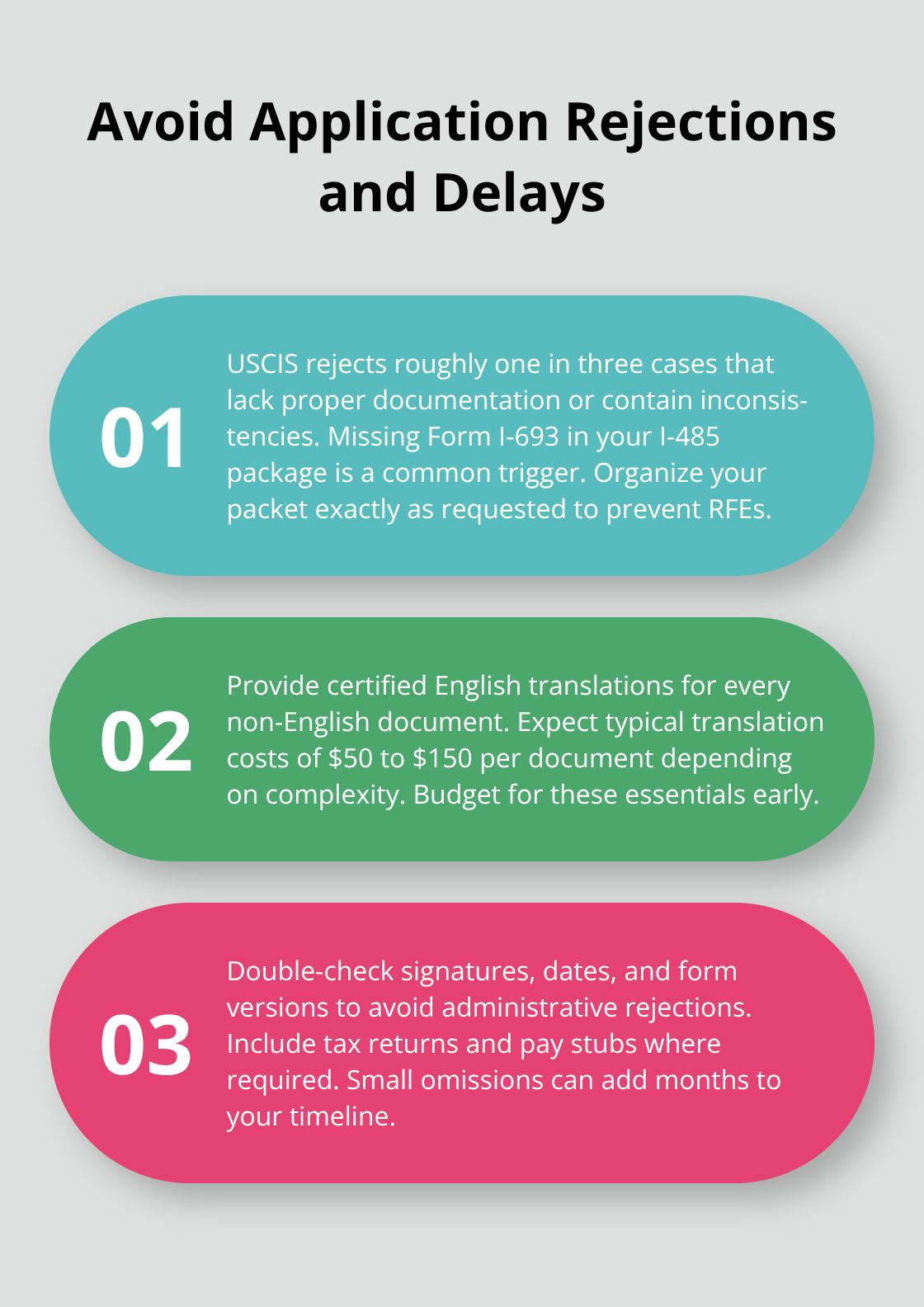
Incomplete applications guarantee delays. USCIS rejects roughly one in three cases that lack proper documentation or contain inconsistencies, according to USCIS adjudication data. The medical exam form (I-693) missing from your I-485 package ranks among the most common rejection triggers. You must obtain a certified English translation for every non-English document you submit, and translation costs typically run $50 to $150 per document depending on complexity.
Gather Essential Documents First
You need your passport, birth certificate, marriage certificate if applicable, police clearance from every country where you lived more than six months, and proof of financial support through Form I-864 (Affidavit of Support). Your sponsor’s income must reach at least 125% of the federal poverty line for your household size, backed by recent tax returns and pay stubs. If you qualify under INA 245(i), you must file Form I-485 Supplement A alongside your main petition. Submit everything in the exact order USCIS requests-disorganization triggers Requests for Evidence that add months to your timeline.
Pay Attention to Fees and Waivers
Current filing fees stand at $640 plus an $85 biometrics fee. You may qualify for a fee waiver if household income falls below 200% of the federal poverty line. Calculate your household size carefully before determining whether you meet waiver thresholds, as miscalculation can delay your application.
Location Affects Your Processing Timeline Significantly
Where you file matters more than most applicants realize. Large urban offices like New York took over 24 months to process I-485 cases according to USCIS processing time data, while smaller Mountain West offices completed cases in under 12 months. After submission, you’ll receive a receipt notice and a biometrics appointment within weeks. Many cases then proceed to an interview where inconsistencies between your application and travel history surface.
Prepare Thoroughly for Your Interview
Bring original documents to your interview, not copies, and if any documents aren’t in English, bring certified translations. Prepare for questions about your employment, family relationships, and financial situation. Common denial reasons include failure to establish eligibility, insufficient financial support documentation, medical exam deficiencies, undisclosed criminal history, or material misrepresentation on your application. Denied cases can be appealed through Form I-290B, though success rates remain limited.
An immigration attorney can identify weaknesses in your package before submission and help you respond to evidence requests that might otherwise result in denial. As you move forward with your application, understanding how long green card processing really takes and how to handle the interview itself becomes your next priority.
What Really Blocks Green Card Approvals
Visa availability ranks as the single most consequential obstacle in green card processing, yet most applicants misunderstand how it works. For family-based categories outside immediate relatives, the Department of State Visa Bulletin controls when you can actually file your I-485. If your priority date hasn’t reached the current date listed in the bulletin for your category and country, USCIS will reject your entire application and you lose your receipt date. This isn’t a minor administrative hiccup-it’s a complete filing failure.
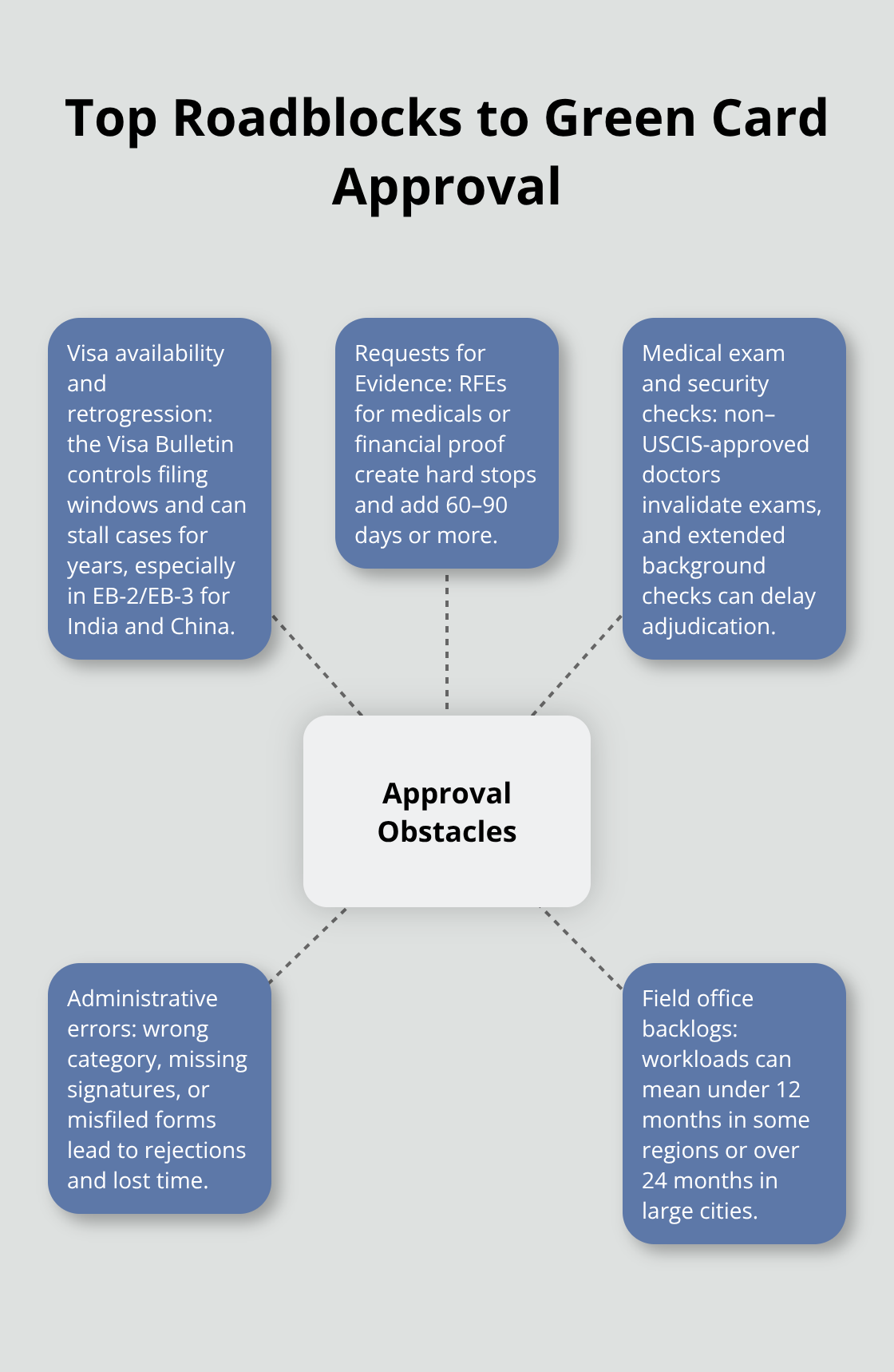
Applicants from India and China in EB-2 and EB-3 employment categories face multi-year retrogression delays due to per-country visa caps, meaning you could wait three to five years before your priority date becomes current, regardless of how quickly USCIS processes other parts of your case.
Monitor the Visa Bulletin Monthly
Check the Visa Bulletin every single month starting the moment your petition approves. The geographic lottery of where your application lands directly determines whether you wait 10 months or 36 months for a decision. Large urban USCIS field offices like New York averaged over 24 months for I-485 adjudication as of late 2025, according to USCIS processing time data. Smaller Mountain West offices completed cases in under 12 months during the same period.
Requests for Evidence Add Substantial Delays
USCIS issues RFEs when your medical exam lacks required signatures from a civil surgeon, when your Form I-693 medical report contains inconsistencies, or when your financial documentation fails to prove the sponsor’s income reaches 125% of the federal poverty line. Each RFE response adds 60 to 90 days minimum to your timeline. Processing delays compound this problem significantly, and RFEs create hard stops that extend your wait indefinitely.
Medical and Security Concerns Create Barriers
Your civil surgeon must be USCIS-approved; using any other physician invalidates your medical exam entirely, forcing you to restart the medical process from scratch. Security checks vary wildly by country of origin and prior travel history. Applicants with travel to certain countries may face extended background investigations that delay final adjudication by months. Criminal history, even minor offenses, triggers mandatory waivers through Form I-601 that require separate processing and approval before your I-485 can receive a final decision.
Administrative Rejections Halt Applications
Administrative rejections happen when you file in the wrong category, submit incomplete forms, or include documents out of the requested order. One missing signature on a form or a misfiled petition at the wrong USCIS service center forces the entire application back to you or causes outright rejection. Material misrepresentation-even unintentional inaccuracies about employment history, prior immigration violations, or family relationships-becomes grounds for permanent bars to approval. An immigration attorney can identify weaknesses in your complete package before submission and help you avoid these traps that trigger RFEs or denials. Understanding adjustment of status eligibility and exploring options like DACA and adjustment of status can clarify which pathway applies to your situation.
Final Thoughts
Family sponsorship, employment-based visas, diversity programs, and humanitarian categories each offer distinct timelines and requirements for Brockton residents pursuing permanent residency. Family-based immediate relative sponsorship remains the fastest route, with concurrent filing eliminating months of waiting, while employment-based pathways demand patience through PERM labor certification and potential retrogression delays, especially for applicants from India and China. Diversity visas operate on strict annual deadlines, and asylum provides alternatives for those facing persecution or hardship.
The obstacles you’ll encounter-visa bulletin delays, incomplete documentation, medical exam deficiencies, and administrative rejections-are predictable and avoidable with proper preparation. Monitor the Visa Bulletin monthly, gather documents in the exact order USCIS requests, and obtain medical exams only from USCIS-approved civil surgeons to eliminate the most common rejection triggers. Your interview preparation, financial documentation, and consistency across all forms determine whether you receive approval or face requests for evidence that extend your timeline by months.
Brockton green card help requires understanding which category fits your circumstances, anticipating obstacles before they derail your application, and responding strategically to evidence requests or denials. We at Law Offices of Jeffrey A. Thompson provide compassionate and knowledgeable guidance through every stage of your immigration journey, from initial eligibility assessment through interview preparation and beyond. Contact us today to schedule a consultation and map a realistic timeline for your specific circumstances.
Share this post: