Citizenship Test Study Guide: Master the Questions
June 29, 2026
The US citizenship test covers government structure, constitutional rights, and civic responsibilities. Passing it requires understanding how the three branches work and what it means to be a citizen.
We at Law Offices of Jeffrey A. Thompson created this citizenship test study guide to help you prepare systematically. You’ll find the actual questions you’ll face, organized by topic, plus proven study strategies that work.
US Government and Civics Fundamentals
How Government Power Works in America
The US government operates on a system of separated powers designed to prevent any single branch from becoming too dominant. Congress handles lawmaking with 435 House members serving two-year terms and 100 Senators serving six-year terms. The President commands the military, signs or vetoes laws, and leads the executive branch with Cabinet advisors. The Supreme Court interprets laws and can overturn them if they violate the Constitution. USCIS will ask you about these three branches during your citizenship interview, and understanding how they check each other’s power matters more than memorizing job titles. The test asks specific questions like which branch Congress belongs to or what the President can do with a law Congress passes. Study the actual power relationships, not just definitions.
What the Constitution Really Protects
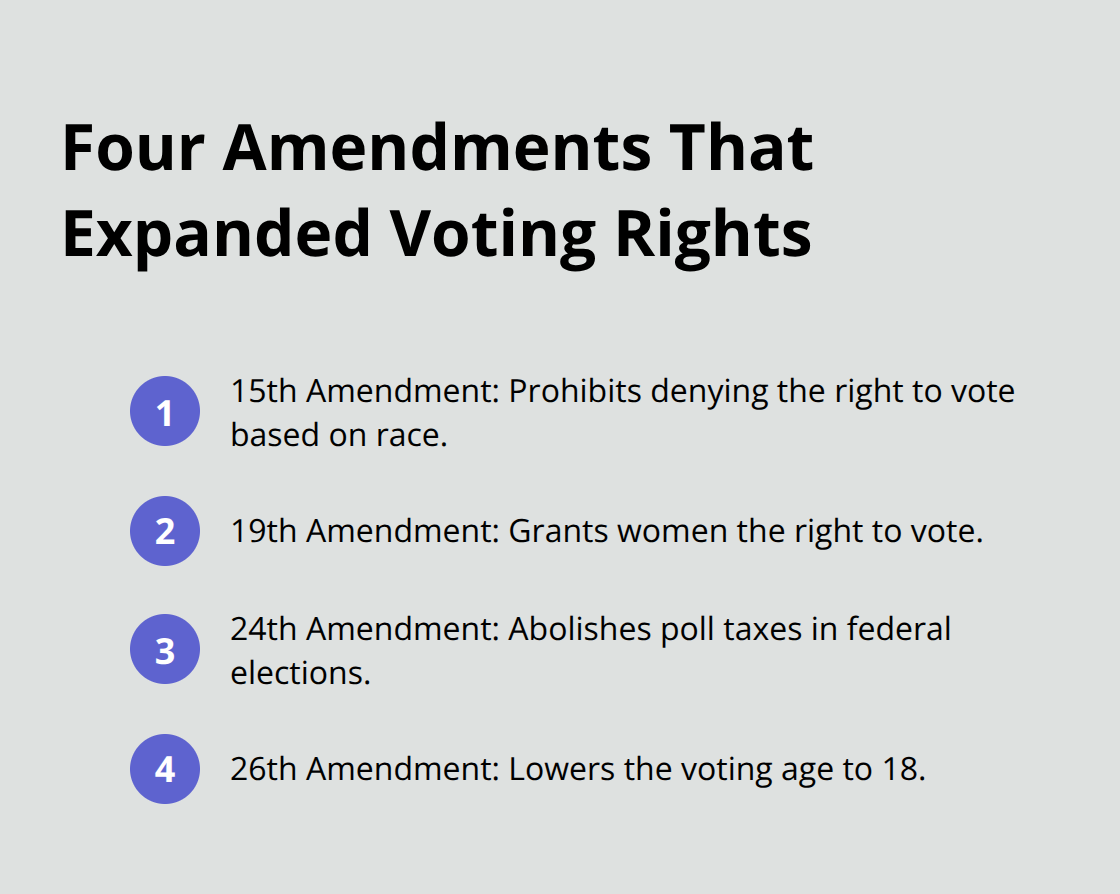
The Constitution serves as the supreme law of the land, and the Bill of Rights and fundamental freedoms-the first ten amendments-guarantees freedoms like speech, religion, and the right to vote. USCIS identifies amendments 15, 19, 24, and 26 as particularly important for the citizenship test because they directly address voting rights and citizenship. The 15th Amendment prohibits denying votes based on race, the 19th gave women voting rights, the 24th abolished poll taxes, and the 26th set the voting age at 18.
You must answer at least 12 of 20 civics questions correctly to pass, and several will test your knowledge of these constitutional protections. Focus on what each amendment actually changed, not just when it was ratified. Test administrators care whether you understand that citizens have both rights and responsibilities to participate in democracy.
Citizenship Duties You Cannot Ignore
Being a US citizen means more than enjoying freedoms-it requires you to follow laws, pay taxes, serve on juries when called, and vote. The citizenship interview specifically tests whether you grasp that rights come paired with obligations. USCIS materials emphasize that understanding civic responsibility separates citizens from permanent residents. When you study for the test, connect each right to its corresponding duty. Freedom of speech exists alongside the responsibility not to use it to harm others or incite violence. The test won’t ask you to recite a list of responsibilities, but questions about government functions and citizen participation will reveal whether you understand this balance. Study how citizens participate in democracy through voting, jury duty, and community involvement rather than treating civics as abstract theory.
Moving Forward With Your Test Preparation
Now that you understand the foundational principles of American government and what the test expects from you, the next section walks you through the actual civics questions organized by branch.
Civics Questions You’ll Actually Face
Legislative Branch Questions Test Your Understanding of Congress
Congress dominates the legislative questions on your citizenship test, and USCIS focuses on how it’s structured and what it can do. You’ll face questions about the two houses-the Senate with 100 members and the House of Representatives with 435 voting members-and the different term lengths that separate them. The test expects you to know that Congress makes federal laws, controls federal spending, and can override a presidential veto. Most candidates struggle with questions about how a bill becomes law because they memorize steps instead of understanding why Congress has multiple stages to pass legislation. Try to study the actual power Congress holds over money and legislation rather than the procedural flowchart. Questions about the legislative branch test whether you understand that Congress represents the people and states, which is why it has two separate chambers with different sizes and term lengths.
Executive Branch Questions Focus on Presidential Powers and Limits
The executive branch questions shift focus to the President’s specific powers and limits. USCIS asks about the President’s role as Commander in Chief, the power to sign or veto laws, and the ability to appoint Cabinet members and judges. Many test-takers miss questions about what the President cannot do-the test includes questions specifically designed to see if you understand presidential limits. The President cannot declare war alone, cannot change laws without Congress, and cannot ignore constitutional protections. Try to study the checks Congress and the courts place on executive power because that’s what separates a constitutional system from an authoritarian one. Your interview officer cares whether you grasp that the President operates within legal boundaries, not above them.
Judicial Branch Questions Emphasize Constitutional Interpretation
The judicial branch questions test your understanding of the Supreme Court and how courts interpret the Constitution. USCIS materials emphasize that the Supreme Court can overturn laws if they violate the Constitution, making it the final authority on constitutional meaning. Candidates often confuse the Supreme Court with lower federal courts, so clarify that the Supreme Court is the highest court and has final say on constitutional questions. Questions ask about the structure of the federal court system and the Supreme Court’s specific power to review laws. You won’t need to memorize the exact number of federal circuits or district courts, but you must understand that courts exist to protect constitutional rights and check the other branches.
The Rule of Law Connects All Three Branches
The test asks about the rule of law concept, meaning everyone-including government officials-must follow the Constitution and laws. Try to study how the three branches limit each other through the system of checks and balances rather than treating each branch as independent. Your citizenship depends on understanding that separated powers prevent tyranny, not on memorizing organizational charts. The next section covers practical study tips that help you move from understanding these concepts to answering test questions correctly under interview conditions.
Practical Study Tips and Test-Taking Strategies
Focus on Official Materials First
The citizenship test rewards focused preparation over endless cramming. USCIS data shows that applicants who study the official 128 civics questions systematically pass at higher rates than those who try to learn everything at once. Start with the official One Nation, One People: The USCIS 2025 Civics Test Study Guide and the 128 Civics Questions and Answers PDF from USCIS.gov-these documents contain exactly what you’ll face during your interview, not approximations or third-party interpretations. Most candidates waste time on general civics knowledge when they should focus on the specific questions in the official pool. Spend your first week reading through all 128 questions without trying to memorize answers, just to understand the topics and difficulty level.
Then organize your study into three-week blocks covering American Government, American History, and Integrated Civics separately. Test yourself on ten questions per day using the official practice test, which simulates the real interview format where you must answer at least 12 of 20 questions correctly to pass. Track which categories trip you up-if you consistently miss questions about the legislative branch, spend extra days on Congress rather than spreading time equally across all topics. The USCIS Citizenship Resource Center also offers civics flashcards in English and Spanish and a Pocket Study Guide for quick reference during short study sessions, both free resources that fit into a commute or lunch break.
Take Full-Length Practice Tests Under Real Conditions
Full-length practice tests under timed conditions matter far more than passive flashcard review. The official civics practice test available through the Citizenship Resource Center forces you to answer questions in the exact format you’ll encounter-an officer asking you questions orally, not written multiple choice. Answer 20 consecutive questions without stopping in at least three separate sessions, which trains your brain to stay focused during your actual interview. After each practice session, review only the questions you missed and study the corresponding section in the official study guide for ten minutes. This targeted review prevents you from wasting time on topics you already know.
If you’re 65 or older with 20 years of permanent residency, you qualify for the simplified version with only 10 questions from a pool of 20, so use the special study materials USCIS provides rather than studying all 128 questions. The Citizenship Resource Center website includes these modified materials specifically for applicants with this status. Candidates who take at least five full practice tests before their interview score consistently higher than those who study materials without practicing under test conditions.
Use Active Recall to Lock Information Into Memory
Reading the study guide once won’t stick in your memory-you need to actively retrieve information from your brain repeatedly. Cover the answers in the official 128 Civics Questions and Answers PDF and try to answer each question from memory before checking your response. This active recall method forces your brain to work harder and creates stronger memory pathways than passive reading. The 100 Civics Questions with MP3 Audio resource works particularly well for retention because hearing questions aloud engages a different part of your brain than reading silently.
Listen to the audio version once, then answer the questions without looking at the text, then check your answers. Repeat this cycle three times per week for four weeks. For specific dates and facts-like the Declaration of Independence adopted on July 4, 1776, or the Constitution containing 27 amendments-create a simple timeline on paper and add one date per day rather than trying to memorize all dates at once. Your brain retains information better when you space learning over weeks rather than cramming in days. The Citizenship Resource Center’s Learn About the United States: Quick Civics Lessons breaks content into modular sections perfect for this spaced-repetition approach, allowing you to study one lesson per day for manageable, consistent progress.
Final Thoughts
Passing your citizenship test comes down to studying the official 128 civics questions systematically, practicing under real interview conditions, and understanding concepts rather than memorizing isolated facts. This citizenship test study guide walks you through the actual questions you’ll face, organized by the three branches of government, plus proven strategies that work. After you follow the study approach outlined here-starting with official USCIS materials, taking full-length practice tests, and using active recall-you’ll feel ready for your interview.
Once you pass your exam and take the oath of allegiance, your responsibilities as a US citizen begin in earnest. You’ll gain the right to vote in all elections, apply for a US passport, and sponsor family members for immigration. You can also run for public office and serve on juries, both ways to participate directly in democracy. The USCIS Citizenship Resource Center continues offering free resources even after you pass-materials about your rights and responsibilities as a citizen, information about voting registration, and guides to civic participation.
If you face complications during your naturalization process or need guidance navigating immigration law, we at Law Offices of Jeffrey A. Thompson in Brockton, Massachusetts, specialize in immigration matters and can assist you in overcoming legal hurdles. Attorney Thompson provides expert guidance through the entire process, from paperwork to interview preparation and beyond. Contact us for compassionate, knowledgeable legal representation tailored to your specific needs as you pursue your American dream.
Share this post: