Naturalization Oath Ceremony Alternatives: What Options Do You Have?
July 3, 2026
Becoming a U.S. citizen is a major milestone, but the oath ceremony doesn’t have to follow a one-size-fits-all approach. We at Law Offices of Jeffrey A. Thompson know that naturalization oath ceremony alternatives exist for those who need them.
Whether you face health challenges, accessibility needs, or serve in the military, options are available. This guide walks you through what’s possible and how to pursue the path that works best for your situation.
What Happens at Your Oath Ceremony
The standard naturalization oath ceremony is where you officially become a U.S. citizen. USCIS administers the oath at administrative ceremonies, which represent the default path for most applicants. The ceremony follows a structured program that typically includes the national anthem, welcoming remarks, a call of countries to recognize applicants’ origins, and the central moment: the Oath of Allegiance. You recite the oath, and only after you take it do you become a legal citizen. The ceremony also features the Pledge of Allegiance and concludes with presentation of your Certificate of Naturalization (Form N-550). Guest speakers may participate, but they focus strictly on citizenship and civic themes, keeping remarks to 5 to 10 minutes. After the oath, you receive important materials including the Important Information for New Citizens form, the U.S. Citizenship Welcome Packet, an American flag, the Citizen’s Almanac, and a pocket-size Declaration of Independence and Constitution. Many ceremonies also provide voter registration assistance on-site, and you can register immediately after you take the oath. Some ceremonies include multimedia presentations like Faces of America and America the Beautiful to celebrate the naturalization process.
Timing and Location Details
USCIS schedules your ceremony after your N-400 application receives approval. You will receive Form N-445 in the mail with the date, time, and location of your ceremony. In some cases, USCIS can schedule your ceremony on the same day as your naturalization interview if availability allows, which speeds up the process significantly. If the scheduled date does not work for you, you must return Form N-445 with a letter requesting a different date. Failing to appear more than once may result in denial of your application, so you should take the scheduled date seriously. You must complete the questionnaire section of Form N-445 before you arrive at the ceremony. At check-in, a USCIS officer reviews your Form N-445, verifies your eligibility, and collects your travel documents and Permanent Resident Card. You generally no longer need the Permanent Resident Card after the oath, though exceptions exist for lost cards with documentation or certain military status situations.
What to Bring and Expect
You should arrive with your completed Form N-445 and valid travel documents. Federal property rules apply at ceremony venues, so prohibited items under Federal Protective Service guidance are not allowed. After you take the oath and receive your Certificate of Naturalization, you should review it immediately for errors before you leave the ceremony. If you spot mistakes, you can request a replacement later. The ceremony provides information and staff to help with next steps. Many ceremonies offer passport application assistance, since new citizens often need a U.S. passport immediately. You can also apply for a passport at post offices or through the State Department’s travel website. Finally, you should update your Social Security Administration record by submitting Form SS-5, but you should wait at least 10 days after the ceremony to allow USCIS records to sync with SSA systems.
Moving Forward After Your Ceremony
The oath ceremony marks the official moment you become a citizen, but your work does not end there. You now have access to benefits and responsibilities that come with citizenship, and several administrative steps remain. Understanding what happens next helps you transition smoothly into your new status and take full advantage of your rights as a U.S. citizen.
Alternative Oath Ceremony Options
Not every applicant can attend a standard USCIS administrative ceremony on the scheduled date, and federal policy recognizes this reality. Two legitimate alternatives exist: judicial oath ceremonies and expedited oath ceremonies. A judicial oath ceremony allows you to take the oath in front of a court rather than at a USCIS facility. When you elect this path, USCIS notifies the court clerk in writing that you meet all eligibility requirements, and the court then administers your oath.
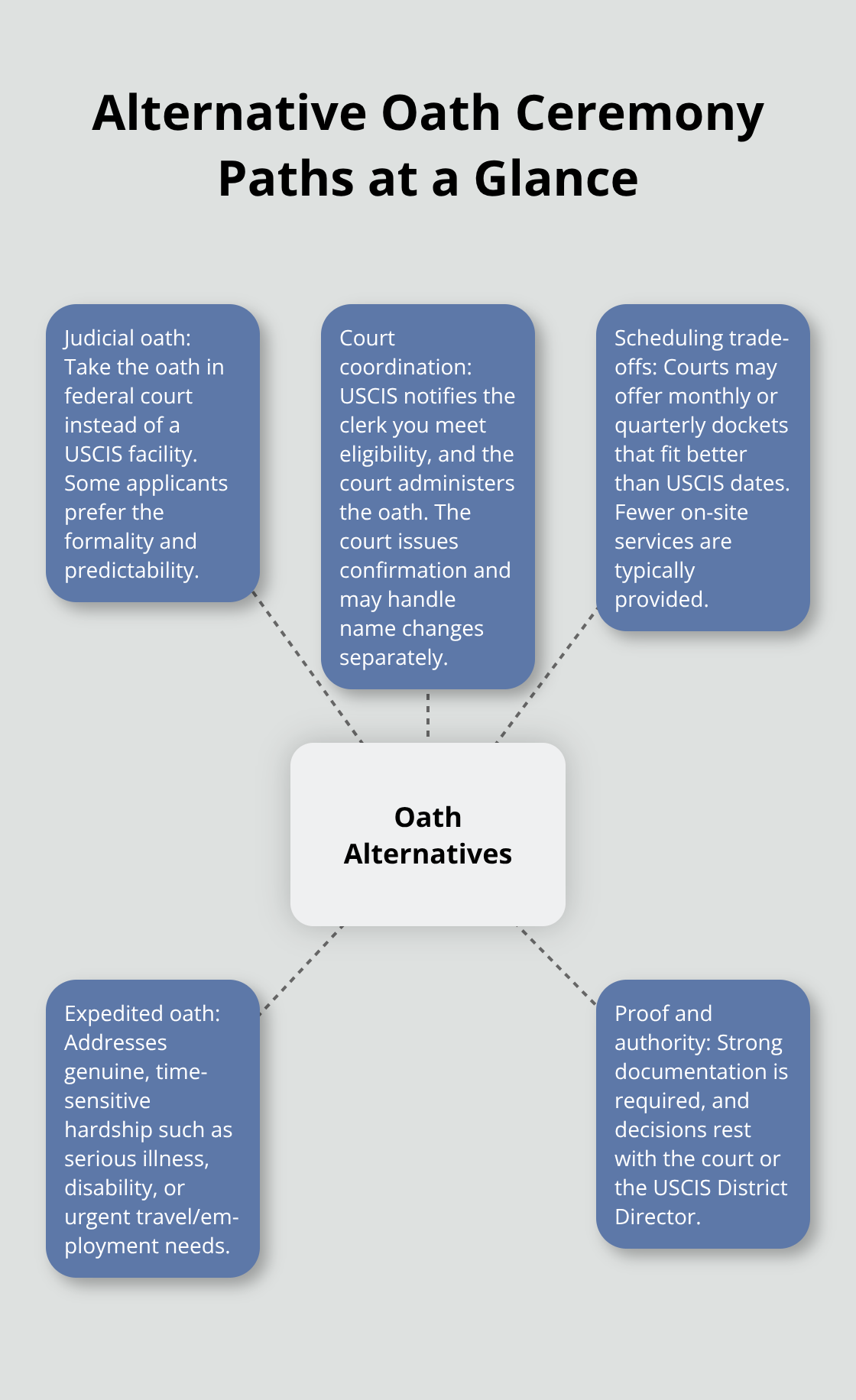
The court issues documentation confirming the oath was administered and handles any name changes separately. This option works well if you prefer the formality of a courtroom setting or if local courts offer more flexible scheduling than USCIS offices. An expedited oath ceremony addresses time-sensitive situations and requires you to demonstrate sufficient cause to the court or USCIS District Director. Acceptable reasons include serious illness affecting you or a family member, permanent disability that prevents you from attending the scheduled ceremony, developmental disability, advanced age that makes the standard ceremony impractical, or urgent employment or travel circumstances. USCIS will verify whatever information you provide to confirm its legitimacy.
When Judicial Oaths Make Sense
Choosing a judicial oath ceremony offers predictability if your local court maintains established regular naturalization dockets. Some courts handle naturalization oaths monthly or quarterly, which gives you scheduling options that might align better with your circumstances than USCIS administrative ceremonies. Contact your local federal district court’s clerk of court to ask about their naturalization oath procedures and available dates. Courts vary significantly in how they handle these ceremonies, so direct communication matters. The downside is that court-administered oaths typically lack the supportive materials and services provided at USCIS ceremonies, such as voter registration assistance, passport application help, and citizenship resource packets. You will still take the oath and become a citizen, but the streamlined court process means fewer resources available immediately after the ceremony.
Expedited Oaths for Compelling Circumstances
An expedited oath is not guaranteed and depends entirely on merit and the decision-maker’s assessment of your circumstances. USCIS and courts take these requests seriously only when genuine hardship exists. If you face a documented medical emergency, significant disability, or a legitimate time-sensitive employment or travel need, you have grounds to petition. Documentation is essential: medical records from a licensed physician, disability certification, or employment letters demonstrating urgency strengthen your request substantially. Vague requests without supporting evidence will be denied. You must submit your expedited oath request through official channels, typically to the USCIS District Director or the court handling your case, depending on which entity has jurisdiction over your naturalization oath. If you request an expedited oath while waiting for a court ceremony, USCIS must promptly forward your request to the court. Courts with exclusive authority over oath administration can either hold an expedited judicial ceremony themselves or refer you to USCIS if an expedited judicial oath proves impractical. Once a court grants an expedited oath, the court notifies the District Director in writing and relinquishes jurisdiction for your case.
Understanding Your Path Forward
The choice between judicial and expedited oaths depends on your specific situation and timeline. If scheduling flexibility matters most, a judicial oath may serve you well. If time-sensitive circumstances apply to you, an expedited oath addresses your needs directly. Either path requires you to communicate clearly with the appropriate authority and provide solid documentation to support your request. The next section explains how we at Law Offices of Jeffrey A. Thompson help you assess which alternative fits your circumstances and prepare the documentation that strengthens your case.
How We Help You Navigate Alternative Oath Ceremonies
Assessing Your Eligibility for an Alternative Path
We at Law Offices of Jeffrey A. Thompson understand that judicial and expedited oath ceremonies involve real decisions with timing implications, and incorrect choices cost you months of delay. The first step is honest assessment of whether an alternative ceremony actually fits your situation. Many applicants assume they qualify for expedited oaths when their circumstances fall short of the legal threshold, and submitting a weak request wastes time and damages credibility with USCIS or the court.
We evaluate your specific facts against the criteria that decision-makers actually apply. Serious illness requires medical documentation from a licensed physician stating the condition’s severity and how attending a standard ceremony poses genuine risk. Advanced age alone does not qualify; you must demonstrate that the ceremony’s physical demands or length would be improper for your specific situation. Employment or travel urgency demands written verification from an employer or organization showing a concrete deadline and explaining why the standard ceremony date creates hardship. Vague claims that you have a busy schedule do not meet the bar.
Choosing Between Judicial and Expedited Oaths
Once we determine whether your circumstances support an alternative path, we help you select the right choice. A judicial oath makes sense if your local federal district court maintains active naturalization dockets and you want more scheduling control. We contact your court’s clerk of court directly to learn their procedures, available dates, and what materials they provide. This research prevents surprises and helps you understand what to expect on ceremony day.
If an expedited oath is your path, we prepare documentation that persuades the decision-maker. Medical records need translation if they are not in English, and they must clearly connect the condition to ceremony attendance. Employment letters must come from someone with authority to sign them and must specify the actual deadline driving your request.
Preparing Documentation That Strengthens Your Request
Preparing your paperwork correctly separates approvals from denials. USCIS receives thousands of expedited oath requests monthly, and most are denied because applicants submit incomplete or unconvincing evidence. We draft your request to the District Director or court with specificity, addressing the regulatory criteria directly and explaining your circumstances in language that decision-makers recognize.
We also ensure your Form N-445 is completed accurately before the ceremony date, because errors at check-in delay you further and can trigger attendance issues. Throughout your naturalization process, we stay in communication with USCIS or the court to track your case status and alert you to any requests for additional information. If the court or USCIS asks questions about your alternative oath request, we respond promptly with whatever clarification or documentation they need.
Preparing for Life After Your Oath
You still receive your Certificate of Naturalization regardless of which oath path you take, and you still need to update your Social Security record within 10 days and apply for a U.S. passport if you need one for travel. A judicial oath typically lacks the on-site voter registration and passport application assistance that USCIS ceremonies provide, so we help you understand what steps you must handle separately. This active management prevents your case from stalling in a queue and removes uncertainty from a process that already feels high-stakes.
Final Thoughts
Your naturalization oath ceremony marks the moment you officially become a U.S. citizen, but the path to that moment does not have to follow a single rigid format. Naturalization oath ceremony alternatives exist specifically because life circumstances vary, and federal policy recognizes that one-size-fits-all scheduling does not work for everyone. Whether you pursue a judicial oath through your local federal court or request an expedited ceremony based on documented hardship, legitimate options are available to you.
The standard USCIS administrative ceremony remains the default path for most applicants and offers valuable resources like voter registration assistance, passport application help, and citizenship materials all in one place. However, if scheduling conflicts, health concerns, or time-sensitive employment needs apply to your situation, judicial and expedited oaths provide real alternatives that address your specific circumstances. A judicial oath gives you access to court-administered ceremonies that may offer more flexible scheduling than your local USCIS office, while an expedited oath addresses genuine hardship when you can document serious illness, disability, or compelling travel or employment circumstances with supporting evidence.
The key to success with any alternative path is preparation and honest assessment of whether your circumstances actually meet the legal criteria. We at Law Offices of Jeffrey A. Thompson help you evaluate which path fits your situation, prepare documentation that strengthens your request, and navigate the process from start to finish. If you are approaching your naturalization oath ceremony and need help assessing your options or preparing your request for an alternative path, contact our immigration law team in Brockton, Massachusetts.
Share this post: