Parent Visa Options: Family-Based Immigration Paths
August 28, 2026
Bringing a parent to the United States requires navigating multiple visa categories, each with distinct eligibility rules and processing timelines. The parent visa options available depend on your citizenship status and family circumstances.
At Law Offices of Jeffrey A. Thompson, we help families understand which pathway works best for their situation. This guide breaks down the immediate relative classification, the IR-5 visa process, and how different routes compare in cost and timeline.
Immediate Relative Parent Visas: What You Need to Know
Understanding Immediate Relative Classification
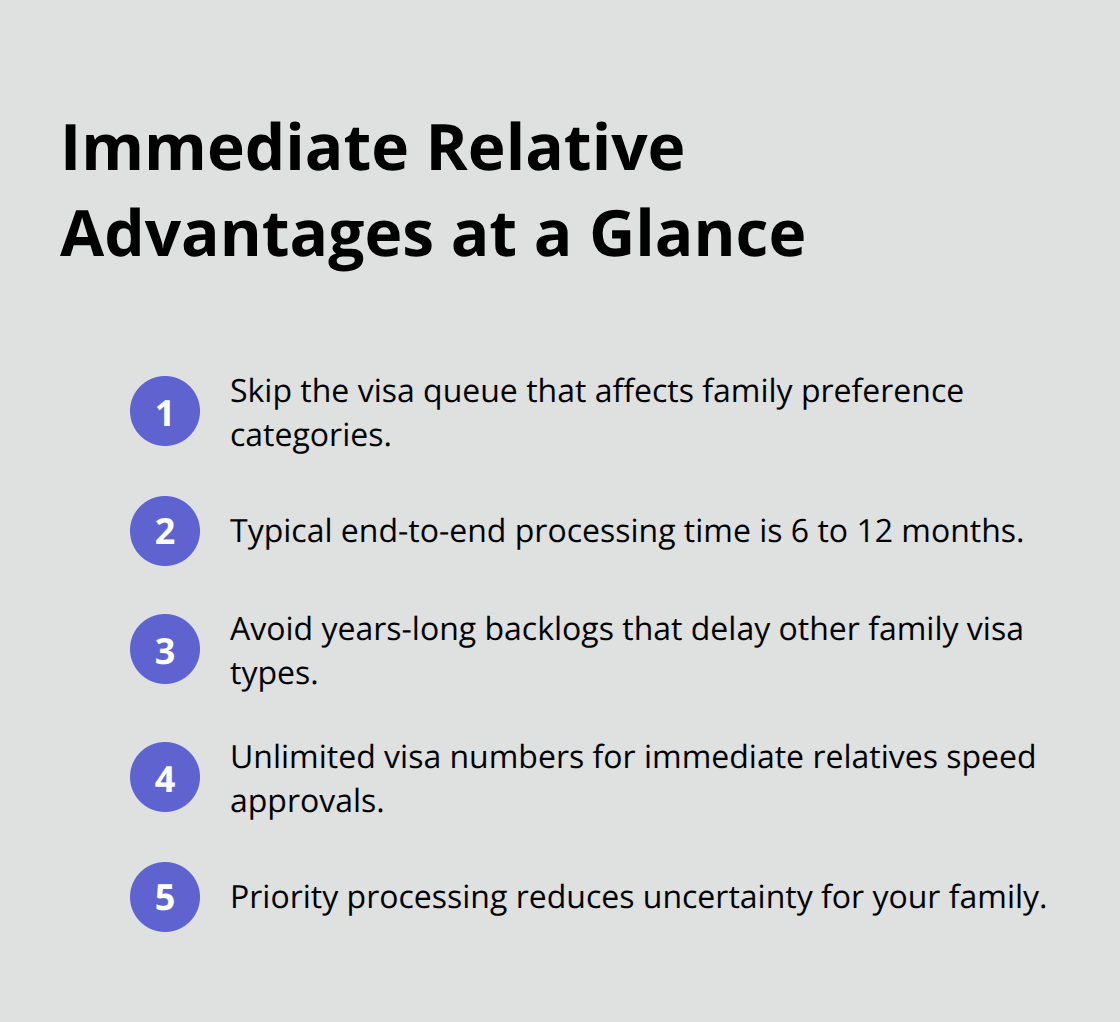
When you hold U.S. citizenship, your parents qualify as immediate relatives under immigration law. This classification allows them to skip the lengthy visa queue that affects other family categories. Congress created this pathway because it recognizes the fundamental importance of keeping families together without arbitrary waiting periods.
U.S. Citizenship and Immigration Services data shows that immediate relative visas process significantly faster than family preference categories. Most cases complete within 6 to 12 months from petition filing to visa approval. This speed matters because your parents avoid the years-long backlogs that plague other family visa types.
The Financial Commitment You Must Make
The financial obligation you accept is substantial and permanent. You must complete Form I-864, the Affidavit of Support, which legally binds you to support your parents financially if they cannot support themselves. This obligation typically lasts until your parents become U.S. citizens, which usually occurs after three years of permanent residency.
The income threshold depends on household size and federal poverty guidelines. For 2024, sponsoring two parents requires an annual income based on current HHS Poverty Guidelines, depending on your state and family size. Many applicants underestimate this commitment and later find they cannot afford the sponsorship, forcing them to withdraw their petitions.
Calculate your actual household income before filing anything. Include all sources like wages, self-employment income, rental income, and retirement benefits. This step prevents costly mistakes later in the process.
Documentation Requirements That Trip Up Applicants
You need your birth certificate, marriage certificate if applicable, and proof of U.S. citizenship (such as a passport or naturalization certificate). Your parents need their birth certificates, marriage certificates, divorce decrees if applicable, and police clearance certificates from every country where they lived for more than six months.
The police clearance requirement causes delays because some countries charge fees, require in-person visits, or process requests slowly. Medical examinations from USCIS-approved civil surgeons are mandatory, costing between $600 and $1,200 per parent. Your parents must undergo vaccinations if they lack proof of immunity, and certain health conditions can trigger additional scrutiny or medical waivers.
Bank statements showing your financial capacity help demonstrate you can meet the affidavit of support obligation. Tax returns from the past two years provide concrete proof of income stability. If you have a co-sponsor, that person submits their own affidavit of support and financial documentation.
Many families submit incomplete documentation initially, causing request for evidence delays that add months to processing time. Gathering everything before filing prevents USCIS from requesting missing items, which resets your timeline each time. With documentation prepared and finances verified, you’re ready to understand the specific IR-5 visa process and how it applies to your parents’ situation.
How the IR-5 Visa Actually Works for Your Parents
Understanding the Immediate Relative Classification for Parents
The IR-5 classification applies specifically to orphaned children, not parents, which creates confusion many families encounter. What actually applies to your parents is the immediate relative sponsorship category, and USCIS processes these cases under the immediate relative umbrella without a specific IR designation. The timeline depends entirely on how quickly you complete Form I-130 and your parents gather their documents. Most petitions reach approval within 3 to 6 months after filing, but this assumes complete documentation from the start.
Your parents become eligible for immediate relative sponsorship the moment you naturalize as a U.S. citizen, not when you hold a permanent resident status yourself. This distinction matters because some applicants mistakenly believe green card holders can sponsor parents, wasting months before discovering they must naturalize first.
The National Visa Center and Consular Processing Stage
The real bottleneck happens at the National Visa Center consular processing stage, where your parents’ consular processing begins. This stage takes an additional 2 to 4 months on average, according to State Department processing times. The total time from petition filing to your parents receiving their visas typically spans 6 to 12 months, but delays at either stage can stretch this significantly.
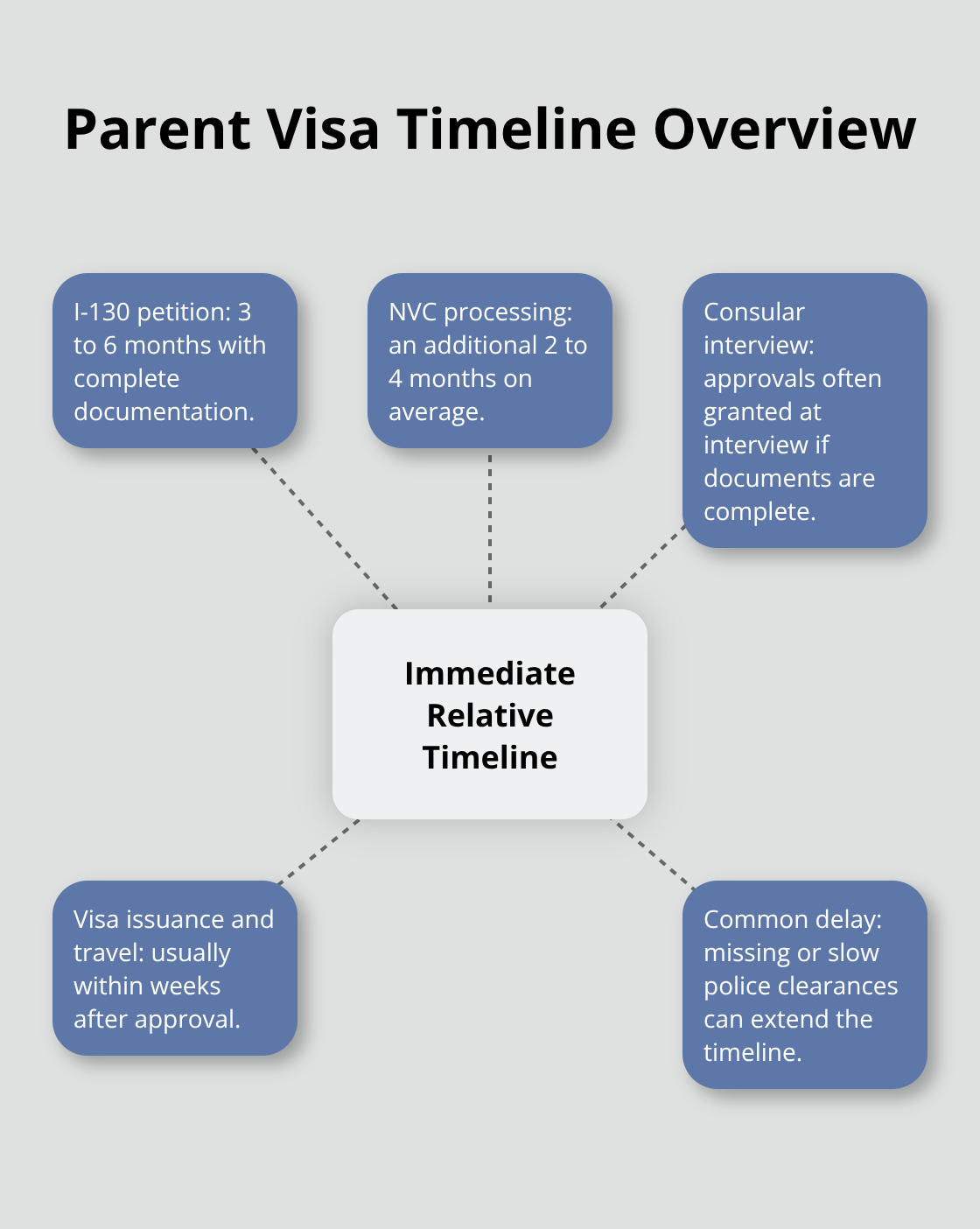
The consular interview happens at the U.S. embassy or consulate in your parents’ home country, and your parents must attend in person. Most parents receive visa approval at the interview itself if documentation is complete, allowing them to travel to the United States within weeks.
Medical Examinations and Timing
Medical examinations must occur after USCIS approves your I-130 petition, not before. Scheduling these appointments early through USCIS-approved civil surgeons prevents last-minute rushes that plague many families. Your parents should expect to pay between $600 and $1,200 per person for the medical examination and required vaccinations.
Bring original documents, passports, and medical examination results to the consular interview. Proof of the approved I-130 petition must accompany all other materials your parents present at this stage.
Police Clearances: The Hidden Timeline Killer
Police clearances from every country where your parents lived over six months create the most common delays we observe. Some countries like the Philippines require in-person applications or charge significant fees, extending timelines by 3 to 6 months alone. Request these certificates immediately after deciding to sponsor, not after filing your petition.
Incomplete police records force USCIS to issue requests for evidence, which essentially restarts your processing timeline. This single step determines whether your family completes the process in under a year or faces extended waiting periods. Understanding how different visa routes compare in cost and processing speed helps you make the right choice for your family’s circumstances.
Why Immediate Relative Sponsorship Beats Family Preference
Immediate relative sponsorship for parents operates in an entirely different universe from family preference categories, and the difference in speed alone makes this worth understanding. Under family preference categories, your parents would wait in visa queue backlogs that currently extend 5 to 10 years depending on your country of origin, according to State Department visa bulletin data. As an immediate relative, your parents face no such queue. They move straight to processing once your I-130 petition approves, typically within 6 to 12 months total. This speed advantage exists because Congress designated immediate relatives as exempt from annual visa caps that limit all other family categories.
Adjustment of Status vs. Consular Processing
If your parents are already in the United States on a visitor visa or other status, immediate relative sponsorship allows them to adjust status without returning home, avoiding consular processing delays entirely. Family preference categories require applicants to wait abroad for visa availability, meaning your parents cannot work legally or travel freely during years-long backlogs. The financial commitment differs too. Immediate relative sponsorship requires the I-864 affidavit, but family preference sponsorship imposes the same obligation, so this factor does not differentiate the routes.
Citizenship Status: The Critical Threshold
What does differ is accessibility. Only U.S. citizens can sponsor parents through immediate relative classification. Green card holders cannot sponsor parents at all, making citizenship status the critical threshold. If you hold a green card, you must naturalize before sponsoring parents, typically a three-year wait after obtaining permanent residence. Some applicants mistakenly believe they can sponsor parents as green card holders, wasting years before discovering this barrier.
Real Costs Across Visa Types
Filing costs for immediate relative sponsorship total approximately $640 for USCIS fees when filing Form I-130 and Form I-485 concurrently, plus $85 for biometric services if required. Add the consular processing fee of $325 per parent when they attend their visa interview abroad. Medical examinations cost $600 to $1,200 per parent depending on your parents’ location and required vaccinations.
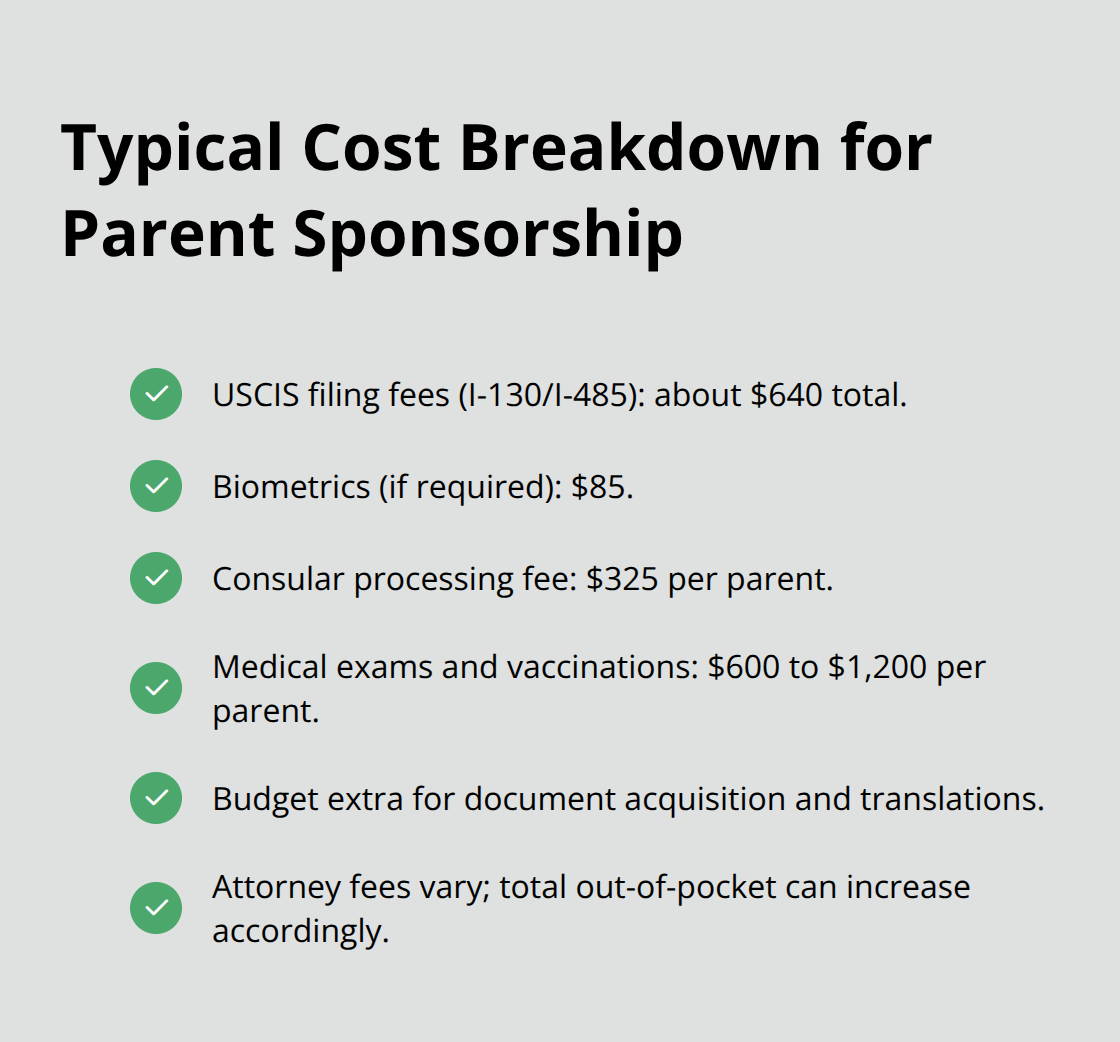
Police clearance certificates vary wildly in cost. The Philippines charges approximately $20 to $30 per certificate but requires in-person application, forcing many families to hire local agents charging $100 to $300. India processes police certificates through their Passport Seva system for roughly $10 to $15 but processing times stretch 4 to 8 weeks. Mexico charges approximately $30 for a certificate but processing takes 2 to 3 weeks. Total out-of-pocket costs typically range from $2,000 to $4,000 per parent depending on country of origin and whether you hire an immigration attorney.
The True Cost of Waiting
Family preference categories cost identical filing and medical fees but add years of waiting without movement, during which your parents cannot work in the United States. The real cost of family preference sponsorship is opportunity cost, not dollars. Your parents miss years of potential earnings, cannot establish roots, and face uncertainty about their immigration timeline. Immediate relative sponsorship offers speed and certainty that justify the modest financial investment required.
Final Thoughts
Sponsoring your parents through immediate relative classification offers the fastest and most direct path to family reunification available in U.S. immigration law. The 6 to 12 month timeline makes this investment worthwhile compared to years-long backlogs in family preference categories. Your parent visa options depend on your citizenship status, but immediate relative sponsorship stands out as the superior choice for U.S. citizens who want to reunite with their parents quickly.
Start by collecting your citizenship proof, birth certificate, and marriage certificate if applicable. Request police clearances from your parents’ countries of residence immediately, as these certificates create the most common delays (some countries require in-person applications or charge substantial fees). Calculate your household income against current poverty guidelines to confirm you meet the sponsorship threshold before filing anything.
We at Law Offices of Jeffrey A. Thompson assist clients in navigating the immigration process from paperwork through overcoming legal hurdles. Attorney Thompson provides expert guidance tailored to your specific circumstances, whether you face complications with police clearances, income verification challenges, or questions about adjustment of status versus consular processing. Contact Law Offices of Jeffrey A. Thompson to discuss your parent visa options and receive compassionate, knowledgeable representation throughout your family immigration journey.
Share this post: