Spouse Visa Processing: From Petition to Permanent Residency
May 25, 2026
Spouse visa processing involves multiple steps, each with specific requirements and timelines. We at Law Offices of Jeffrey A. Thompson guide clients through every stage, from the initial petition to achieving permanent residency.
This guide walks you through the complete process, including medical exams, background checks, and the final path to citizenship.
Starting Your Spouse Visa Petition
The I-130 petition is where your spouse visa journey begins, and this step determines the speed of your entire process. You file Form I-130, Petition for Alien Relative, with USCIS to officially notify the government that you want to sponsor your spouse for permanent residency. If you are a U.S. citizen, this petition has no annual cap and moves faster than petitions filed by green card holders. If you are a green card holder, your spouse falls into the F2A preference category, which means a multi-year wait until a visa number becomes available. The difference between these two sponsorship statuses is significant and shapes everything that follows.
What Documents You Actually Need
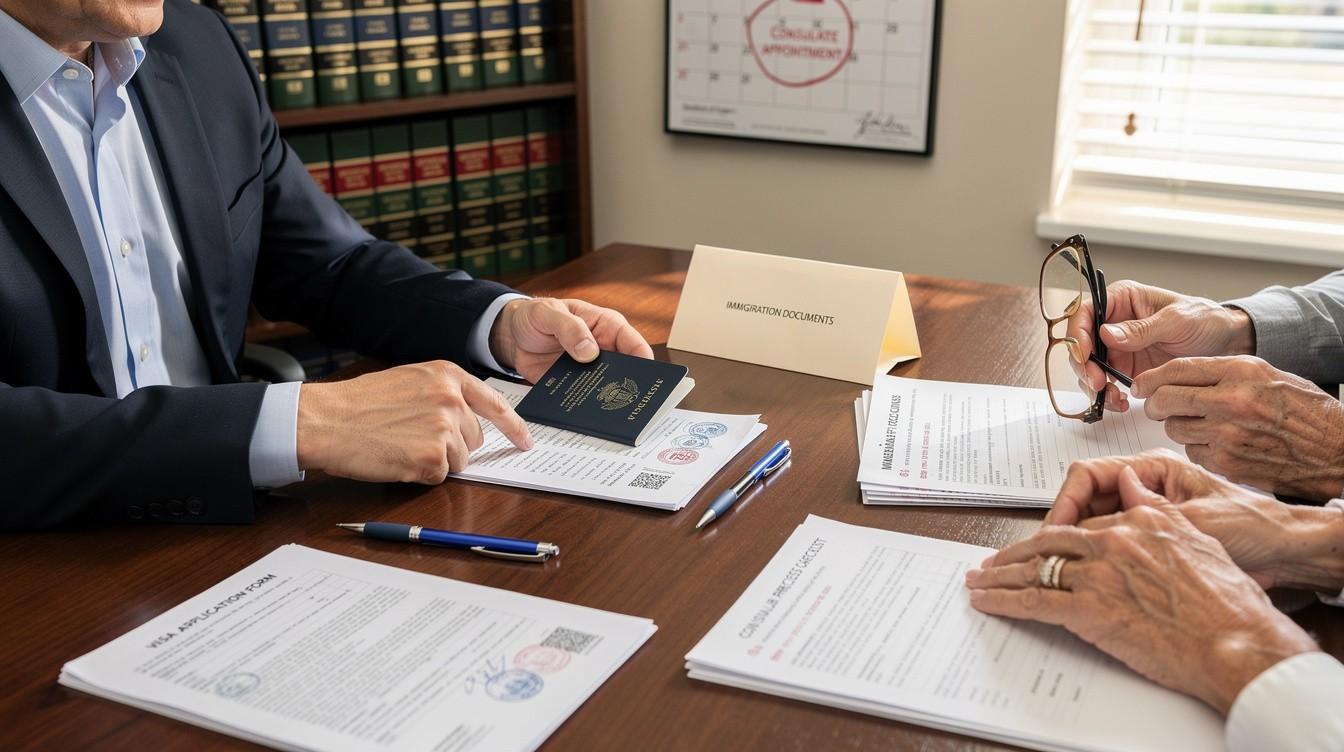
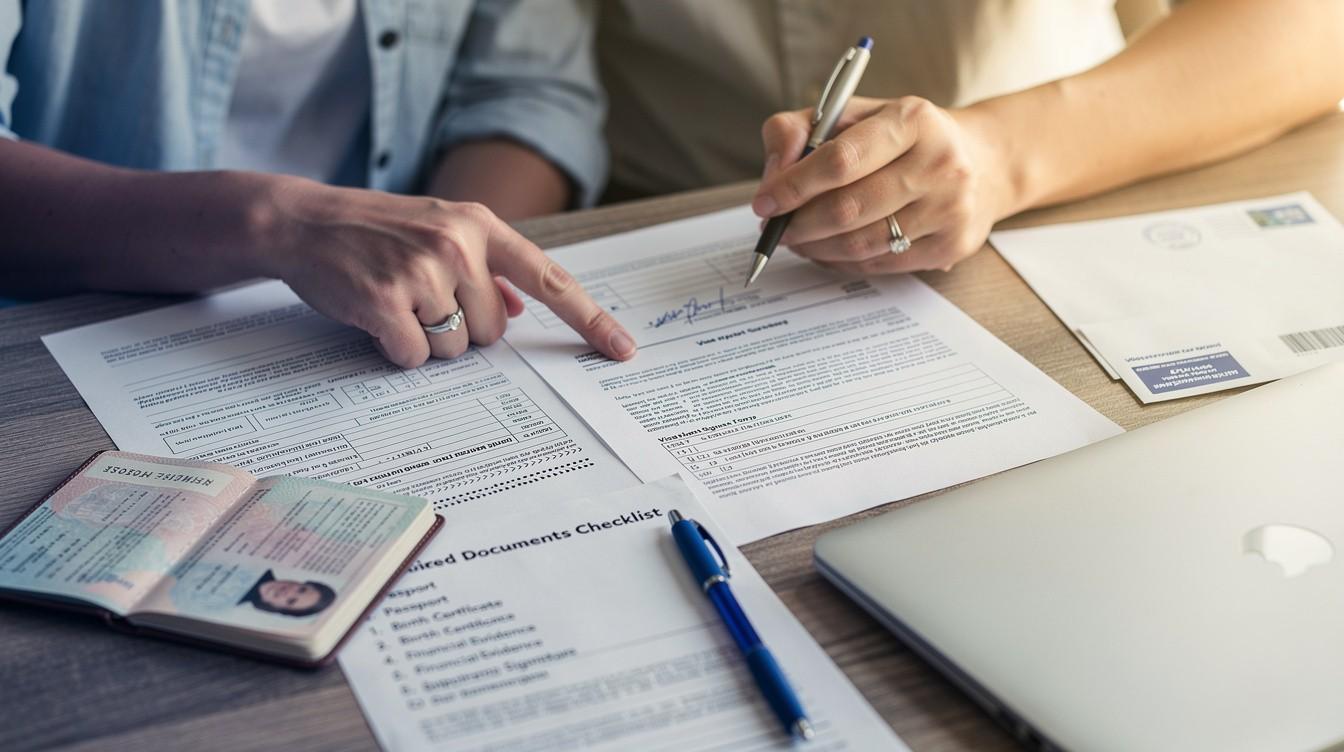
You must gather your civil marriage certificate first, along with any divorce decrees, death certificates, or annulment papers if either of you was previously married. USCIS requires these originals or certified copies, not photocopies. You also need passport-style photos and evidence of any name changes. To prove your status as a U.S. citizen or green card holder, submit your passport, birth certificate, naturalization certificate, or the front and back of your green card. USCIS enforces strict standards about document quality and consistency. Names must be spelled identically across all forms and documents. If your passport shows your name as Maria Elena Garcia but your marriage certificate lists it as Maria E. Garcia, USCIS will request additional evidence to confirm they are the same person.
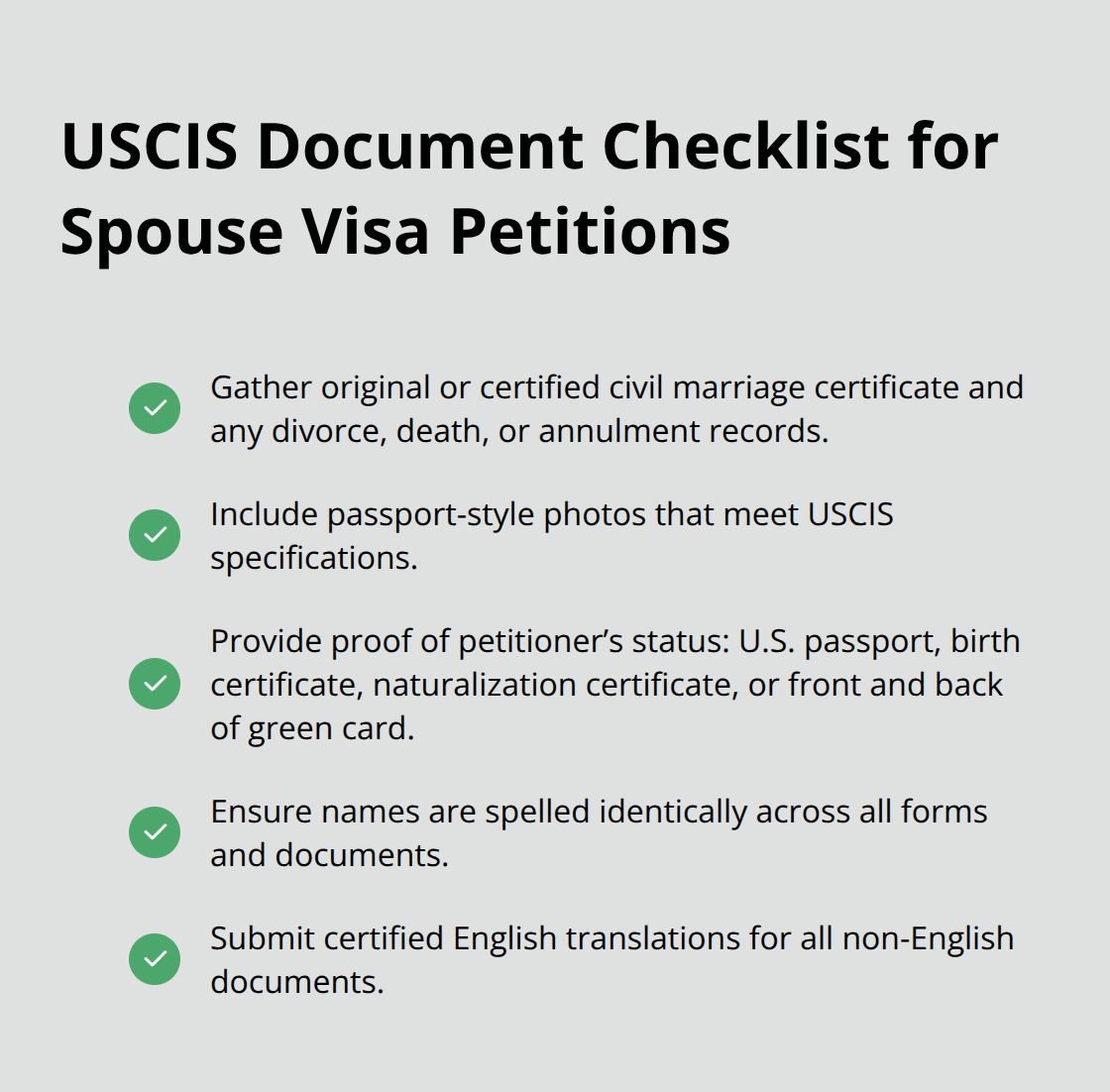
This inconsistency delays cases unnecessarily. You should have all non-English documents professionally translated and certified before submission. Hiring a translator now costs far less than dealing with a request for evidence later.
Proving Your Marriage Is Real
USCIS investigates whether your marriage is genuine, not entered into primarily to obtain immigration benefits. You should include photographs together from different times and settings, not just your wedding day. Submit joint bank statements, lease agreements, utility bills, insurance documents, or mortgage statements showing you live together. Affidavits from friends and family members who know you as a couple carry weight, especially if they describe your relationship history and daily life together. According to USCIS guidance, field investigations happen when inconsistencies emerge in your application or when USCIS has reason to question the marriage’s legitimacy. High-volume filing locations like Los Angeles experience more scrutiny than smaller jurisdictions. The stronger your evidence package upfront, the less likely USCIS initiates an investigation. If you marry less than two years before your spouse becomes a permanent resident, your spouse receives conditional permanent residency valid for two years. You must then jointly file Form I-751 to remove those conditions within 90 days before the card expires. Missing this deadline terminates your spouse’s status. You should begin collecting joint documents early so you are prepared when the removal-of-conditions filing window arrives.
How Long This Actually Takes
Processing times vary significantly based on whether you file from inside or outside the United States. If you are a U.S. citizen filing from inside the U.S., you can file I-130 and I-485 simultaneously, and the entire adjustment of status process typically takes 10 to 13 months according to USCIS data. If you are a U.S. citizen filing from outside the U.S., the I-130 petition must receive approval first, then your spouse proceeds through consular processing abroad, which can take 12 to 18 months total. If you are a green card holder, you will face longer waits because visa numbers for F2A spouses are limited by per-country caps. You should monitor the monthly Visa Bulletin published by the Department of State to track when your spouse’s priority date becomes current. Country-specific backlogs vary enormously. Check the I-130 Awaiting Visa Availability dataset from USCIS to see how many approved petitions are waiting for visa numbers in your spouse’s country. This data updates quarterly and gives you realistic expectations. Incomplete applications and requests for additional evidence add months to your timeline.
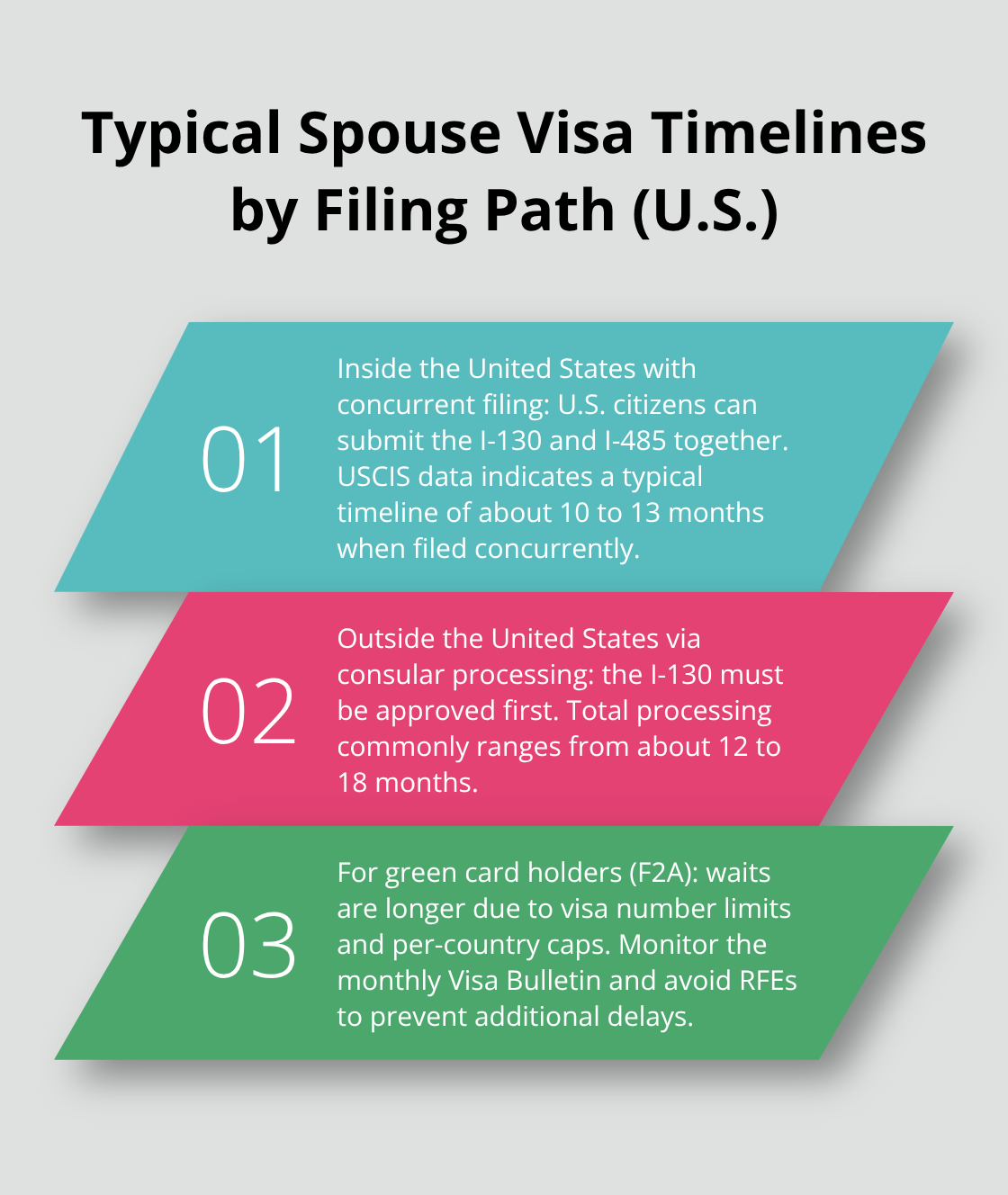
You must submit everything correctly the first time to avoid unnecessary delays.
Medical Exams and Background Checks
The Medical Examination Your Spouse Must Complete
The medical examination comes next in your spouse visa process, and this step cannot be skipped or delayed without jeopardizing your entire case. Your spouse must complete a medical examination with an approved panel physician designated by the U.S. State Department for your country. This is not a routine checkup-the panel physician evaluates whether your spouse has any conditions that would make them ineligible for an immigrant visa under U.S. immigration law, including communicable diseases, mental disorders, or physical or mental abnormalities that pose a threat to public safety or welfare.
According to the State Department, required vaccinations include measles, rubella, polio, tetanus, diphtheria, pertussis, hepatitis B, and haemophilus influenzae type B. Your spouse must receive these vaccinations before the visa interview unless they have medical or religious contraindications documented by the panel physician. Schedule the medical exam early, not the week before your interview. Processing the results and obtaining vaccination records takes time, and you need this documentation ready for your consular interview.
The panel physician provides Form I-693, Report of Medical Examination and Vaccination Record, which your spouse brings to the interview. If your spouse has a condition requiring a waiver, the process extends your timeline significantly. Waivers for certain medical conditions are possible but require additional processing through the State Department.
Criminal and Security Background Clearance
Your spouse undergoes criminal and security background clearance, which the State Department and USCIS conduct independently. These agencies check national crime databases, fingerprint records, and security watch lists to determine if your spouse poses a law enforcement or security risk. The State Department performs administrative processing for cases that require additional investigation, and this can add weeks or months to your timeline without notice.
If your spouse has a criminal record, even minor offenses, disclose this to your attorney immediately before filing. Some crimes are grounds for permanent ineligibility, while others may qualify for a waiver. The State Department publishes the Classifications of Aliens Ineligible to Receive Visas, which details all grounds of ineligibility and waiver options. Do not assume a minor conviction will be overlooked. USCIS and State Department databases are thorough, and misrepresentation of criminal history leads to permanent ineligibility and can trigger fraud investigations.
Preparing for Your Consular Interview
Your spouse must answer interview questions about criminal history, prior immigration violations, and security concerns truthfully. Consular officers are trained to detect inconsistencies between written applications and oral statements. If your spouse has any history that could raise questions, prepare a clear explanation with documentation. Transparency at this stage reduces the risk of case denial and moves your case forward toward the next critical phase-adjusting status or proceeding through consular processing, depending on where your spouse currently resides.
Adjusting Status or Consular Processing: Your Path to Permanent Residency
Your spouse’s location when USCIS approves the I-130 petition determines whether you proceed with adjustment of status or consular processing. This choice shapes your timeline, costs, and the specific documents required. If your spouse is physically in the United States and entered legally, adjustment of status allows them to apply for permanent residency without leaving the country. If your spouse remains abroad or entered without inspection, consular processing at a U.S. embassy or consulate is the only option.
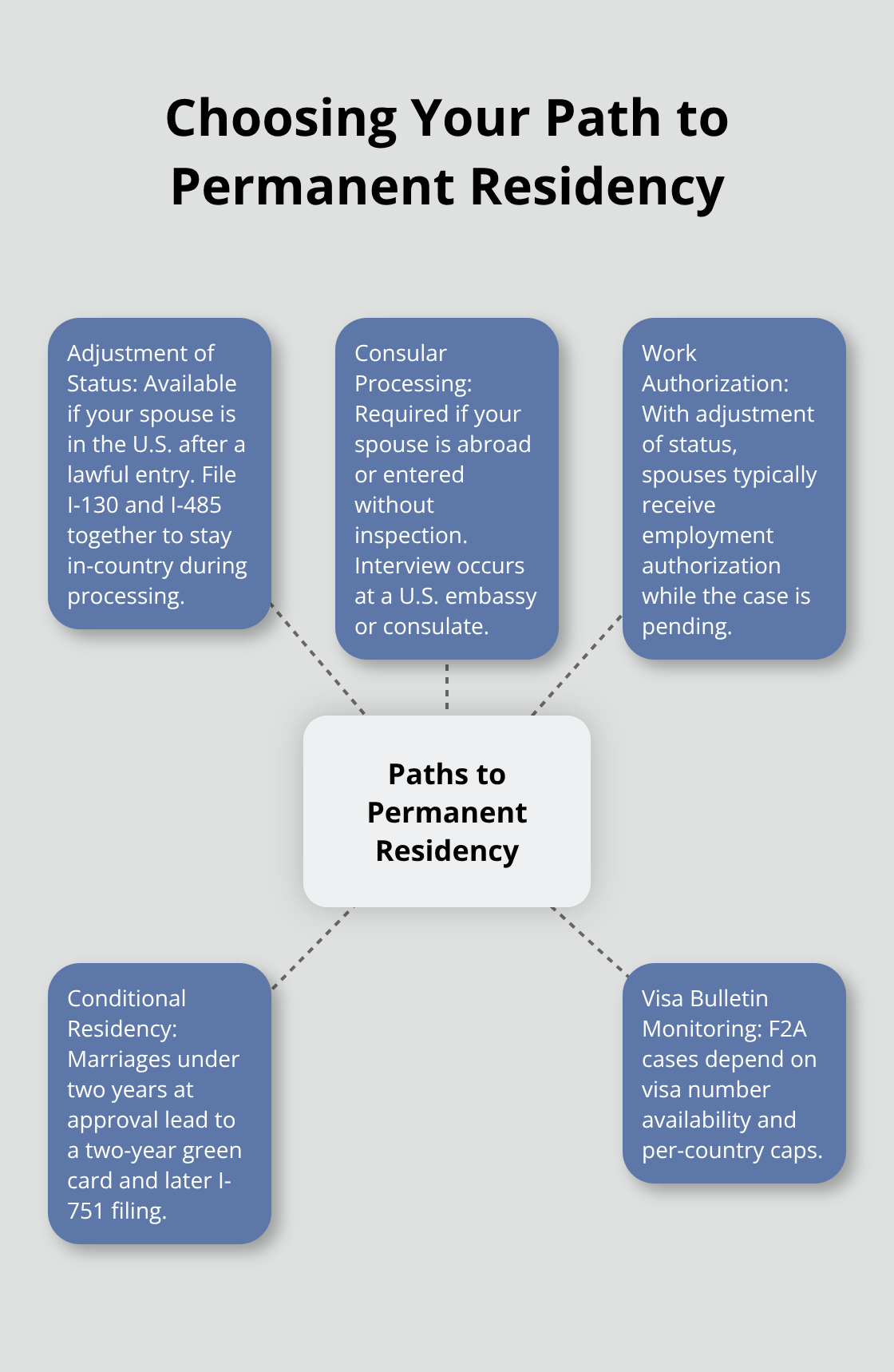
Understanding both pathways before filing prevents delays and complications that arise when you switch between them mid-process.
Adjustment of Status: Staying in the United States
USCIS data shows that adjustment of status for spouses of U.S. citizens takes 10 to 13 months when filed concurrently with the I-130. If you are a U.S. citizen, you file Form I-485 at the same time as your I-130 petition, which accelerates the process significantly. Your spouse receives work authorization while the case is pending, typically within 5 to 7 months according to USCIS processing standards. This means your spouse can legally earn income before permanent residency is granted.
If your spouse entered the U.S. without inspection, they may still adjust status under INA 245(i) if grandfathered, or they may require an I-601A waiver to avoid unlawful presence bars. This waiver extends your timeline considerably and requires additional processing through USCIS.
The National Visa Center assigns a case number after I-130 approval and directs you to pay processing fees, complete Form DS-260, submit civil and financial documents, and schedule a medical exam. You must provide original documents, certified translations, the Affidavit of Support demonstrating your financial ability to support your spouse, and evidence of the medical examination.
Consular Processing: Your Spouse Abroad
Consular processing requires your spouse to appear for a visa interview at the U.S. embassy or consulate in their home country. The State Department’s visa interview is the final adjudication of your spouse’s immigrant visa application. Consular processing takes 12 to 18 months total because your spouse must wait for I-130 approval, then for visa availability at the consulate.
Consular officers assess credibility, verify the marriage’s genuineness, and confirm that no grounds of ineligibility apply. The interview typically lasts 10 to 20 minutes, though cases requiring additional investigation take longer. Your spouse brings original documents, certified translations, the Affidavit of Support, and evidence of the medical examination to the interview.
Green card holders face significantly longer waits due to per-country visa caps limiting F2A spouse petitions. You should monitor the monthly Visa Bulletin published by the Department of State to track when your spouse’s priority date becomes current.
Conditional Residency: The Two-Year Rule
If you married less than two years before your spouse receives the immigrant visa, your spouse arrives as a conditional permanent resident with a green card valid for two years. You must file Form I-751 jointly within 90 days before the two-year expiration date. Missing this deadline automatically terminates your spouse’s status with no appeal.
USCIS publishes a filing calculator on its website to determine your exact 90-day window. You should gather evidence of your joint life together immediately after your spouse arrives: joint tax returns, joint bank statements, mortgage or lease documents, utility bills, insurance policies, and affidavits from people who know you as a couple.
Incomplete I-751 filings are denied without opportunity to supplement. File with all supporting documents included, and monitor your case status online through USCIS’s My Case Status tool. The stronger your evidence package, the faster USCIS processes your removal-of-conditions petition.
Final Thoughts on Your Spouse Visa Journey
Your spouse’s green card arrival marks a major milestone in spouse visa processing, and permanent residency comes with ongoing responsibilities. The green card grants your spouse the right to live, work, and study anywhere in the United States without employer sponsorship, and your spouse can travel internationally with the card and re-enter the U.S. without needing a visa. After five years as a permanent resident, or three years if married to a U.S. citizen, your spouse becomes eligible to apply for citizenship through naturalization, which requires passing an English and civics test, demonstrating good moral character, and taking the Oath of Allegiance.
Maintaining permanent resident status demands strict adherence to specific rules. Your spouse must not abandon U.S. residency by living abroad for extended periods without filing Form I-131 for a re-entry permit, and criminal convictions-even misdemeanors-can trigger deportation proceedings. Your spouse should avoid fraud, illegal activity, or violations of the Affidavit of Support you filed, and they must carry the green card and valid passport whenever traveling outside the U.S. to re-enter legally.
If you need guidance navigating the final steps toward citizenship or have questions about maintaining permanent resident status, contact our immigration law team in Brockton, Massachusetts for personalized support.
Share this post: